
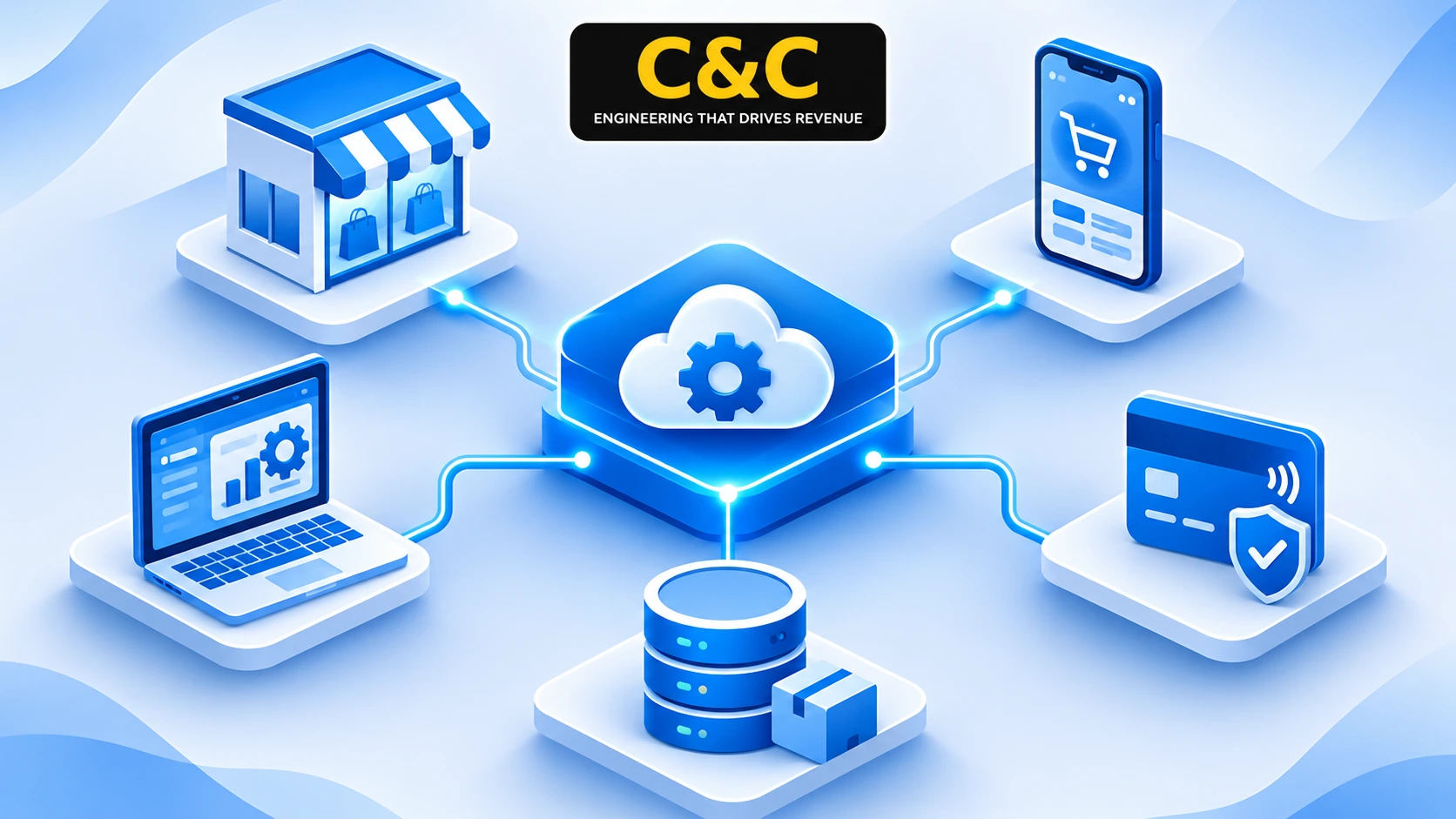
API-first commerce architecture connecting storefront, backend, and integrations
API-first commerce architecture is a method of building online stores in which every business function, including catalog, pricing, cart, checkout, and orders, is designed as a documented API before any storefront exists. Growing brands choose API-first commerce architecture because tightly coupled stores struggle to add channels, connect new tools, and stay fast during traffic spikes.
Quick answer: API-first commerce architecture separates the customer-facing experience from backend commerce logic through APIs. In the headless vs traditional commerce decision, API-first design is the foundation that keeps a decoupled store dependable. Releases get faster, integrations get easier, and selling across web, mobile, and marketplaces no longer requires rebuilding the core.
Key takeaways
- API-first design treats the API as the product and the storefront as one client among many.
- Headless ecommerce architecture is the visible result, and API-first design is the discipline that keeps the result stable.
- Choosing the right eCommerce platform 2026 should follow channels, integrations, and team skills, not trends.
- Speed, clean product data, and API governance decide long-term success.
What Is API-First Commerce Architecture?
In an API-first model, the contract between systems comes first. Teams define endpoints, data structures, and authentication rules, often with the OpenAPI Initiative specification or a GraphQL schema, and then build interfaces on top.
A well-designed ecommerce backend exposes every function through those contracts, so no capability stays locked inside a template.
Short answer: API-first means every commerce capability is available through a documented interface before any screen is designed.
Three principles define the approach:
- Every capability is a service. Inventory, promotions, customer accounts, and search respond through consistent endpoints.
- Frontends are replaceable. A website, app, kiosk, or voice interface can call the same services.
- Integrations are planned, not patched. ERP, CRM, PIM, and payment tools connect through stable contracts instead of custom workarounds.
The idea borrows from service-oriented design. Martin Fowler’s overview of microservices explains the background that shaped modern composable commerce.
Headless vs Traditional Commerce: Where the Real Differences Sit
Quick answer: Traditional commerce bundles frontend and backend into one codebase. Headless commerce detaches the frontend and communicates through APIs. API-first commerce architecture is the design philosophy that makes a headless setup dependable.
Limits of the Traditional Monolith
A monolithic store ties templates, business logic, and database together. A small design change can force a backend deployment, and a storefront traffic spike strains the whole system.
Adding a mobile app or marketplace feed often means duplicating logic. Each new channel strengthens the case for decoupling in the headless vs traditional commerce debate.
Gains From a Headless Approach
Headless ecommerce development gives frontend teams freedom to use modern frameworks such as Next.js and ship changes without touching checkout logic. Backend teams can upgrade pricing, tax, or inventory services independently.
The trade-off is added complexity, since orchestration, monitoring, and content management need deliberate planning.
Short answer: Headless suits brands with multiple channels, custom experiences, or heavy integration needs. Simple catalogs with modest traffic are often well served by a traditional setup.
Headless eCommerce Architecture: The Core Layers
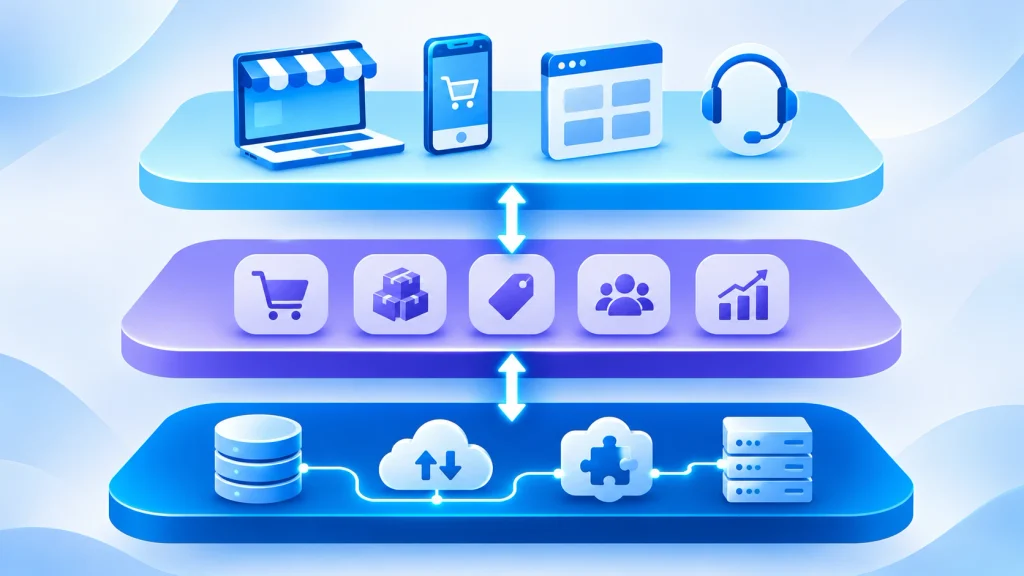
Headless ecommerce architecture in an API-first commerce environment is easiest to understand through three main layers. Each layer performs a specific function while working together to deliver a flexible and scalable shopping experience.
Experience Layer
The experience layer holds storefronts, progressive web apps, mobile apps, and in-store screens. Shopify Hydrogen shows how a platform can supply a dedicated headless frontend toolkit.
Commerce Services Layer
Catalog, cart, checkout, pricing, promotions, and order management live here. Platforms expose these through REST or GraphQL, and composable stacks swap individual services.
The MACH Alliance promotes the same principle: microservices, API-first, cloud-native, and headless.
Integration and Data Layer
The ecommerce backend connects to ERP, warehouse, CRM, marketing automation, and analytics. Strong ecommerce API integration services keep data consistent, handle retries, and log failures so problems are diagnosed quickly.
Businesses needing help here can explore ecommerce API integration services for scoping and delivery.
Platform Fit in API-First Commerce Architecture: Magento, Adobe Commerce, Shopify, WooCommerce, and BigCommerce
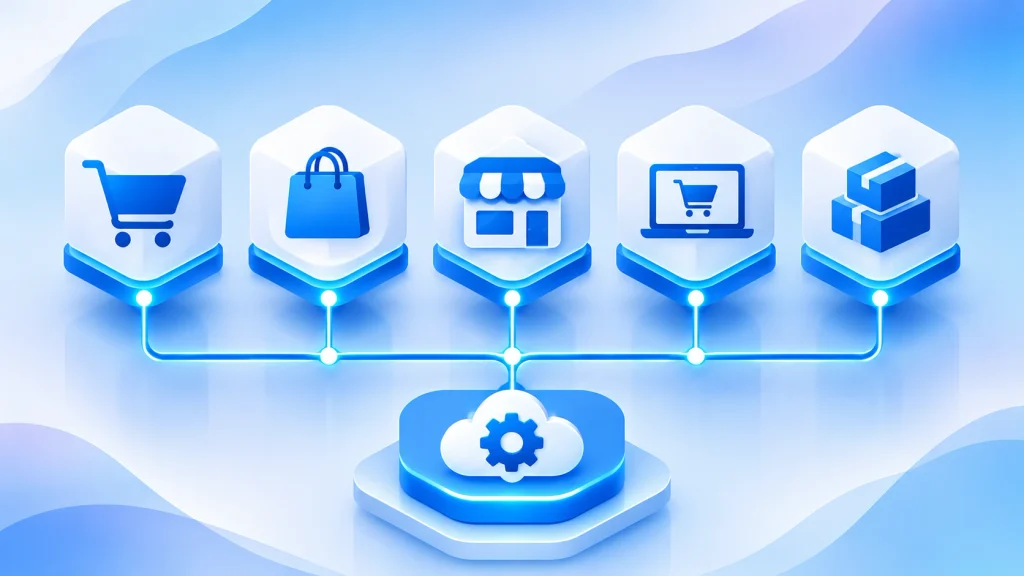
Platform fit for Magento, Adobe Commerce, Shopify, WooCommerce, and BigCommerce in API-first commerce architecture
No platform wins in every scenario. Fit depends on catalog complexity, team skills, budget, and growth plans.
Magento Open Source and Magento 2
Magento offers deep flexibility, REST and GraphQL APIs, and a large extension ecosystem. Complex B2B rules, multi-store setups, and custom pricing logic are strengths.
Teams planning a build can review magento ecommerce development options. The Adobe Commerce developer documentation covers API behavior in detail, including the GraphQL web API.
Magento enterprise development often centers on custom modules, ERP connections, and multi-region rollouts.
Magento 2 vs Adobe Commerce Cloud
Quick answer: Magento 2 vs Adobe Commerce Cloud comes down to hosting responsibility and feature depth. Magento 2 (open source) is self-hosted and community supported. Adobe Commerce Cloud adds managed hosting, a built-in CDN, B2B modules, and enterprise support.
Magento 2 commerce cloud deployments suit organizations that want infrastructure handled for them and need advanced B2B features. Adobe Commerce development services typically cover architecture planning, migration, and headless frontends.
Teams comparing paths can look at adobe commerce development services for scoping help.
Shopify
Shopify provides a managed platform with a mature Storefront API for headless builds. Setup is faster and operations are simpler, though deep backend customization is more constrained.
WooCommerce
WooCommerce runs on WordPress and exposes a REST API. The platform suits content-led stores and smaller teams, but large catalogs require careful hosting and caching work.
BigCommerce
BigCommerce follows an open SaaS model with strong APIs, which makes the platform popular for headless storefronts. The BigCommerce developer center documents catalog, cart, and checkout endpoints.
Choosing the Right eCommerce Platform in 2026
Quick answer: The right eCommerce platform 2026 matches catalog complexity, integration needs, and in-house technical capacity, not the longest feature list.
A practical checklist:
- Count the channels. More channels raise the value of API-first commerce architecture.
- Audit integrations. ERP, PIM, and OMS requirements often decide platform fit.
- Assess team skills. Headless demands frontend engineering and DevOps capability.
- Estimate total cost. License, hosting, development, and maintenance all count.
- Plan for data growth. Large catalogs and personalization need scalable search and caching.
A Simple Readiness Score
Score one point for each statement that is true:
- Three or more sales channels are active or planned.
- At least two systems need real-time data exchange.
- The storefront needs a custom experience that templates cannot deliver.
- A frontend developer team is available.
- Release delays are caused by backend dependencies.
A score of 4 or 5 points toward headless. A score of 0 to 2 points toward a well-tuned traditional platform.
Performance Optimization in API-First Commerce Architecture: Magento 2 and Ecommerce Speed
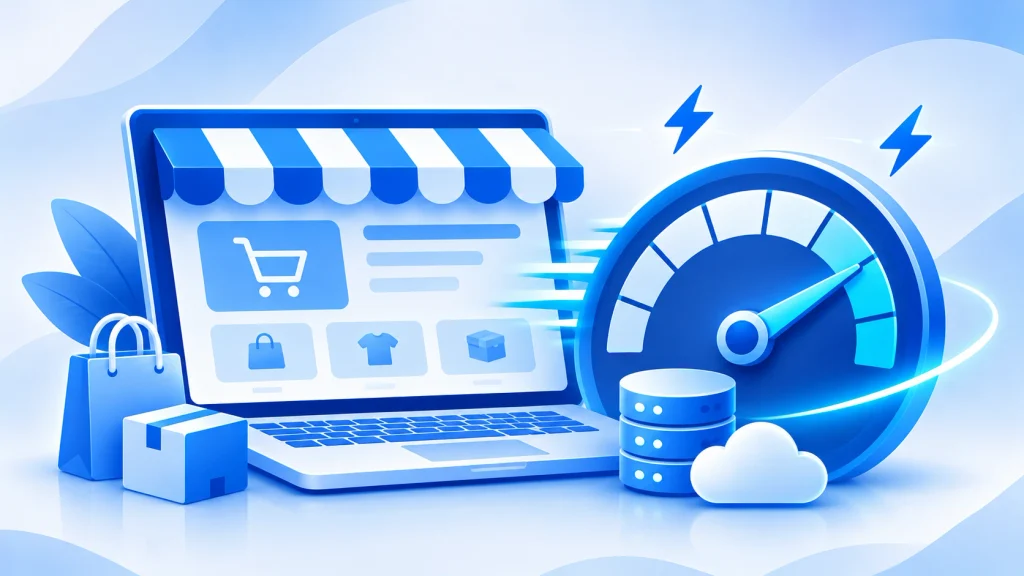
Ecommerce performance optimization in API-first commerce architecture
Speed influences conversion, search visibility, and paid media efficiency. Google’s Core Web Vitals guidance on web.dev defines the loading, interactivity, and visual stability metrics worth tracking.
Magento 2 Performance Optimization
Effective Magento 2 performance optimization usually includes full-page caching with Varnish, Redis for sessions and cache, optimized indexers, image compression, database query tuning, and a content delivery network.
Headless frontends can cut render time further by serving pre-built pages.
Ecommerce Performance Optimization Beyond Magento
General ecommerce performance optimization applies to every platform: reduce third-party scripts, cache API responses following HTTP caching standards, use edge delivery, lazy-load media, and monitor real-user data.
API-first commerce architecture helps by scaling only the services under pressure instead of the entire stack.
Security and Observability in API-First Commerce Architecture
Short answer: Every exposed endpoint is an attack surface, so authentication, rate limits, and tracing matter as much as features.
The OWASP API Security Project lists the most common API risks, such as broken object-level authorization and excessive data exposure. Token-based access built on OAuth 2.0 is the common standard for protecting commerce APIs.
Distributed services also need tracing and metrics, and OpenTelemetry provides a vendor-neutral way to collect both. A hardened ecommerce backend treats security reviews as part of every release.
AI Product Data Enrichment
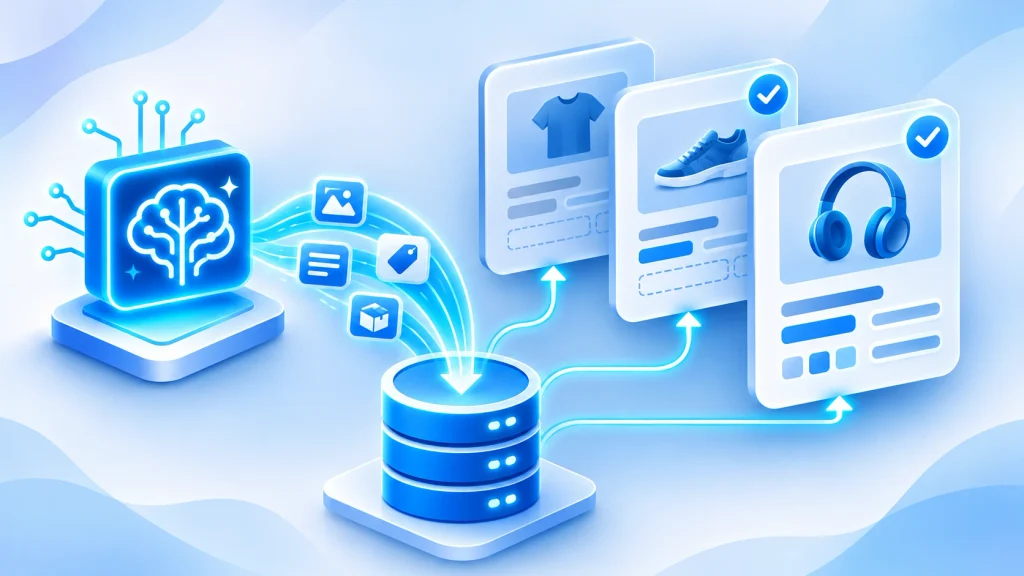
AI product data enrichment feeding a catalog service in API-first commerce architecture
Short answer: AI product data enrichment uses machine learning to fill gaps in product attributes, descriptions, categories, and tags so catalogs become more searchable and consistent.
Clean, structured product data fuels site search, recommendations, and marketplace feeds. AI product data enrichment tools can standardize attribute names, draft descriptions for human review, and flag missing fields.
Structured data also supports search visibility. Google’s structured data documentation and the schema.org Product vocabulary explain how product details can be marked up for rich results and machine understanding.
An API-first setup makes enrichment practical, because a PIM or AI service can push updates to the catalog service without manual exports. Google’s guidance on helpful, people-first content is a useful standard for reviewing any generated descriptions before publishing.
Common Mistakes in API-First Projects
- Going headless without a business reason. Technology should follow channel and growth goals, and a clear headless vs traditional commerce assessment prevents costly detours.
- Ignoring content workflows. Marketing teams need a headless CMS or preview tools.
- Underestimating integration effort. Mapping data between ERP, PIM, and commerce services takes planning.
- Skipping API governance. Versioning, documentation, and rate limits prevent breakage.
- Neglecting observability. Logging, tracing, and alerting are essential across distributed services.
- Forgetting crawlability. JavaScript-heavy storefronts need server-side or static rendering, as outlined in Google’s JavaScript SEO basics.
A Practical Roadmap for Building a Commerce Website
- Define business goals and target channels.
- Map current systems and data flows.
- Select the platform and commerce services.
- Design API contracts and authentication.
- Build the frontend and integrations in parallel.
- Test performance, security, accessibility, and failover.
- Launch in phases and monitor real-user metrics.
Accessibility deserves early attention, and the WCAG standards give a clear target for storefront design.
Brands exploring the path can learn more about headless ecommerce development and how phased migration reduces risk.
Frequently Asked Questions About API-First Commerce Architecture
What is API-first commerce architecture?
A design approach where commerce functions are built as documented APIs first, and storefronts, apps, and integrations consume the APIs. Frontends can change without rewriting backend logic.
Is API-first the same as headless commerce?
Not exactly. Headless describes a decoupled frontend, while API-first describes how services are designed. Reliable headless ecommerce architecture depends on an API-first foundation.
When should a growing business move to headless?
Usually when multiple channels, custom experiences, or complex integrations begin to slow releases on a traditional platform. A fair headless vs traditional commerce review should come first.
What is the difference between Magento 2 and Adobe Commerce Cloud?
Magento 2 is open source and self-managed. Adobe Commerce Cloud adds managed infrastructure, enterprise features, and vendor support. Many enterprise teams pair Magento 2 commerce cloud hosting with custom modules.
Does headless improve ecommerce performance?
Often, yes. Pre-rendered frontends, edge caching, and independent service scaling usually improve speed, though poor implementation can erase the gains. Steady ecommerce performance optimization keeps the gains in place.
Which platform is best for API-first commerce architecture?
Magento, Adobe Commerce, Shopify, BigCommerce, and WooCommerce can all support the approach. The best option depends on catalog size, budget, team skills, and integration needs, which is the core of choosing the right eCommerce platform 2026.
How does AI product data enrichment help an online store?
AI product data enrichment improves attribute completeness, categorization, and descriptions, which strengthens search, filtering, recommendations, and structured data.
How long does an API-first migration take?
Small projects may take a few months. Enterprise migrations with many integrations often run six to twelve months, usually delivered in phases.
Conclusion
API-first commerce architecture gives growing eCommerce businesses a flexible base for new channels, faster releases, and cleaner integrations. Success depends on matching the approach to real business needs, choosing a platform with strong APIs, and investing in performance, data quality, security, and governance from the start.
Brands that plan these foundations early, whether through Magento ecommerce development, Adobe Commerce development services, or a fully headless build, are better positioned to scale through 2026 and beyond.