
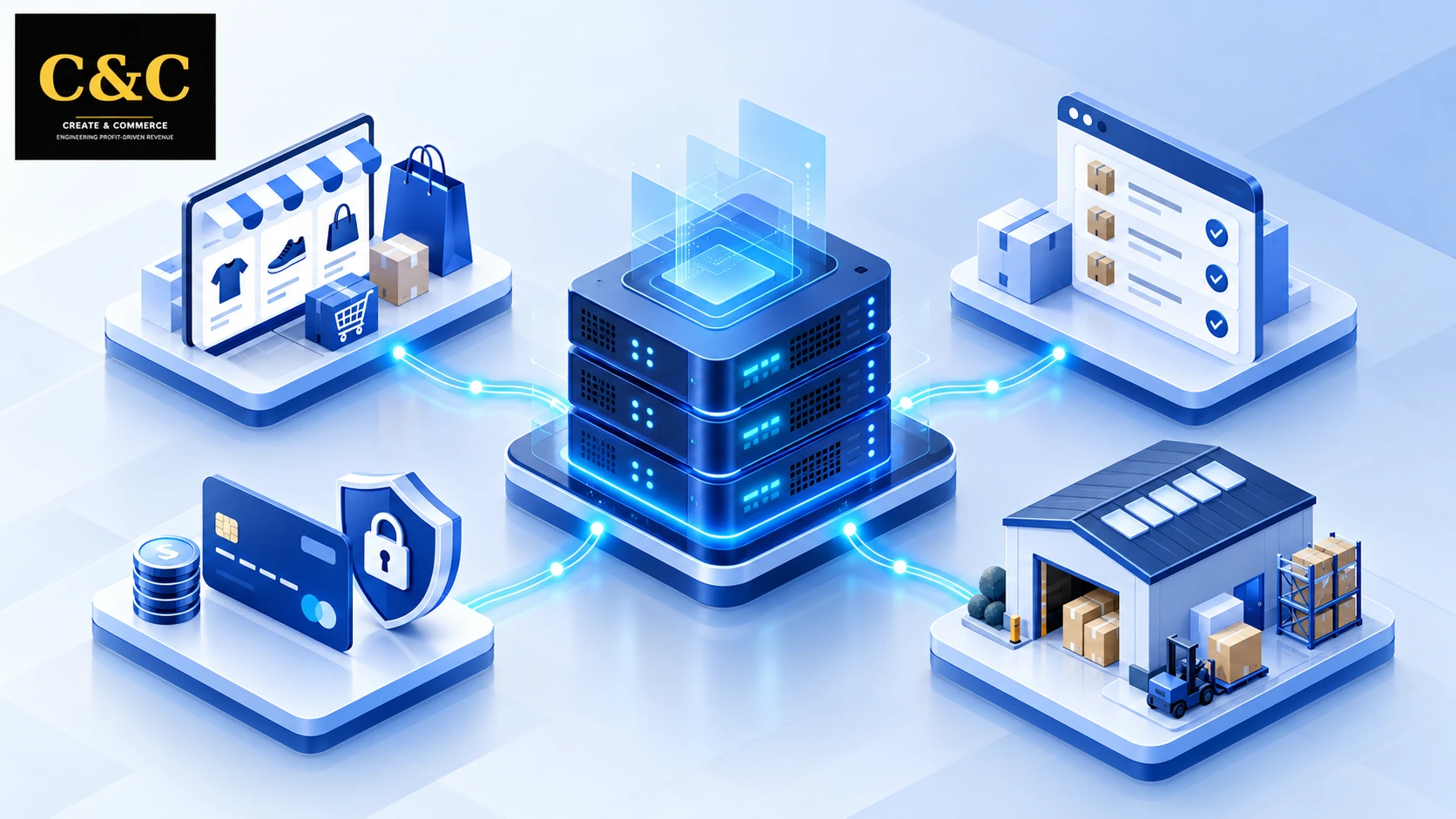
Ecommerce backend development shapes every shopping experience long before a customer clicks “Buy Now.” Behind each product page, cart, and confirmation email sits a network of databases, APIs, queues, and third-party services. All of these must stay perfectly aligned.
When inventory counts differ between systems, revenue suffers. When an order disappears between the storefront and the warehouse, customer trust suffers too. Strong data synchronization and dependable system reliability separate stores that scale smoothly from stores that struggle during every sale.
Online retail has moved far beyond a single website connected to a single database. A typical merchant now runs an ERP, a CRM, a payment gateway, a shipping platform, marketplaces, and analytics tools at the same time. Each system holds a piece of the truth. The ecommerce backend must keep every piece consistent.
The sections below cover the most common failure points, the architectural principles that prevent them, and the tactics for Magento, Adobe Commerce, Shopify, WooCommerce, BigCommerce, and headless stacks. Security, compliance, and platform migration are covered as well.
Why Ecommerce Backend Development Decides Store Success
The storefront attracts attention. The backend delivers on the promise. Page speed, checkout stability, accurate stock levels, and correct pricing all depend on server-side logic and data pipelines. The Core Web Vitals program from Google links slow, unstable experiences to weaker engagement, and backend response time is a major contributor.
Three business outcomes depend directly on a well-built ecommerce backend:
- Revenue protection: Accurate stock and price data prevents overselling and refund-heavy orders.
- Operational efficiency: Automated data flows remove manual spreadsheet updates and re-entry errors.
- Customer trust: Reliable order tracking, payment confirmation, and delivery updates build repeat purchases.
A fast storefront on top of an unreliable backend only delivers failure faster.

Common Data Synchronization Problems in Ecommerce Backend Development
Synchronization failures rarely announce themselves. Small mismatches build up quietly. A busy campaign then exposes every one of them at once. Knowing the typical patterns makes prevention much easier.
Inventory Drift Across Channels
Inventory drift happens when a stock quantity changes in one system and the update reaches other systems late, or never. A product sold on a marketplace may still appear available on the website. The result is oversold orders, cancellations, and negative reviews.
Batch-based syncs that run every few hours are the most frequent cause.
Order and Payment State Mismatches
An order can be paid in the gateway yet remain “pending” in the store. Another order can be shipped from the warehouse yet stay unconfirmed to the customer. Network timeouts, duplicate webhooks, and partial failures create these split states.
Without safeguards, support teams spend hours reconciling records by hand.
Catalog and Pricing Conflicts
Product data often originates in a PIM or ERP and flows to several storefronts. When two systems both allow edits, last-write-wins behavior silently overwrites correct values. Pricing rules, tax settings, and promotional discounts are especially vulnerable.
Core Principles for Reliable Data Synchronization
Dependable ecommerce backend development rests on a small set of architectural principles. Applying them consistently matters more than choosing any specific tool.
Establish a Single Source of Truth
Every data type needs one authoritative owner. Inventory may belong to the ERP. Customer profiles may belong to the CRM. Product content may belong to the PIM.
Other systems consume that data and never edit it directly. Clear ownership removes conflicting updates at the root.
Prefer Event-Driven Architecture Over Scheduled Batches
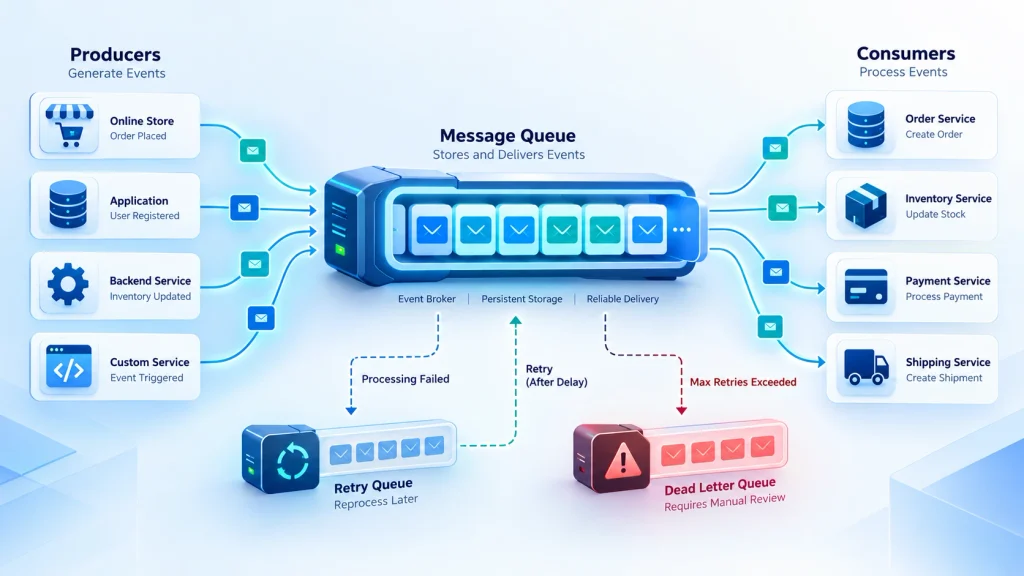
Polling for changes every few hours leaves long gaps. Event-driven designs close those gaps by publishing a message the moment something changes. Message brokers such as RabbitMQ and Apache Kafka deliver events to every subscribed system within seconds.
Queues also absorb traffic spikes. A flash sale no longer overwhelms downstream services.
Build Idempotency and Smart Retries
Networks fail, and messages sometimes arrive twice. Idempotent operations guarantee that processing the same message repeatedly produces the same result. No duplicate orders appear, and no stock is deducted twice. Payment providers such as Stripe document the pattern clearly in their guide to idempotent requests.
Idempotency keys work best when paired with exponential backoff retries and dead-letter queues. Failed messages are then captured, inspected, and replayed safely.
Reconcile Regularly
Even strong pipelines drift occasionally. Scheduled reconciliation jobs compare totals between systems, such as stock counts, order numbers, and payment amounts. Any difference is flagged automatically.
Reconciliation acts as the safety net behind real-time sync.
Ecommerce API Integration Services for Stable Data Flow
APIs are the connective tissue of any modern store. Professional ecommerce API integration services design the contracts between the storefront, ERP, payment providers, logistics partners, and marketplaces. Data then moves predictably in both directions.
Effective integration work usually includes:
- Versioned APIs that protect existing connections when changes are released.
- Rate-limit awareness so bulk updates never trigger throttling from external providers.
- Webhook verification using signatures to block spoofed requests.
- Centralized logging that traces a single order across every connected system.
- Schema validation that rejects malformed payloads before corruption occurs.
Platform vendors publish the reference material needed to build these integrations correctly. Useful starting points include the Adobe Commerce developer documentation and the BigCommerce developer center.
Merchants managing many connected systems benefit from a dedicated integration middleware layer. Middleware prevents a tangle of fragile point-to-point connections. Teams planning this kind of work can review dedicated ecommerce API integration services to understand typical scope.
Platform-Specific Ecommerce Backend Development Strategies
Every platform handles data, extensibility, and scaling differently. Matching the strategy to the platform avoids wasted effort.
Magento and Adobe Commerce
Large catalogs and complex B2B workflows make Magento a common choice for enterprise retailers. Magento enterprise development focuses on custom modules, multi-store configurations, and deep ERP connections. Strong Magento ecommerce development practices include asynchronous operations through message queues, properly configured indexers, and cron jobs monitored for failures.
Magento 2 performance optimization deserves special attention. Slow indexing and cache misses create both speed problems and stale data. Useful tactics include:
- Redis for sessions and cache
- Varnish for full-page caching
- OpenSearch tuning for catalog search
- Database query profiling
- Removal of unused extensions
Merchants who prefer managed infrastructure often adopt Magento 2 Commerce Cloud. The environment bundles hosting, CI/CD pipelines, and scaling tools in one place. Official guidance is available in the Adobe Commerce documentation on Experience League.
Experienced teams offering Adobe Commerce development services can configure these environments, build custom integrations, and handle upgrades without disrupting live sales.
Shopify
Shopify manages hosting and core infrastructure. Backend work therefore centers on apps, webhooks, and the Admin and Storefront APIs. Reliable setups verify webhook signatures, handle duplicate deliveries, and respect API rate limits.
The Shopify developer documentation outlines best practices for bulk operations and event subscriptions.
WooCommerce
WooCommerce runs on WordPress. Hosting, database health, and plugin quality therefore stay in the merchant’s hands. Reliable data handling depends on a well-tuned database, object caching, and background processing through Action Scheduler. Careful use of the WooCommerce REST API also matters.
Plugin conflicts are a frequent cause of sync errors. Staging environments and regular audits are essential.
BigCommerce
BigCommerce offers a SaaS foundation with strong API coverage and built-in multi-channel tools. Backend effort focuses on webhook handling, catalog synchronization with marketplaces, and middleware for ERP connections.
Infrastructure is managed, so development time goes into integration quality rather than server maintenance.
Headless Commerce Architecture
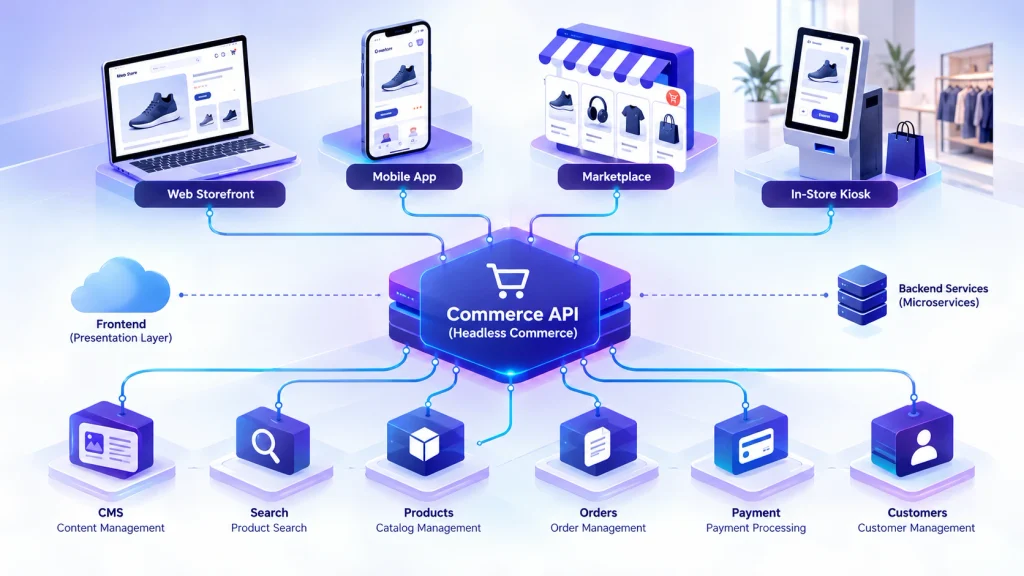
Headless ecommerce development separates the frontend experience from the commerce engine. The two communicate through APIs. The model offers flexibility for web, mobile, kiosks, and marketplaces from one backend.
The tradeoff is added responsibility. API performance, caching layers, and error handling become critical because every channel depends on them. The MACH Alliance promotes composable, API-first principles that guide these builds.
Done well, headless ecommerce development produces fast storefronts and a backend that adapts quickly to new channels.
System Reliability Practices in Ecommerce Backend Development
Synchronization keeps data consistent. Reliability keeps the entire system available. Both goals support each other.
Monitoring and Observability
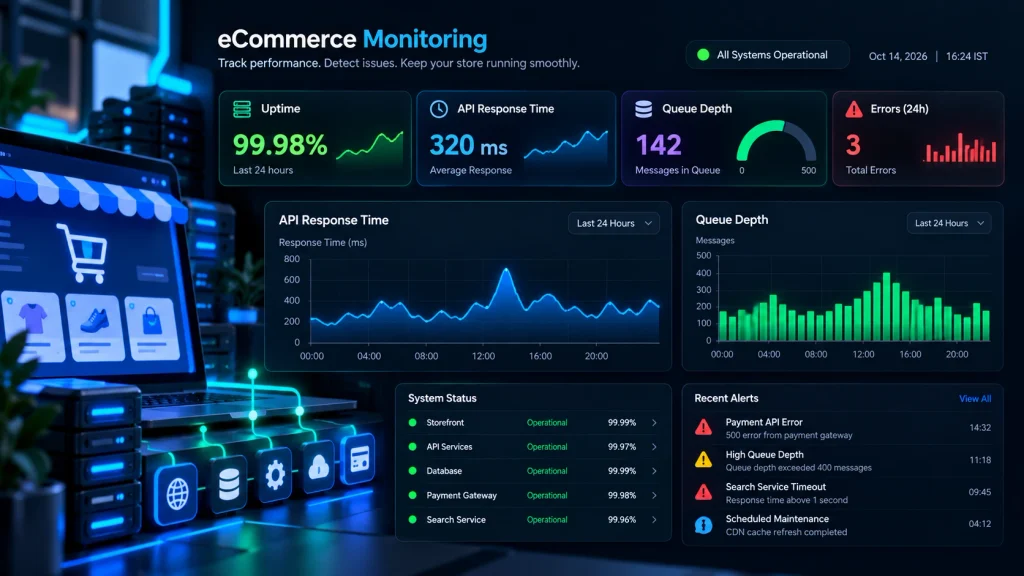
Dashboards and alerts should cover response times, error rates, queue depth, failed webhooks, and checkout completion rates. Distributed tracing connects a single customer action to every service touched.
The Google Site Reliability Engineering book offers well-regarded guidance on service level objectives and alerting. Early alerts allow fixes before customers notice any disruption.
Scalable Caching and Infrastructure
Caching at multiple layers reduces load on the origin server. Useful layers include CDN, full-page, object, and database query caches. Auto-scaling and load balancing prepare the store for traffic surges during sales events.
Strong ecommerce performance optimization also includes image compression, efficient database indexing, and lean third-party scripts.
Backup, Failover, and Disaster Recovery
Regular automated backups, tested restoration procedures, and database replication protect against data loss. Clear recovery time and recovery point objectives define how quickly operations must resume. They also define how much data loss is tolerable.
Rehearsed recovery plans turn a potential crisis into a routine procedure.
Safe Deployment Habits
Staging environments, automated testing, feature flags, and blue-green or canary releases reduce the risk of new code breaking checkout. A rollback plan should exist before every release, not after a problem appears.
Security and Compliance in Ecommerce Backend Development (NEW SECTION)
Reliability means little if customer data is exposed. Security belongs inside the ecommerce backend from the first design decision, not as a final patch.
Payment Data and PCI DSS
Any store that accepts card payments must follow the PCI Security Standards Council requirements. The safest approach keeps raw card data away from the store entirely. Hosted payment fields and tokenization move the most sensitive information to a certified provider.
Scope shrinks, audits become simpler, and breach risk drops.
Protection Against Common Web Attacks
The OWASP Top 10 lists the most critical web application risks. Several apply directly to commerce systems:
- Injection attacks that target search, filters, and checkout forms
- Broken access control that exposes admin functions or customer records
- Vulnerable components such as outdated extensions and plugins
- Security misconfiguration in servers, storage buckets, and API gateways
Regular dependency updates, input validation, and least-privilege access reduce exposure to all four.
Privacy and Data Retention
Regulations such as GDPR and CCPA shape how customer data is collected, stored, and deleted. The official GDPR portal explains the core obligations in plain language. Backend systems should support data export and deletion requests across every connected tool, including the CRM, email platform, and analytics warehouse.
Consistent synchronization makes compliance far easier. A deletion request that reaches only one system leaves personal data behind in the others.

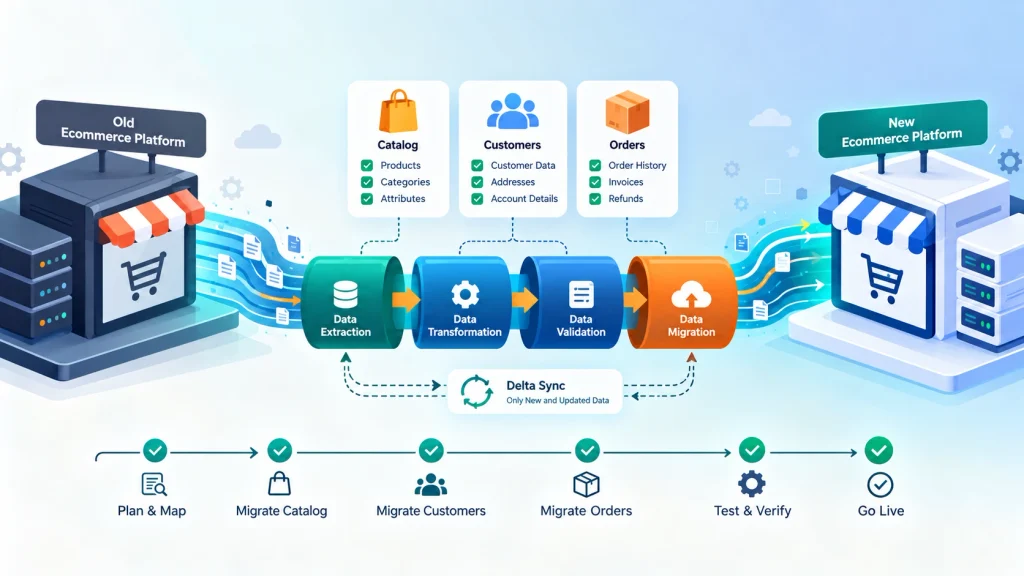
Data Migration and Replatforming Without Losing Sync
Growth often forces a platform change. A merchant may leave a legacy system for Adobe Commerce, move from WooCommerce to BigCommerce, or adopt a headless setup. Migration is one of the riskiest moments in ecommerce backend development, since orders, customers, and stock keep changing during the move.
Plan the Data Mapping First
Every field in the old system needs a clear destination in the new one. Product attributes, customer groups, tax classes, and order statuses rarely match one to one. A written mapping document prevents missing data and surprise errors after launch.
Migrate in Stages With Delta Syncs
A full cutover in one step is risky. A staged approach works better:
- Migrate the catalog and customer records into a staging environment.
- Test orders, payments, and integrations end to end.
- Run a delta sync that copies only records changed since the first import.
- Freeze changes briefly, complete the final delta, and switch traffic.
Teams handling Magento ecommerce development migrations often add a rollback path so the old store can resume instantly if a critical issue appears.
Protect Search Rankings and Customer Accounts
URL structures, redirects, and structured data affect organic traffic. Google’s guidance on site moves and migrations explains how to preserve rankings with correct 301 redirects. Password hashes, loyalty balances, and saved addresses also need careful handling so returning customers can sign in without friction.
Ecommerce Performance Optimization Checklist
A concise checklist keeps quality consistent across releases:
- Confirm one authoritative source for each data type
- Replace slow batch jobs with event-driven updates where possible
- Apply idempotency keys to order, payment, and inventory operations
- Configure retries with exponential backoff and dead-letter queues
- Schedule nightly reconciliation of stock, orders, and payments
- Cache aggressively at the CDN, page, and object levels
- Track queue depth, error rates, and API latency with alerts
- Keep extensions, plugins, and dependencies patched
- Test backups and failover on a regular schedule
- Load-test before every major sales event
Choosing the Right Partner for Ecommerce Backend Development
Technical skill alone does not guarantee success. A strong development partner demonstrates platform-specific certifications, documented integration experience, and a clear approach to testing and monitoring.
Evaluation should cover:
- Case studies with measurable results
- Post-launch support options
- Transparency around architecture decisions
- Experience with the specific platform in use
Merchants comparing agencies can explore related resources on Magento 2 performance optimization and headless commerce solutions before shortlisting. Businesses seeking dedicated expertise for large catalogs may also review Magento enterprise development and Adobe Commerce development services to understand typical scope and timelines.
Frequently Asked Questions About Ecommerce Backend Development
What is ecommerce backend development?
Ecommerce backend development covers the server-side systems that power an online store. These include databases, APIs, order management, inventory logic, payment processing, and integrations with ERP, CRM, and shipping tools. The backend operates behind the storefront and keeps every business process running accurately.
How can data synchronization be improved in an ecommerce store?
Data synchronization improves with a single source of truth for each data type, event-driven updates instead of slow batch jobs, idempotent processing, and scheduled reconciliation checks. Professional ecommerce API integration services can design and maintain these data flows.
Why is system reliability important for online stores?
Reliability protects revenue and reputation. Downtime, failed payments, and incorrect stock data push customers toward competitors. Monitoring, caching, failover, and safe deployment practices keep stores available during normal traffic and major sales alike.
Is Magento a good choice for enterprise ecommerce?
Magento and Adobe Commerce suit enterprises with large catalogs, complex pricing, multiple storefronts, and custom B2B needs. Success depends on proper Magento 2 performance optimization, quality extensions, and skilled development support. Managed options such as Magento 2 Commerce Cloud reduce the infrastructure workload.
What is the difference between headless and traditional ecommerce?
Traditional ecommerce couples the frontend and backend in one platform. Headless ecommerce separates the two and connects them through APIs. Custom experiences become possible across web, mobile, and other channels. Headless ecommerce development requires stronger API performance and caching strategies.
How often should ecommerce data reconciliation run?
Most stores benefit from daily reconciliation of inventory, orders, and payments. Extra checks after major promotions or system changes add safety. High-volume merchants often run hourly checks on critical data such as stock levels.
Conclusion
Ecommerce backend development determines whether data stays accurate, systems stay online, and customers stay loyal. Clear data ownership, event-driven synchronization, idempotent processing, strong security, thorough monitoring, and tested recovery plans form the foundation of a dependable store.
Platform choice changes the tools but never the principles. Magento, Adobe Commerce, Shopify, WooCommerce, BigCommerce, and headless setups all reward the same discipline.
Investing in a resilient backend pays off through fewer support tickets, smoother peak-season performance, and faster launches of new sales channels. Businesses ready to strengthen synchronization and reliability can start with an audit of current data flows and build a prioritized roadmap from the findings.