
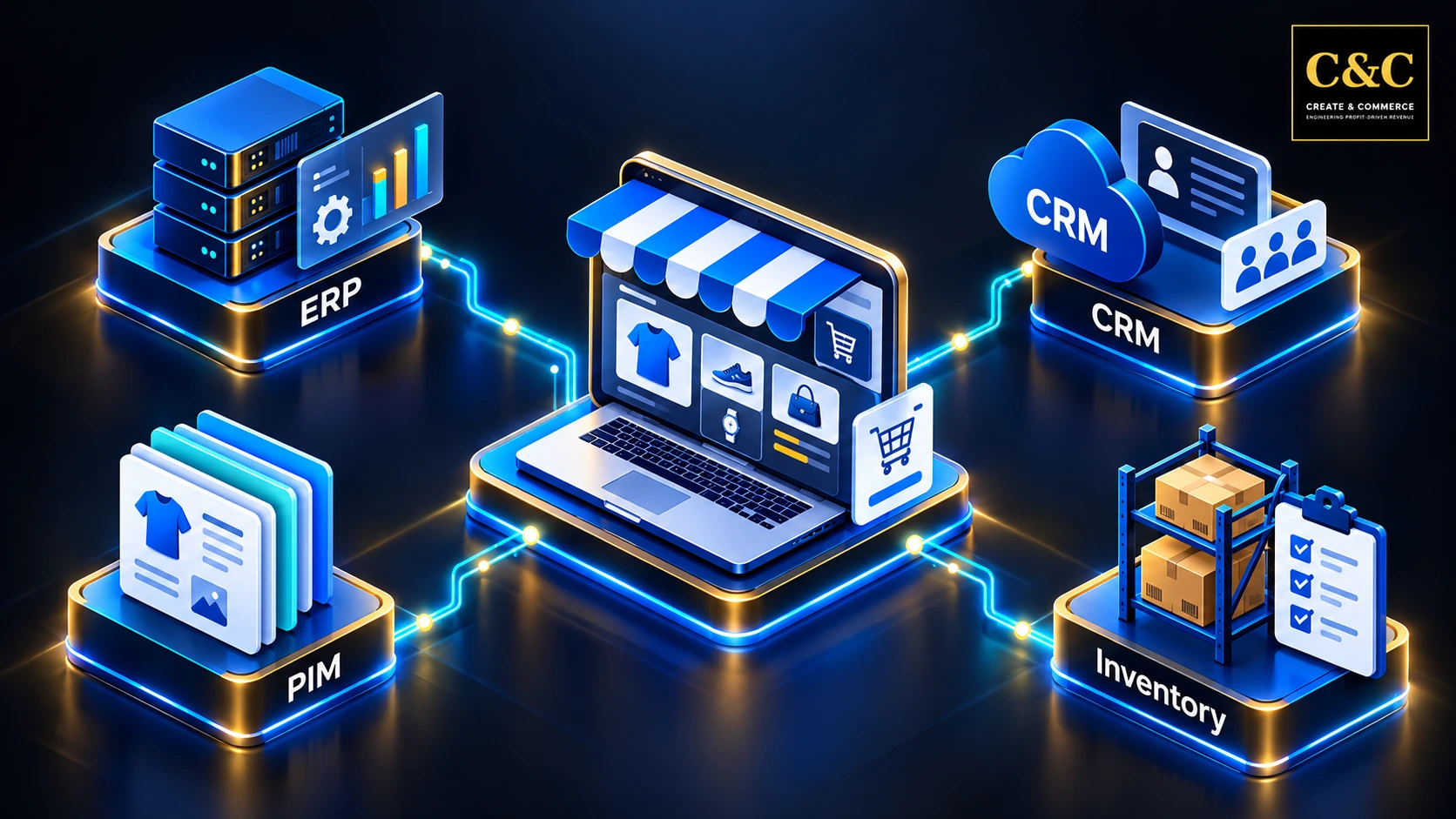
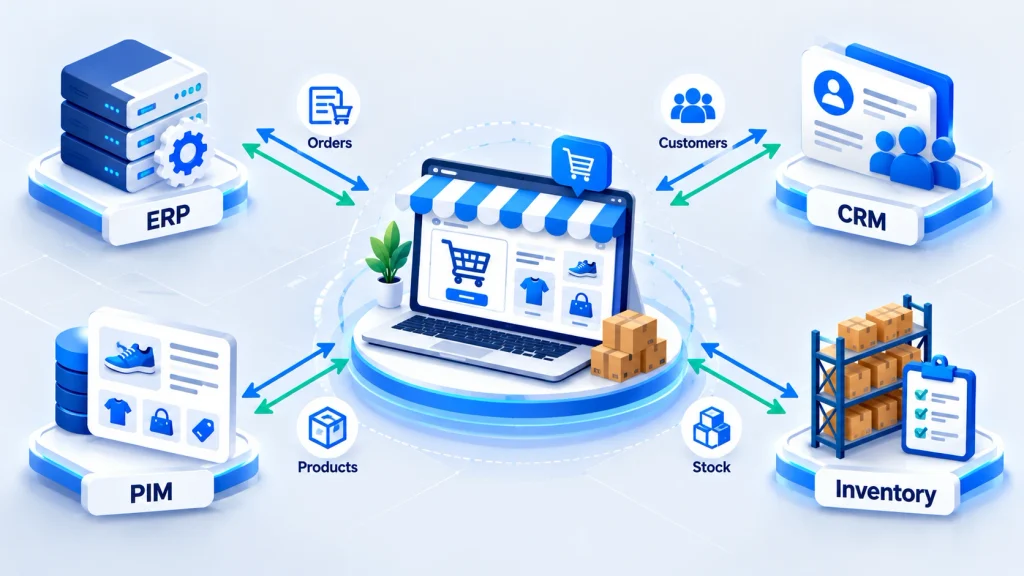
eCommerce API Integration Services turn scattered business tools into one automated commerce engine. An online store never runs alone. Orders move into an ERP. Customer records live in a CRM. Product content sits in a PIM. Stock counts travel through warehouse software.
Without solid connections, teams retype data by hand. Prices drift. Customers see wrong stock levels. Reliable eCommerce API Integration Services fix these problems by letting every platform exchange data in real time through secure interfaces.
The guide below explains how ERP, CRM, PIM, and inventory systems connect to a store. It also covers architecture patterns, platform differences, performance, and security.
What Are eCommerce API Integration Services?
An API (Application Programming Interface) is a set of rules that lets one software system send or request data from another.
eCommerce API integration services cover planning, development, testing, and maintenance of the links between a store and the systems around it. A typical project includes:
- Mapping data fields such as SKU, price, tax, customer ID, and order status
- Building connectors, middleware flows, and webhooks
- Managing error retries, rate limitations, and authentication
- Monitoring data flows after launch
One version of the truth for goods, costs, clients, and orders is the aim.
Why Disconnected Systems Slow Ecommerce Growth
Manual work seems manageable at low order volume. The cost grows fast as sales rise. Common symptoms include:
- Overselling: Website stock and warehouse stock are not the same.
- Slow fulfillment: Orders wait for manual entry into the ERP.
- Inconsistent product data: Descriptions differ between marketplaces and the storefront.
- Weak personalization: Marketing teams lack purchase history from the CRM.
- Reporting gaps: Finance reconciles spreadsheets instead of reading one dashboard.
Professional eCommerce API Integration Services remove each problem by automating the data exchange that people once handled by copy and paste.
Core Systems Connected Through eCommerce API Integration Services
ERP Integration
The foundation for operations and finances is the ERP. It oversees billing, accounting, purchasing, and frequently master pricing. Typically, a store-to-ERP link syncs:
- Orders sent to the ERP from the store
- Invoices, shipment status, and tracking numbers back to the store
- Customer-specific pricing and payment terms, which matter most in B2B
- Tax rules and currency data
Popular platforms include SAP, Microsoft Dynamics 365, NetSuite, and Odoo. Each exposes REST, SOAP, or OData endpoints for developers.
CRM Integration
The CRM stores customer profiles, interaction history, and pipeline data. A store-to-CRM link pushes registrations, order history, abandoned carts, and support tickets into one customer record.
Marketing and sales teams can then segment audiences, trigger follow-ups, and measure lifetime value with accurate data. Salesforce, HubSpot, and Zoho are frequent integration targets.
PIM Integration
The master copy of the product content is stored in a Product Information Management (PIM) system. That includes titles, descriptions, attributes, digital assets, translations, and category assignments.
When the PIM feeds the store through an API, launches speed up and content stays consistent across the website, marketplaces, and print catalogs. Akeneo, Pimcore, and Salsify are widely used options.
Inventory, WMS, and OMS Integration
Accurate inventory protects revenue and customer trust. Connecting warehouse management (WMS), order management (OMS), and multi-location inventory tools to the storefront enables:
- Real-time stock updates per warehouse
- Accurate shipping estimates and “in stock” labeling
- Automated backorder and low-stock rules
- Stock reservation at checkout
Architecture Patterns for eCommerce API Integration Services
The right pattern decides long-term stability and cost.
Point-to-Point Connections
Each system links directly to another. Setup is quick for two or three tools. Complexity then explodes. Ten systems can require dozens of separate connections, and a single change can break several of them.
Middleware and iPaaS Platforms
An integration platform such as MuleSoft, Boomi, Celigo, or Workato sits in the middle. It manages transformations, queues, and monitoring. Every system connects once to the middleware instead of to every other system. Maintenance becomes far easier.
Event-Driven Architecture
Systems publish events, such as “order placed” or “stock changed,” to a message broker like Kafka or RabbitMQ. Subscribers react independently. The result is high scalability and strong resilience during traffic spikes.
API-Led and Headless Connectivity
Layered APIs separate system access, business logic, and customer experience. Headless builds rely on exactly that structure. The storefront consumes APIs instead of a tightly coupled backend.
Platform Guidance for eCommerce API Integration Services
Magento and Adobe Commerce Integration
Magento (Adobe Commerce) offers REST, SOAP, and GraphQL APIs, plus a flexible module system and message queues. Strong magento ecommerce development includes custom modules for ERP order export, asynchronous bulk APIs for large catalogs, and service contracts that survive version upgrades.
Large merchants often depend on magento enterprise development for complex needs. Examples include multi-store setups, B2B company accounts, shared catalogs, and custom pricing rules. Dependable adobe commerce development services also cover queue configuration, cron optimization, and secure token management.
Hosting matters too. Magento 2 commerce cloud, known officially as Adobe Commerce Cloud, provides managed infrastructure, built-in CI/CD pipelines, and the Fastly CDN. Deployment of integration code becomes simpler.
Cloud hosting works best alongside focused Magento 2 performance optimization. Indexer tuning, full-page caching, Redis, and lean API payloads keep synchronization jobs from slowing the storefront. Full reference material is available in the Adobe Commerce developer documentation.
Shopify Integration
Shopify provides Admin and Storefront APIs in REST and GraphQL formats. Webhooks deliver real-time events. Cost-based throttling in the GraphQL Admin API calls for careful batching on large catalogs.
Shopify Plus merchants can add Flow automation and Shopify Functions for custom logic. Full details appear in the Shopify API documentation.
WooCommerce Integration
WooCommerce runs on WordPress and exposes a REST API with webhook support. Flexibility is high. Plugin conflicts and hosting limits, however, can hurt sync reliability. Dedicated queues and scheduled background jobs keep ERP and inventory updates stable. The WooCommerce REST API documentation outlines endpoints and authentication.
BigCommerce Integration
BigCommerce follows an open SaaS model with REST and GraphQL APIs, plus webhooks and a strong catalog and pricing API for B2B cases. Multi-storefront support and native headless features suit composable setups. Endpoint references live in the BigCommerce developer documentation.
Headless Commerce Integration
Headless ecommerce development separates the frontend experience from the commerce engine. A React, Next.js, or Vue storefront calls commerce, PIM, search, and CRM APIs directly or through a backend-for-frontend layer.
Benefits include faster page loads, design freedom, and flexibility across web, mobile app, kiosk, and marketplace channels. The main requirement is disciplined API design and caching, because the frontend depends fully on endpoint availability. The GraphQL site is a good starting point for query design.

Step-by-Step Process for eCommerce API Integration Services
- Audit existing systems. List every platform, data owner, and manual process.
- Define data ownership. Choose the source of truth for products, prices, stock, customers, and orders.
- Map fields and rules. Document field names, formats, validation, and transformation logic.
- Choose an architecture. Pick direct APIs, middleware, or event-driven flows based on scale and budget.
- Build in a sandbox. Develop connectors against staging environments with realistic sample data.
- Test edge cases. Cover partial shipments, refunds, duplicate orders, timeouts, and rate-limit errors.
- Deploy gradually. Launch one data flow at a time, starting with low-risk syncs.
- Monitor and improve. Track failed jobs, latency, and mismatches through alerts and dashboards.
Building a Commerce Website with API Integrations from Day One
A new commerce website launched without an integration plan often needs expensive rework. Planning connections during design delivers better results:
- Select a platform with mature APIs and webhook support.
- Reserve fields for ERP IDs, PIM identifiers, and CRM references in the data model.
- Set naming conventions for SKUs and categories before data import.
- Separate staging and production credentials through environment-based configuration.
Teams building a store from scratch can combine platform selection with eCommerce API Integration Services at the start. Migration effort drops later.
Ecommerce Backend and Performance Optimization
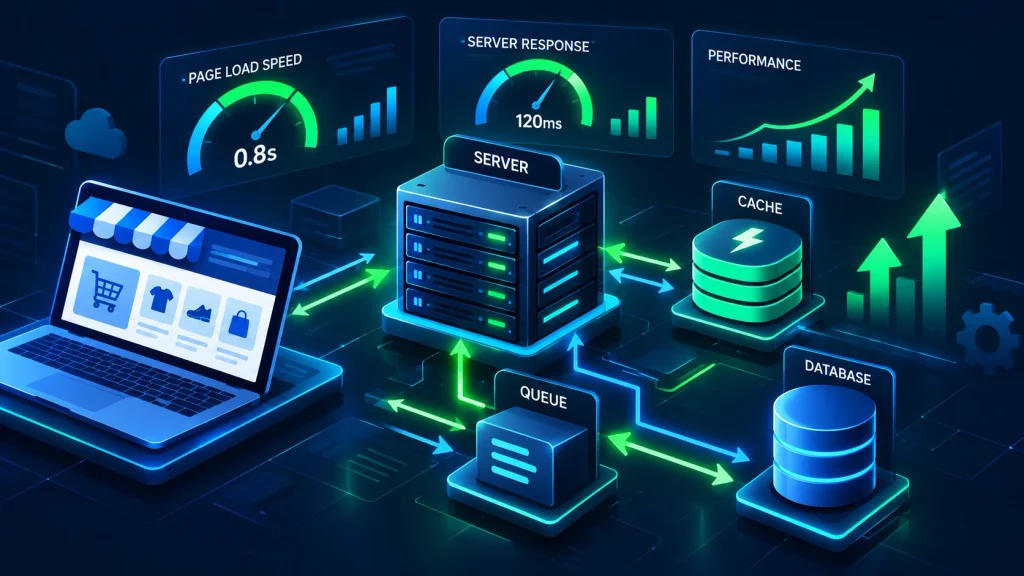
A well-structured ecommerce backend handles catalog data, pricing logic, checkout, and integration traffic without slowing customer-facing pages. Heavy sync tasks must never compete with shoppers for server resources.
Proven ecommerce performance optimization tactics for integrated stores:
- Queue heavy jobs: Process bulk imports and order exports asynchronously.
- Use delta syncs: Transfer only changed records instead of full catalogs.
- Cache read-heavy responses: Apply Redis, Varnish, or CDN caching to catalog and pricing data.
- Schedule smartly: Run large updates during low-traffic windows.
- Trim payloads: Request only required fields and compress responses.
- Monitor continuously: Use APM tools to catch slow endpoints early.
Fast integrations also protect Core Web Vitals, which connect to Google’s page experience guidance. Strong scores support both rankings and conversions.
Security and Data Governance in eCommerce API Integration Services
Connected systems share sensitive data. Security must be planned from the first sprint.
- Authentication: Use OAuth 2.0, scoped API tokens, and regular key rotation.
- Encryption: Enforce TLS for all traffic and encrypt stored credentials.
- Least privilege: Grant integrations only the permissions required.
- Audit logs: Record every request and change for traceability.
- Risk awareness: Review the OWASP API Security Top 10 during design and testing.
- Compliance: Align customer data handling with GDPR, PCI DSS, and regional privacy laws.
- Documentation: Maintain API specifications in the format promoted by the OpenAPI Initiative.
Common Challenges in eCommerce API Integration Services and Fixes
Rate Limits and Throttling
Platforms restrict request volume. Batch requests, apply exponential backoff, and prefer webhooks over constant polling.
Inconsistent Data Formats
Systems rarely agree on field structure. A transformation layer with validation at every entry point keeps data clean.
Duplicate Orders and Customers
Network retries can create duplicates. Idempotency keys and unique external IDs prevent the problem.
Legacy ERP Systems
Older ERPs often lack modern APIs. Middleware or file-based adapters (SFTP, CSV, EDI) bridge the gap.
Silent Failures
Failed jobs can go unnoticed for days. Alerting, dead-letter queues, and daily reconciliation reports expose problems quickly.
Platform API Version Changes
Updates can break working flows. Pin API versions and run regression tests before every upgrade.
How to Choose a Provider of eCommerce API Integration Services
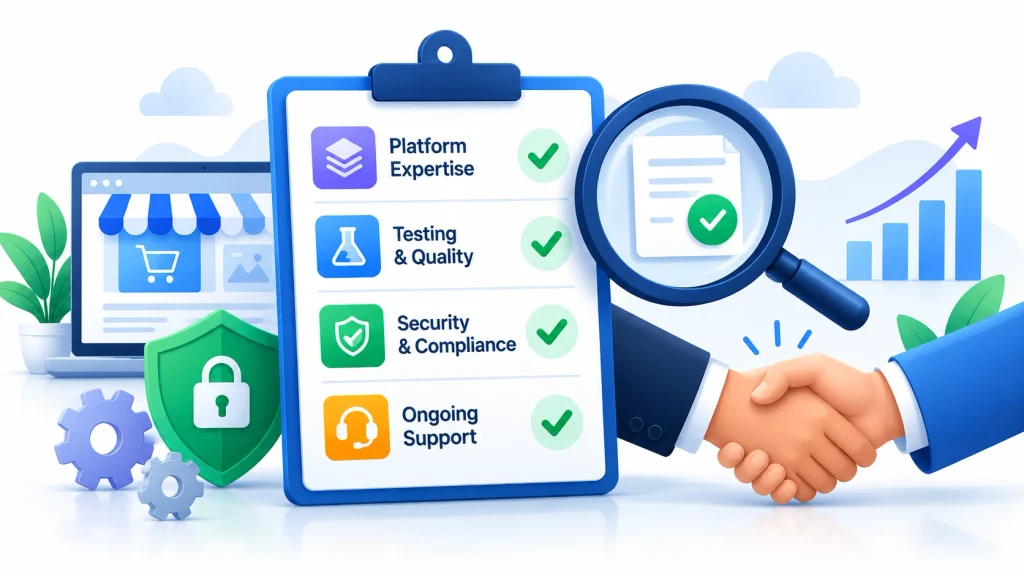
Careful evaluation avoids costly rebuilds. Key criteria include:
- Platform expertise: Proven delivery on Magento, Adobe Commerce, Shopify, WooCommerce, or BigCommerce
- ERP, CRM, and PIM experience: Case studies involving the same systems already in use
- Architecture skills: Capability across middleware, event-driven, and headless models
- Testing discipline: Automated tests, staging environments, and rollback plans
- Support model: Monitoring, SLAs, and clear ownership after launch
- Transparent documentation: Data maps, API specs, and runbooks delivered with the project
Businesses needing deeper platform support can explore Magento ecommerce development, magento enterprise development, and headless ecommerce development alongside integration work.
Frequently Asked Questions (FAQ)
What are eCommerce API integration services?
eCommerce API integration services are professional solutions that connect an online store with ERP, CRM, PIM, inventory, shipping, and payment systems through APIs. Data then moves automatically and accurately.
How long does ERP integration with an online store take?
A basic integration can finish in four to eight weeks. Complex projects with custom pricing, multiple warehouses, or legacy systems may need three to six months.
Which eCommerce platform is best for API integrations?
Adobe Commerce (Magento) suits complex enterprise needs. Shopify offers speed and a large app ecosystem. WooCommerce provides flexibility. BigCommerce delivers open SaaS APIs. The best choice depends on catalog size, budget, and integration complexity.
What is the difference between middleware and direct API integration?
Direct integration connects two systems without an intermediary. Setup is faster, but scaling is harder. Middleware centralizes transformations, monitoring, and error handling, which makes larger system landscapes easier to maintain.
Is headless commerce suitable for ERP and PIM integrations?
Yes. Headless architecture is API-first by design. ERP, PIM, CRM, and search tools connect cleanly to one flexible frontend, provided caching and API governance are in place.
How can integration affect store performance?
Poorly designed syncs slow checkout and category pages. Asynchronous queues, delta updates, caching, and scheduled bulk jobs protect store speed.
How is data security maintained in API integrations?
Security relies on OAuth 2.0 or token authentication, TLS encryption, least-privilege access, audit logging, and compliance with PCI DSS and privacy regulations.
Conclusion
Connected systems form the foundation of modern online retail. eCommerce API Integration Services link ERP, CRM, PIM, and inventory platforms so orders, products, customers, and stock move automatically and accurately. The right architecture, platform expertise, strong security, and steady monitoring turn integration into a lasting competitive advantage.
Businesses ready to modernize can start with a system audit, define data ownership, and roll out integrations in phases. For platform-focused help, explore Magento 2 performance optimization, Magento 2 Commerce Cloud, ecommerce performance optimization, and adobe commerce development services. A custom integration roadmap can also be requested through the contact page.