
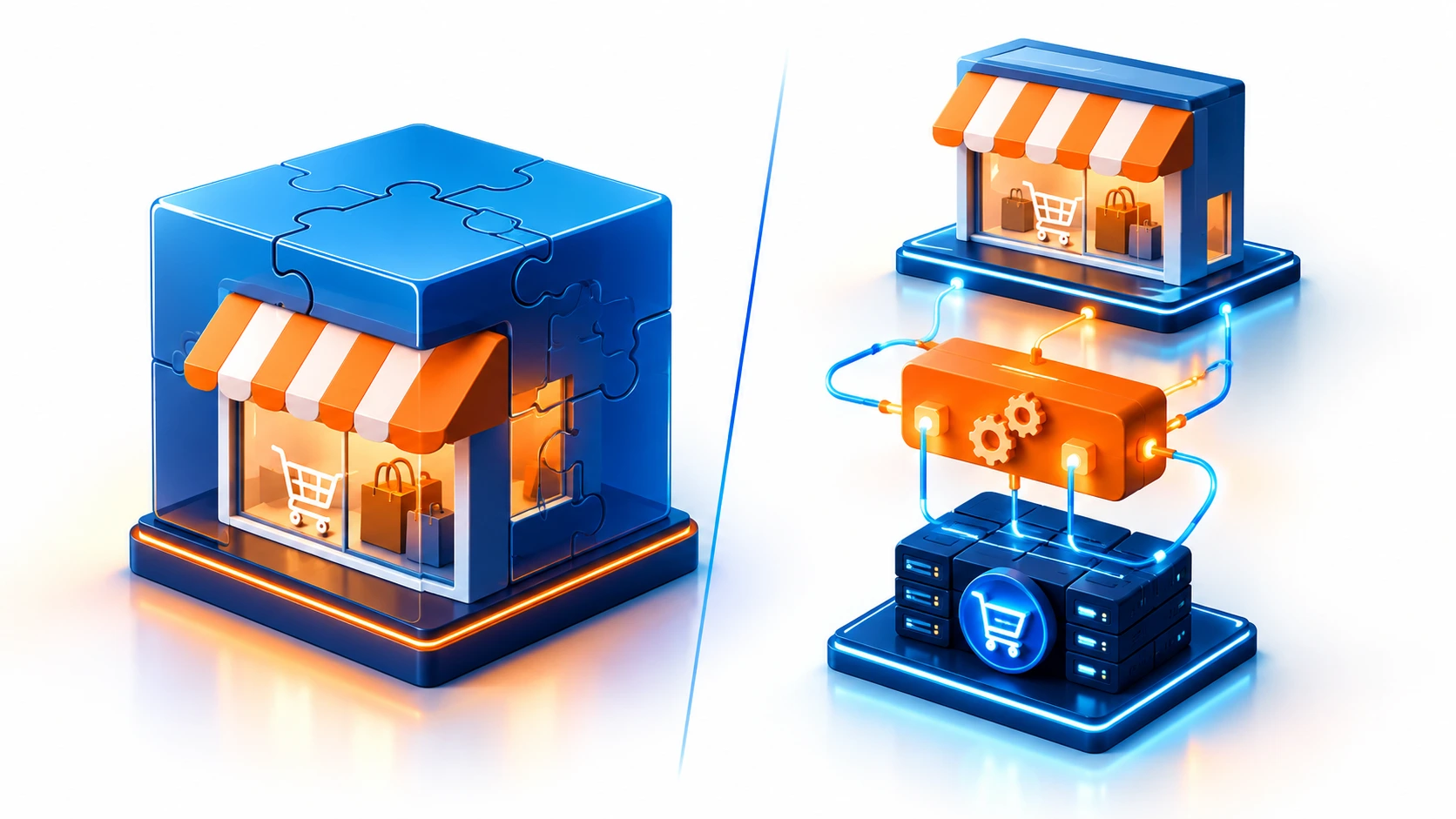
Headless commerce vs traditional commerce is the architecture question shaping how online stores are built, scaled, and discovered in 2026. A traditional platform bundles the storefront, checkout, and database into one system, while a headless setup separates the front end from the commerce engine and connects both through APIs. The shift changes speed, flexibility, cost, and visibility inside AI-powered answer engines.
A clear view of headless commerce vs traditional commerce helps decisionmakers avoid expensive replatforming mistakes. The sections below cover architecture, performance, SEO, content workflow, security, budget, and platform choices across Shopify, Magento, Adobe Commerce, WooCommerce, and BigCommerce. Brands planning ecommerce website development or evaluating headless commerce services will find a practical decision framework at the end.
What Traditional Commerce Looks Like Today
Traditional commerce, often called monolithic commerce, runs the product catalog, cart, checkout, content, and storefront templates inside a single codebase. Magento Open Source, Adobe Commerce, WooCommerce, and standard Shopify themes follow the model. A merchant installs the platform, picks a theme, adds extensions, and launches. Setup is quick, plugin ecosystems are rich, and marketing teams can edit pages without developer help.
The tradeoff appears at scale. Theme code, extensions, and database logic share the same server resources, so a heavy promotion or a poorly coded plugin can slow the entire store. Custom front-end changes often require edits to core templates, which raises upgrade risk.
What Headless Commerce Means for an Online Store
Headless commerce removes the “head,” the customer-facing front end, from the “body,” the back-end commerce engine. Product data, pricing, inventory, and checkout logic stay in the back end. A separate front end built with frameworks such as Next.js, Nuxt, or Remix pulls the data through APIs. The same back end can then feed a website, mobile app, kiosk, marketplace, or smart device.
Industry groups such as the MACH Alliance promote microservices, API-first, cloud-native, and headless principles as the foundation of the approach. Because each layer is independent, teams can replace the search tool, CMS, or storefront without rebuilding everything.
Headless Commerce vs Traditional Commerce: Core Differences
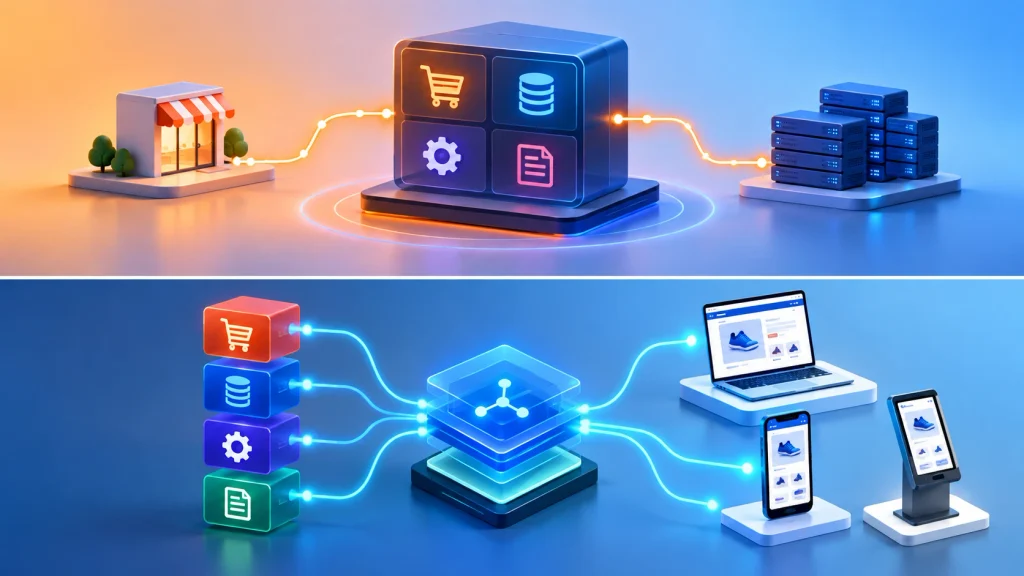
The difference between headless commerce vs traditional commerce starts with coupling. In a traditional stack, the front end and back end are tightly bound. In a headless stack, APIs form the bridge. Several practical changes follow.
Front-End Freedom and Design Control
Traditional themes limit layouts to what the template engine allows. Headless storefronts allow fully custom interfaces, animations, and personalized journeys. Brands with a complex visual identity gain the most. The cost is that every page element, including the header, cart drawer, and search, must be built or integrated rather than toggled in an admin panel.
Speed and Core Web Vitals

In headless commerce vs traditional commerce speed tests, headless storefronts using static generation or edge rendering often win because pages are prebuilt and served from a content delivery network. Faster pages improve Largest Contentful Paint and Interaction to Next Paint, metrics covered in Google’s Core Web Vitals guidance. Speed is not automatic, however. Poorly optimized JavaScript can make a headless store slower than a well-tuned traditional one.
Omnichannel Selling
A single back end serving many front ends keeps pricing and stock consistent across web, app, social commerce, and in-store screens. Traditional platforms can reach other channels through plugins or connectors, but each connector adds another point of failure.
How SEO Changes in Headless Commerce vs Traditional Commerce
Traditional platforms ship with SEO basics included: editable title tags, canonical URLs, XML sitemaps, and clean URL structures. A headless build removes that safety net. Every SEO element must be coded into the front end or supplied by the CMS.
Technical SEO Risks in Headless Builds
Client-side rendering can hide product content from crawlers that struggle with JavaScript. Server-side rendering or static generation solves the problem. Redirect maps, hreflang tags, canonical logic, pagination, and faceted navigation also need deliberate planning. Teams comparing headless commerce vs traditional commerce for organic growth should budget for technical SEO from the first sprint, because skipped redirects are the most common cause of ranking drops after a replatform.
Structured Data and Rendering
Product, Offer, Review, and Breadcrumb schema should render in the initial HTML response. Google’s structured data documentation explains supported formats. Done well, rich results lift click-through rate and bring more organic traffic to category and product pages.
AEO, GEO, and AI Visibility: Why Architecture Matters

Search is no longer limited to ten blue links. Answer engines and generative tools such as Google AI Overviews, ChatGPT, Perplexity, and Gemini summarize products and recommend brands directly. Winning in that environment involves AEO (answer engine optimization), GEO (generative engine optimization), and broader AI visibility.
AEO for Product and Category Pages
AEO focuses on concise, direct answers placed near the top of a page. Product pages benefit from short specification summaries, comparison tables, and FAQ blocks marked up with schema. Traditional platforms make such edits easy through built-in content fields. Headless stores can match or exceed that capability by modeling FAQs as structured content inside a headless CMS.
GEO and AI Visibility Signals
GEO rewards clear entities, consistent brand mentions, original data, and trustworthy citations. Generative engines favor pages that are fast, crawlable, and well structured. A headless build with clean semantic HTML and complete schema can increase AI visibility, while a bloated traditional theme with script-injected content may be skipped. In the debate over headless commerce vs traditional commerce, AI visibility is becoming a deciding factor rather than an afterthought.
Platform Breakdown: Shopify, Magento, Adobe Commerce, WooCommerce, and BigCommerce
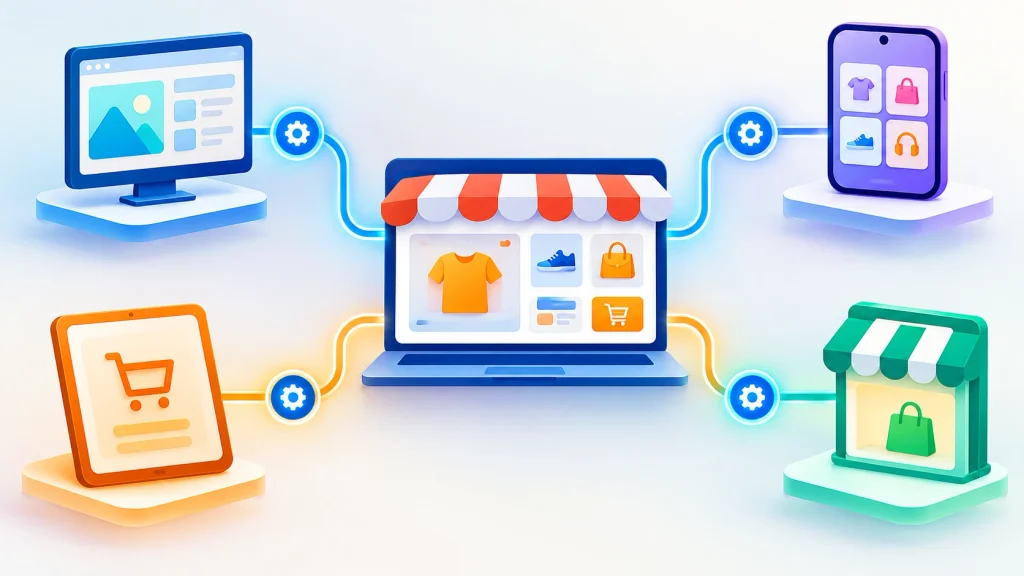
Each major platform handles headless commerce vs traditional commerce differently, and the right fit depends on catalog size, team skills, and budget. Specialized development partners also matter, because platform expertise decides how smoothly a store moves from theme-based to decoupled.
Shopify and Hydrogen
Shopify supports headless through the Storefront API and its React-based framework, Shopify Hydrogen. Merchants keep Shopify’s checkout and admin while building a custom storefront. Brands that invest in professional Shopify development services often choose the headless route once theme limits start blocking growth. Experienced Shopify development services teams also handle app integrations, Liquid customization, and Hydrogen storefront builds.
Magento and Adobe Commerce
Magento and Adobe Commerce expose GraphQL and REST APIs and support decoupled storefronts through PWA-based approaches. Adobe Commerce fits enterprises with complex catalogs, B2B pricing rules, and multi-store requirements. Traditional Magento remains viable for mid-size merchants with in-house developers. Reliable Magento development services cover performance tuning, extension development, upgrades, and headless migrations for either model.
WooCommerce
WooCommerce, built on WordPress, offers a REST API that can power a decoupled front end, often paired with WPGraphQL. A traditional WooCommerce store is budget friendly and plugin rich. Headless WooCommerce suits content-heavy brands that already rely on WordPress editorial workflows. Dedicated WooCommerce development services help with custom plugins, checkout optimization, and API-driven storefronts.
BigCommerce
BigCommerce positions itself as open SaaS with strong API coverage and native support for decoupled storefronts, detailed in its headless commerce guide. Multi-storefront features allow several front ends to run from one catalog. Skilled BigCommerce development services providers can connect Next.js storefronts, ERP systems, and B2B pricing tools to the platform.
Content Management and Marketing Workflow in Headless Commerce vs Traditional Commerce
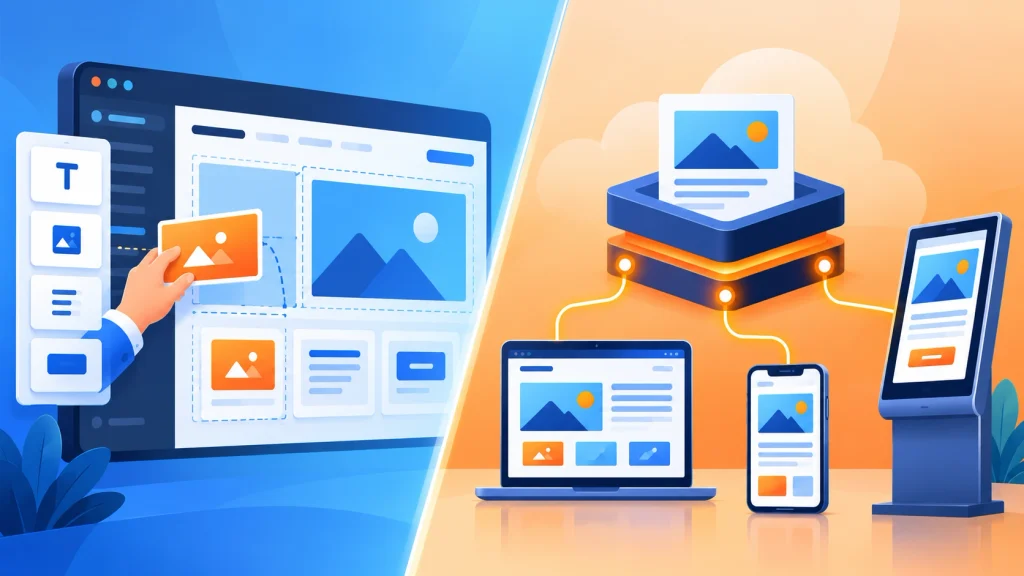
Daily content work often decides whether an architecture succeeds. Marketing teams update banners, launch landing pages, and test offers every week. The platform model determines how fast those changes go live.
Editing Pages in a Monolithic Store
A monolithic platform places the page editor inside the admin panel. Marketers drag blocks, swap images, and publish within minutes. No developer ticket is required for most changes. The limitation is flexibility. Layouts must fit the theme, and unusual designs usually need custom template code.
Editing Pages in a Headless Store
A headless setup moves content into a dedicated headless CMS. Editors write once, and the same content appears on the website, mobile app, and in-store screens. Key advantages include:
- Reusable content blocks across every channel
- Structured fields that support schema markup and answer engine optimization
- Preview environments that allow safe testing before publishing
A drawback appears at launch. Visual drag-and-drop editing must be configured deliberately, and developers often need to build page components first. Once the component library exists, editing becomes fast and consistent.
Security, Scalability, and Peak Traffic in Headless Commerce vs Traditional Commerce
Security and uptime protect revenue. A store that crashes during a sale loses money and trust within minutes. Architecture shapes both risks.
Security Surface Differences
A monolithic store exposes the storefront, admin, and database through one application. A single vulnerable extension can open access to customer data. Regular patching and a limited plugin list reduce the risk.
A headless store separates the public front end from the commerce engine. Attackers reach only the presentation layer, while sensitive systems sit behind API gateways. More moving parts do exist, so each API key, token, and webhook needs careful management.
Scaling During Sales Events
Traffic spikes during holiday campaigns test every platform. Monolithic stores scale by adding server capacity for the whole application, even when only the storefront is under pressure. Such an approach raises hosting costs quickly.
Headless storefronts scale independently. Static pages sit on a content delivery network, and only checkout and inventory calls reach the back end. The result is steadier performance during peak demand, which supports conversion rates and protects organic traffic gained from paid and search campaigns alike.
Quick comparison for decisionmakers:
- Content editing: Monolithic is faster to start, while headless is more flexible at scale.
- Security: Monolithic has one large surface, while headless has several smaller ones that need monitoring.
- Peak traffic: Monolithic scales as one block, while headless scales layer by layer.
Cost, Team, and Maintenance in Headless Commerce vs Traditional Commerce
Traditional builds usually cost less upfront. A theme, a few extensions, and a small team can launch a store in weeks. Headless projects require front-end engineers, DevOps support, API integration work, and often a separate CMS and search tool. Initial investment can run several times higher, and ongoing maintenance spans multiple systems instead of one.
Long-term value shifts the equation. Headless architecture reduces vendor lock-in, supports faster experiments, and allows independent scaling. Traditional systems can become expensive when heavy customization piles up. A realistic total cost comparison should cover three years, including hosting, development, licensing, and opportunity cost.
Which Model Fits: Headless Commerce vs Traditional Commerce by Business Type
Choosing between headless commerce vs traditional commerce is less about trends and more about business stage and capability.
When Traditional Commerce Is the Smarter Choice
- Early-stage stores with limited developer resources
- Catalogs under a few thousand products with standard design needs
- Teams that rely on plugins and drag-and-drop page editing
- Budgets that cannot support ongoing engineering
When Headless Commerce Pays Off
- Brands selling across web, app, marketplaces, and physical locations
- Stores needing sub-second page loads and custom experiences
- Enterprises with complex integrations such as ERP, PIM, and CRM
- Teams investing in AEO, GEO, and AI visibility through structured content
Headless Commerce Services: What a Capable Partner Delivers
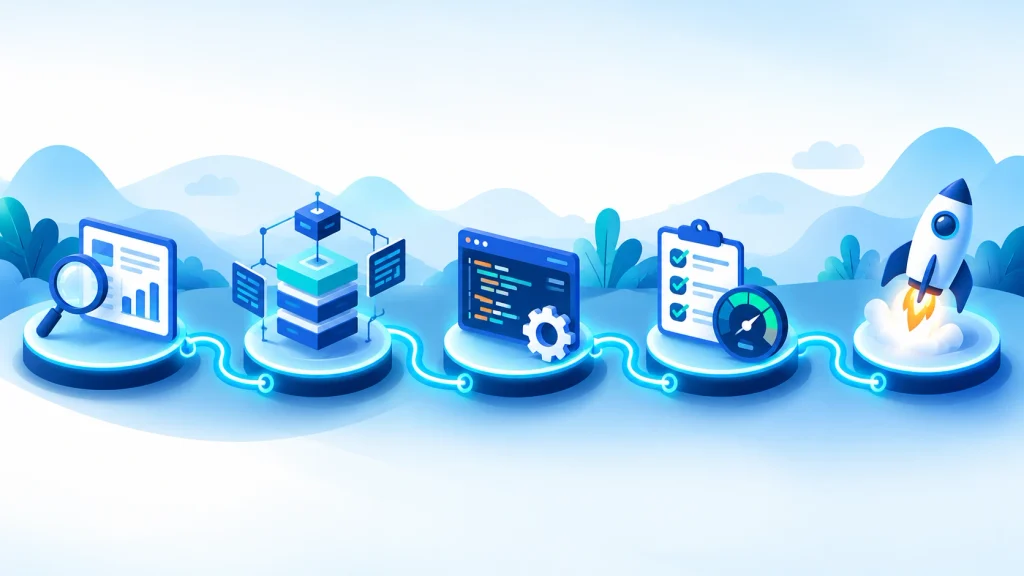
Professional headless commerce services cover far more than front-end coding. A complete engagement connects strategy, architecture, development, and long-term growth. Strong headless commerce services usually include the following:
- Discovery and architecture planning: audit of the current stack, API mapping, and a platform recommendation
- Storefront development: Next.js, Nuxt, Remix, or Hydrogen builds with server-side rendering and edge delivery
- CMS and search integration: headless CMS setup, product search, and personalization tools
- Platform migration: data transfer, redirect mapping, and schema preservation
- Performance and SEO engineering: Core Web Vitals tuning, structured data, and crawl testing
- Support and optimization: monitoring, A/B testing, and release management after launch
Quality headless commerce services also protect search visibility during migration. Redirect accuracy, rendered schema, and clean internal linking keep rankings stable while the new front end goes live.
How to Choose the Best E-Commerce Agency for a Headless or Traditional Build

Selecting the best e-commerce agency affects timeline, budget, and long-term growth more than any single technology choice. A capable partner explains tradeoffs honestly, even when the simpler traditional route is the better fit.
Questions to Ask Before Hiring
- Does the agency hold real experience with Shopify, Magento, WooCommerce, and BigCommerce builds?
- Can the team show live headless projects with measurable speed and conversion gains?
- Are SEO, AEO, and GEO planning included from the first sprint?
- Who owns hosting, monitoring, and security after launch?
- Is pricing transparent, with clear milestones and a defined scope?
Signs of the Best E-Commerce Agency
The best e-commerce agency shares case studies with real metrics, assigns a dedicated project lead, and documents every integration. Partners with in-house strategists, designers, and engineers reduce handoff delays. Brands needing end-to-end support can review the best e-commerce agency options that combine platform-specific development with technical SEO and ongoing growth marketing.
Migration Roadmap From Monolith to Headless
A phased approach lowers risk. Teams weighing headless commerce vs traditional commerce should start small rather than rebuild everything at once.
- Audit the current store: traffic, top landing pages, revenue drivers, and technical debt.
- Map every URL, redirect, and schema type before development begins.
- Choose the back-end platform, front-end framework, CMS, and hosting layer.
- Pilot with one section, such as a blog or a single category.
- Test rendering, speed, and crawlability before launch.
- Monitor rankings, organic traffic, and AI citations for 90 days after go-live.
Final Verdict on Headless Commerce vs Traditional Commerce
Neither model wins in every situation. Traditional platforms deliver speed to market, lower cost, and ease of use. Headless architecture delivers flexibility, performance, and omnichannel reach, with higher complexity as the price.
The smartest view of headless commerce vs traditional commerce treats architecture as a growth tool. Stores outgrowing theme limits, chasing stronger Core Web Vitals, or building authority in AI-driven search will benefit from decoupling. Stores still validating demand should stay traditional, then migrate when revenue and requirements justify the investment.
The right partner makes either path safer. Specialist Shopify development services, Magento development services, WooCommerce development services, and BigCommerce development services, backed by dependable headless commerce services, turn architecture decisions into measurable growth. Strong content, clean structure, and consistent brand signals matter in both models for lasting organic traffic and domain authority.
Frequently Asked Questions (FAQs)
What is the main difference between headless commerce vs traditional commerce?
Traditional commerce keeps the storefront and back end in one connected system. Headless commerce separates the two and links both through APIs, allowing custom front ends and multichannel selling.
Is headless commerce vs traditional commerce better for SEO?
Neither is automatically better. Traditional platforms include SEO features by default, while headless builds offer more control over speed and markup but demand careful technical setup.
Is headless commerce more expensive?
Yes, upfront costs are typically higher because of custom development, API integrations, and multiple tools. Long-term savings can appear through scalability and faster iteration.
What do headless commerce services include?
Headless commerce services include architecture planning, custom storefront development, CMS and search integration, platform migration, performance tuning, SEO engineering, and post-launch support.
What is AEO in ecommerce?
AEO, or answer engine optimization, is the practice of structuring content so search engines and AI assistants can extract direct answers. Concise summaries, FAQ schema, and clear headings support it.
What is GEO, and how does it affect online stores?
GEO, or generative engine optimization, improves the chances that AI tools mention or cite a brand in generated answers. Original data, consistent entities, and authoritative references help.
How can an online store improve AI visibility?
Stores can improve AI visibility with fast pages, complete product schema, helpful guides, authoritative backlinks, and consistent brand information across the web.
Can Shopify, WooCommerce, BigCommerce, and Adobe Commerce all run headless?
Yes. Each platform offers APIs that support decoupled storefronts, though the tooling, cost, and complexity differ.
How does a store owner find the best e-commerce agency?
The best e-commerce agency shows platform-specific case studies, offers transparent pricing, includes SEO and AI visibility planning, and provides support after launch.
Which is better for security, a monolithic or a headless store?
Neither is automatically safer. Monolithic stores have one large attack surface, while headless stores split risk across several layers that each need monitoring and key management.
Conclusion
Architecture shapes speed, cost, flexibility, and visibility for years after launch. Monolithic platforms offer quick setup, lower upfront spend, and easy page editing. Decoupled builds offer design freedom, stronger performance, and omnichannel reach, with higher complexity as the tradeoff.
Fast pages, complete schema, concise answers, and trusted references support organic traffic, AEO, GEO, and AI visibility in both models.
The practical path is simple: start traditional while demand is being validated, move to headless when theme limits or multichannel goals hold growth back, and plan redirects, rendering, and schema before any migration begins. The right architecture is the one that matches business goals, team skills, and customer expectations.