

AI in eCommerce demand forecasting replaces guesswork with statistical learning. Online retailers can predict what shoppers will buy, when purchases will happen, and in which quantities. Inventory choices once based on spreadsheets and instinct now draw on live signals such as traffic, pricing, weather, promotions, and marketplace trends.
The payoff is practical. Stockouts shrink. Overstock stops draining cash. Campaigns are planned around realistic numbers.
Results still depend on clean data, a sound technical foundation, and an honest view of where models fail. Each of those areas is covered below, along with metrics, tooling choices, a rollout plan, peak-season tactics, and future direction.
Key Takeaways
- Definition: machine learning that predicts product demand from sales, behavior, pricing, and external signals.
- Best fit: catalogs with seasonality, promotions, and many SKUs.
- Minimum data: roughly two years of order history, with stockout dates flagged.
- Main risks: sparse data, market shocks, model drift, and weak explainability.
- Success factor: a clean ecommerce backend that exposes reliable data through stable APIs.
- Rollout approach: five phases, from data audit to scaled deployment.
- Peak readiness: event features, scenario ranges, and load-tested infrastructure.
What AI in eCommerce Demand Forecasting Actually Does
Traditional forecasting leans on moving averages and last year’s sales. Machine learning models examine hundreds of variables at once and learn nonlinear relationships. One example is how a discount interacts with a holiday weekend. Another is how a competitor’s price drop shifts conversion.
Academic references such as Forecasting: Principles and Practice show that combining several methods usually beats relying on a single model.
Statistical Models vs Machine Learning Models
Statistical methods such as ARIMA and exponential smoothing perform well on stable products with long histories. Open-source tools like Prophet make trend and seasonality modeling approachable. Gradient boosting, recurrent networks, and transformer architectures, including the Temporal Fusion Transformer research paper, handle volatile catalogs and promotional spikes with less manual tuning.
Forecast Horizons That Matter
- Short range (days to weeks): replenishment and ad spend.
- Mid range (months): purchasing and staffing.
- Long range (seasons): supplier contracts and warehouse capacity.
Top Use Cases
Inventory Planning and Replenishment
Reorder points and safety stock adjust automatically as predicted demand shifts. Capital stays out of slow movers. Bestsellers remain available.
Dynamic Pricing and Promotion Planning
Forecasts estimate price elasticity at different discount levels. Merchandising teams can test discount depth before launch, which protects margin.
New Product Launch Forecasting
Products without history borrow patterns from similar items. Matching relies on category, price band, color, and season.
Marketing and Ad Spend Allocation
Predicted demand by product and region directs budget toward items likely to sell. Fewer impressions are wasted on out-of-stock listings.
Fulfillment and Logistics Optimization
Regional demand predictions support smarter warehouse placement, shorter delivery windows, and lower shipping costs.

Data Requirements for AI in eCommerce Demand Forecasting
Forecast quality rises or falls with input quality. Strong programs gather data across several layers.
Core Internal Data
- Order history with timestamps, quantities, and SKU-level detail
- Inventory records covering stock levels, lead times, and stockout dates
- Pricing and promotion logs showing every discount and its duration
- Returns and cancellations, because gross sales overstate true demand
Behavioral and Traffic Data
Product views, add-to-cart events, search queries, and wishlist activity often move before purchases do. Such signals work as early indicators. Official market context is available from sources like the U.S. Census Bureau retail e-commerce statistics.
External Signals
Holidays, weather, economic indices, competitor pricing, and social trends add context that internal records cannot supply. Infrastructure such as Google BigQuery helps ingest and join large external feeds.
Data Quality Standards
Most projects need at least two years of history to capture seasonality. Consistent product identifiers matter, and outliers such as one-time viral spikes need treatment. Lost sales during stockouts must be flagged. Otherwise, models learn that demand was low when supply was the real constraint.
Platform Readiness: Magento, Adobe Commerce, Shopify, WooCommerce, BigCommerce and Headless Builds
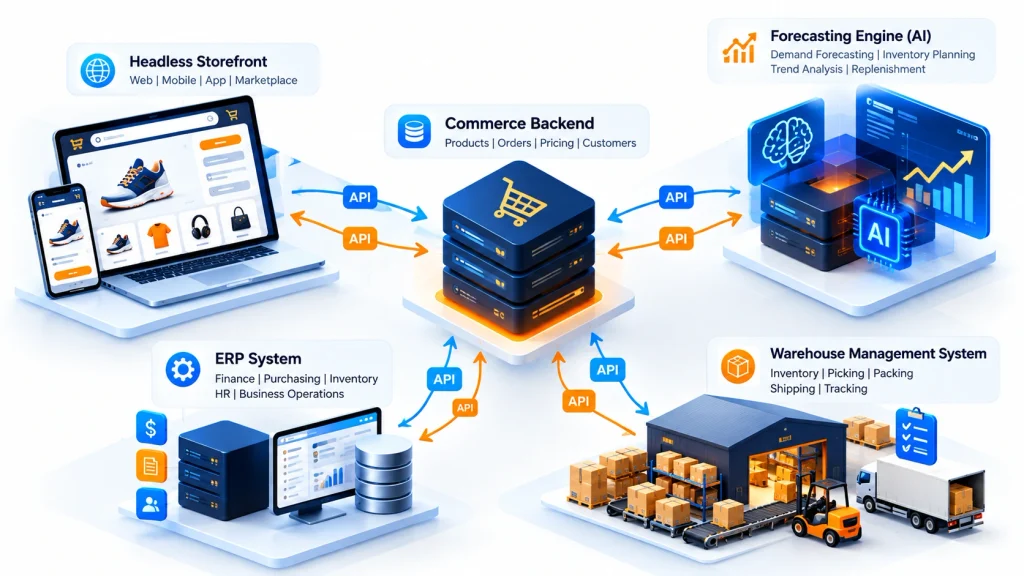
Forecasting accuracy depends on how easily a store exposes clean data. Platform choice shapes the integration path.
Magento and Adobe Commerce
Magento enterprise development teams often connect forecasting engines through message queues and REST or GraphQL endpoints. Adobe Commerce development services frequently pair predictive models with inventory modules. The Adobe Commerce developer documentation covers available extension points, and the Adobe Experience League hosts merchant-focused guides.
Heavy forecast queries must never compete with storefront traffic. Magento 2 performance optimization, including indexing strategy, caching layers, and read replicas, therefore remains essential. Merchants on Magento 2 Commerce Cloud gain scalable environments suited to scheduled model jobs. A dedicated Magento ecommerce development partner can design the data pipeline end to end.
Shopify
Shopify exposes orders, inventory, and product data through APIs documented at Shopify Developer Docs. Many forecasting apps plug in directly, which suits smaller catalogs.
WooCommerce
WooCommerce stores hold data in WordPress tables, so database tuning matters before large exports. The WooCommerce developer resources outline hooks and REST endpoints for extraction.
BigCommerce
BigCommerce offers open APIs and webhooks that stream catalog and order events. Details sit in the BigCommerce developer center.
Headless Commerce
Headless ecommerce development separates the storefront from the commerce engine. Forecast outputs such as low-stock badges, delivery estimates, and personalized sort order then reach any channel easily. A solid ecommerce backend paired with well-structured ecommerce API integration services keeps data moving between ERP, warehouse, marketplace, and storefront. GraphQL, explained at GraphQL Learn, is a common choice for flexible queries.
Ecommerce performance optimization, such as edge caching and efficient API design, prevents prediction calls from slowing page loads. Browser-side guidance is available at web.dev Performance.
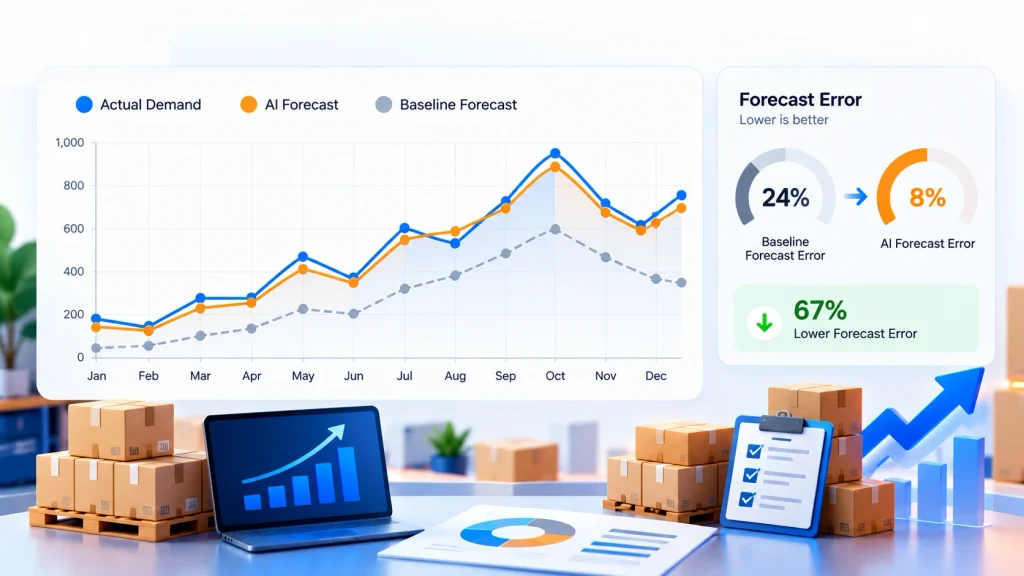
Measuring Accuracy in AI in eCommerce Demand Forecasting
A forecast without measurement is only an opinion. Clear metrics show whether a model earns its place.
Core Error Metrics
- WAPE (weighted absolute percentage error) works well for catalogs with many low-volume items.
- MAPE is easy to read but breaks down when actual sales approach zero.
- RMSE punishes large misses, which suits high-value products.
The International Journal of Forecasting publishes peer-reviewed work on choosing error measures.
Bias and Service Level
Bias reveals consistent over-prediction or under-prediction. Service level shows the share of orders filled from stock. Pairing the two links statistical accuracy to business outcomes.
Baselines and Backtesting
A simple seasonal average acts as the benchmark. Backtesting replays past periods to confirm that gains are real rather than lucky.
Build vs Buy: Tools for AI in eCommerce Demand Forecasting
Ready-Made Forecasting Apps
App-based tools connect quickly and need little engineering. Customization is limited, which suits Shopify and BigCommerce stores with moderate catalogs.
Cloud Machine Learning Platforms
Managed services like Amazon SageMaker provide training, deployment, and monitoring without server management. Flexibility is higher, but data engineering skills are required.
Custom Models on Open-Source Libraries
Libraries such as scikit-learn and XGBoost give full control over features and logic. Large Magento enterprise development projects often choose the custom route to match unusual catalog rules and ERP constraints.
Decision Factors
- Catalog size and SKU volatility
- In-house data science capacity
- Integration depth with ERP and warehouse systems
- Budget for ongoing monitoring
Professional guidance on planning and inventory practice is available through ASCM, a supply chain association.
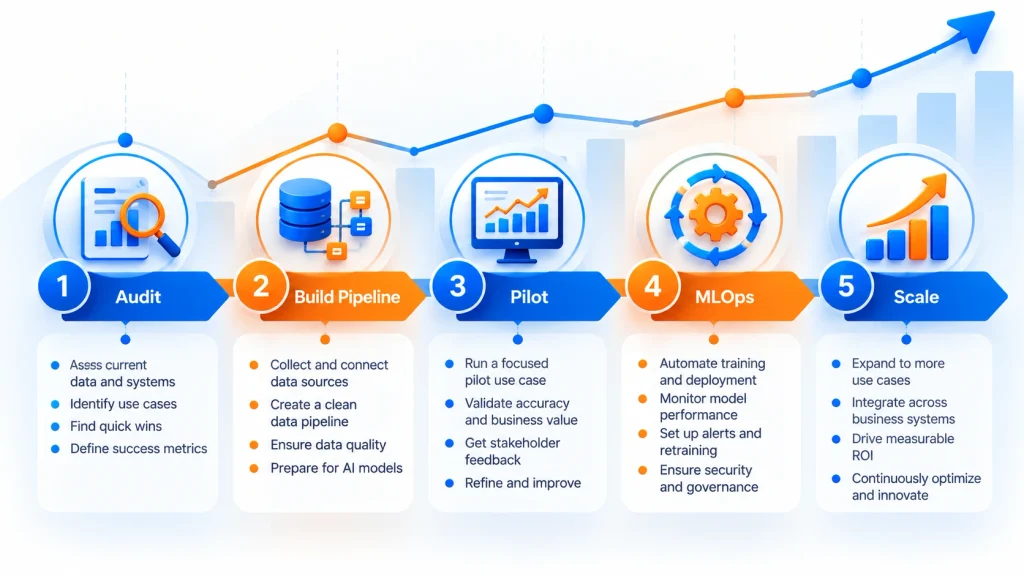
Implementation Roadmap for AI in eCommerce Demand Forecasting
A phased rollout keeps risk low and proves value early. Successful programs treat AI in eCommerce demand forecasting as an operating capability, not a software purchase.
Phase 1: Audit Data and Systems
Start with an inventory of every data source: orders, stock, promotions, returns, and traffic. Gaps such as missing stockout dates or inconsistent SKU codes should be fixed first. A reliable ecommerce backend matters more than model choice at the audit stage, because weak inputs cap accuracy.
Phase 2: Build the Data Pipeline
Reliable ecommerce API integration services move data between the storefront, ERP, warehouse, and forecasting engine on a schedule. Event streaming handles fast-changing signals, while nightly batch jobs handle heavy history. Teams running Magento 2 Commerce Cloud can schedule such jobs in isolated environments, protecting checkout speed. Strong Magento 2 performance optimization (indexers, full-page cache, and database read replicas) keeps shoppers unaffected while data flows out.
Phase 3: Pilot One Category
Pick a category with stable history and meaningful revenue. Run the model in shadow mode beside the current planning process for several weeks. Comparing both sets of numbers reveals real lift without risking stock decisions. Public benchmarks such as the M5 Forecasting Competition on Kaggle show how retail forecasting methods perform on large product hierarchies.
Phase 4: Operationalize with MLOps
Production models require versioning, monitoring, and automated retraining. Open-source platforms like MLflow track experiments and model versions, while the Google Cloud MLOps architecture guide outlines pipeline automation patterns.
Phase 5: Scale and Surface Outputs
Once accuracy holds, expand to more categories and push predictions to customer-facing channels. Headless ecommerce development makes the step simpler, since low-stock messages, delivery promises, and ranking tweaks can be served to web, app, and marketplace frontends from one API layer. Adobe Commerce development services and Magento enterprise development teams often extend the same pipeline into B2B quoting and multi-warehouse allocation.
Future Trends in AI in eCommerce Demand Forecasting
Real-Time Forecast Updates
Streaming events now refresh predictions within minutes. Flash sales and viral spikes are caught sooner.
Generative AI as a Planning Assistant
Language models summarize forecast changes in plain words. Planners can ask why a number moved and receive an explanation tied to drivers.
Probabilistic Forecasts
Single-number predictions are giving way to ranges. A range shows the risk behind each stocking decision.
Unified Commerce Data
Composable and headless architectures give models one clean stream across web, marketplace, and store channels. Analyst research from Gartner supply chain insights tracks the shift toward connected planning.
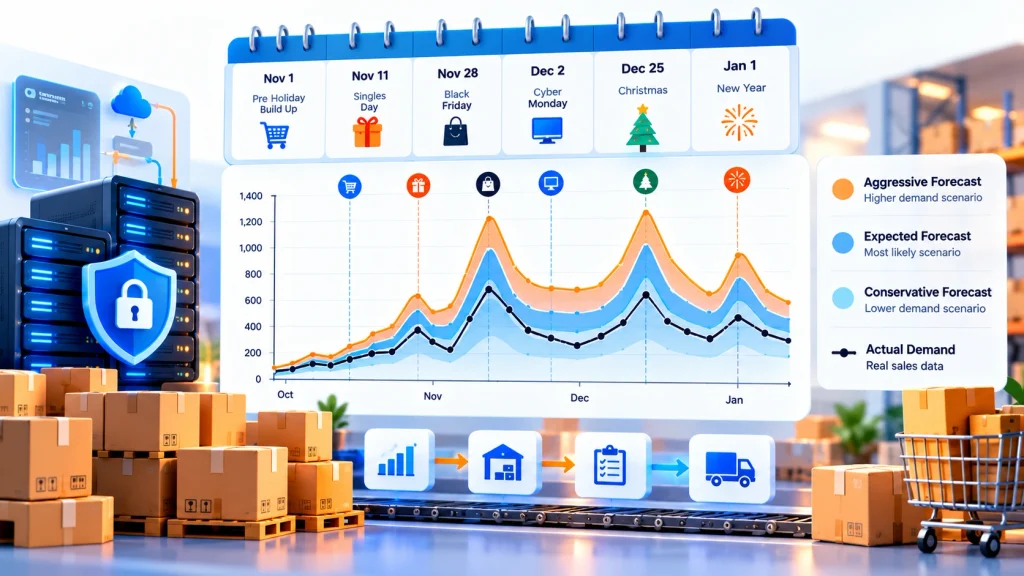
Peak Season and Promotion Planning with AI in eCommerce Demand Forecasting
Seasonal events create the sharpest forecasting tests. A single flash sale can consume months of stock in hours, and a missed prediction hurts both revenue and reputation.
Modeling Holiday and Event Spikes
Calendar features for Black Friday, Cyber Monday, regional festivals, and back-to-school periods let models learn recurring lift patterns. Two or more years of event history make such patterns reliable. Consumer behavior research from Think with Google helps teams anticipate which categories gain search interest ahead of major shopping moments.
Separating Baseline Demand from Promotional Lift
Promotional sales mask underlying demand. Strong models split the two, so a discount that merely pulled purchases forward is not mistaken for permanent growth. Cannibalization between similar products, and the post-sale dip that follows deep discounts, should be included as explicit features.
Capacity and Infrastructure Readiness
Forecasts predict traffic as well as units. Expected visit surges inform server scaling, caching rules, and queue limits. Ecommerce performance optimization before a peak window, including a content delivery network as explained in the Cloudflare CDN guide, keeps pages fast while demand climbs. Load testing against forecasted peaks exposes weak points early.
Scenario Planning for Uncertain Events
Probabilistic ranges support three working scenarios: conservative, expected, and aggressive. Purchasing teams can reserve flexible supplier capacity for the upper range and avoid committing cash to the full amount. Research on resilience and inventory strategy at Harvard Business Review adds useful context for balancing cost against availability.
Post-Event Review
Every peak ends with a structured review. Forecast versus actual by category, stockout hours, markdown depth, and returns feed directly into the next training cycle. Documented lessons make each season’s forecast sharper than the last.
Limitations of AI in eCommerce Demand Forecasting
Sparse and Noisy History
Long-tail products with few sales produce unstable predictions. Forecasting at category level often performs better than forecasting every SKU.
Sudden Market Shocks
Pandemics, supply disruptions, viral trends, and policy changes fall outside learned patterns. Human review and scenario planning remain necessary during turbulence.
Black-Box Decisions
Complex models can be hard to explain to buyers and finance teams. Feature importance reports and forecast-versus-actual dashboards build trust. The NIST AI Risk Management Framework offers guidance on transparency and governance.
Privacy and Compliance
Behavioral data carries obligations under regulations such as GDPR. Aggregated or anonymized inputs reduce exposure.
Cost and Maintenance
Models drift as customer behavior changes. Retraining schedules, monitoring, and engineering time create ongoing expense.
Best Practices for Implementing AI in eCommerce Demand Forecasting
- Begin with one high-value category and measure improvement before expanding.
- Benchmark against a simple baseline so genuine gains are visible.
- Track WAPE and bias together to catch consistent over- or under-prediction.
- Keep planners involved, since human overrides on known events improve results.
- Automate retraining and alerts when error rates climb.
- Protect storefront speed with a separate analytics pipeline.
Broader operational thinking appears in McKinsey’s operations insights. A related internal guide on ecommerce performance optimization explains how to keep infrastructure fast under analytical load.
Frequently Asked Questions
What is AI in eCommerce demand forecasting?
It is the use of machine learning to predict future product demand from sales history, traffic behavior, pricing, promotions, and external signals. The output guides inventory and marketing decisions.
How much historical data is needed?
Two years of order history is a common starting point for capturing seasonality. Newer stores can begin with category-level models and similar-product comparisons.
Which platform works best for forecasting integrations?
Every major platform can support forecasting. Shopify and BigCommerce suit quick app-based setups. WooCommerce suits WordPress-centered stores. Magento, Adobe Commerce, or headless architectures suit large catalogs needing custom pipelines.
Can AI forecasting handle new products?
Yes, through attribute-based similarity to existing items. Accuracy improves as real sales data accumulates.
Which metric is best for measuring accuracy?
WAPE suits most catalogs. Bias and service level should be tracked alongside it.
How long does an AI forecasting rollout take?
A single-category pilot usually runs for several weeks in shadow mode, with wider expansion following once accuracy holds against the baseline.
How does AI in eCommerce demand forecasting handle Black Friday?
Event calendars, past promotional lift, and probabilistic ranges let models estimate peak volume, while scenario planning protects against both stockouts and overbuying.
What are the biggest risks?
Poor data quality, unexplained outputs, market shocks, privacy obligations, and model drift are the most common.
Does forecasting affect site speed?
Heavy analytics on the live database can slow a store. Separate pipelines, caching, and Magento 2 performance optimization prevent slowdowns.
Conclusion
AI in eCommerce demand forecasting delivers the most value when treated as a continuous program rather than a one-time install. Reliable data, a flexible platform architecture, and realistic expectations about uncertainty turn predictions into measurable gains in availability, margin, and customer satisfaction.
Platform choice, whether Magento, Adobe Commerce, Shopify, WooCommerce, BigCommerce, or a headless build, sets the integration path. Strong metrics keep models honest, a phased roadmap controls risk, and thoughtful tool selection controls cost. Retailers that start small, measure carefully, and expand steadily gain a lasting planning advantage.
Next step: a project built on Magento enterprise development, Adobe Commerce development services, or headless ecommerce development benefits from an architecture review before any model goes live. Contact the team to scope a forecasting pipeline.