

AI customer support for ecommerce has shifted from a novelty chat widget to a core layer of the modern storefront. Online retailers handle order status questions, return requests, sizing doubts and payment problems around the clock, and shoppers expect instant, accurate answers on every channel.
Automated assistants built on language models and retrieval systems now resolve a large share of routine requests without an agent. Complex or sensitive cases move to trained staff through structured handoff. Done well, AI customer support for ecommerce lowers cost per contact and lifts satisfaction at the same time.
The sections below cover practical use cases, honest limitations, escalation design, omnichannel delivery, cost and metrics, platform fit, common mistakes and the technical base that decides whether an assistant gives correct answers or confident mistakes.
Key takeaways
- Routine, rule-based requests deliver the fastest return.
- Hallucination and weak data connections are the biggest risks.
- Clear escalation triggers protect trust and revenue.
- A solid ecommerce backend matters more than the chat interface.
- Measured page speed keeps support tools from hurting conversion.
- Avoidable launch mistakes cause most failed projects.
What Is AI Customer Support for Ecommerce?
Quick answer: AI customer support for ecommerce is the use of conversational AI, automation and machine learning to answer shopper questions, complete service tasks and route difficult cases to human agents across chat, email, messaging apps and voice.
How Modern Assistants Differ from Rule-Based Bots
A rule-based bot follows a fixed decision tree. Any question outside the tree ends in a dead end.
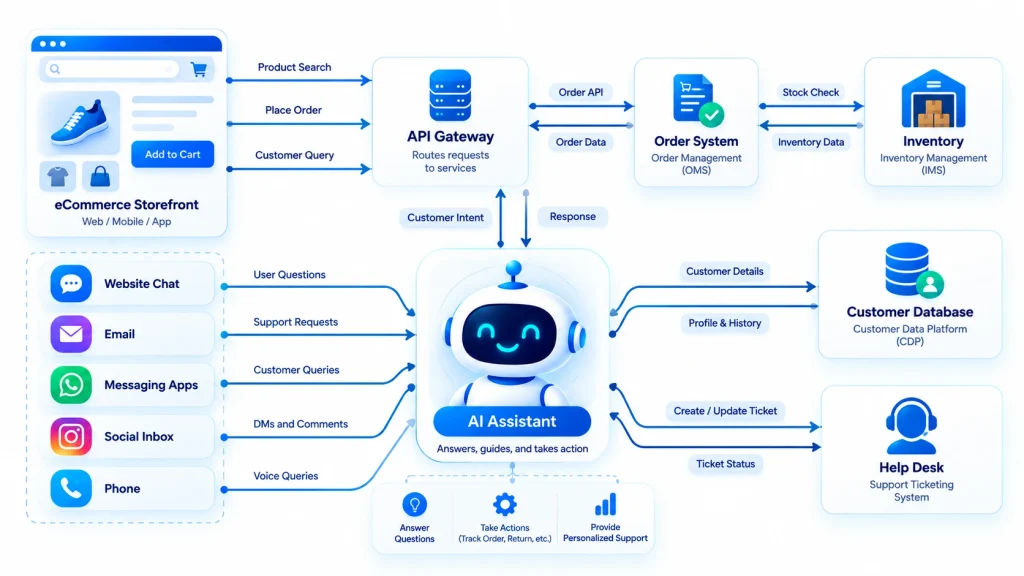
A current assistant reads free-form text, retrieves facts from policy pages and product catalogs, and calls store systems to check an order or start a return. Accuracy depends less on the language model and more on the quality of connected data.
Building Blocks of a Reliable Assistant
- Language model: understands intent and writes replies
- Retrieval layer: pulls facts from approved policies and catalog data
- Action layer: reads and updates orders, returns and accounts through APIs
- Guardrails: block risky topics and unsupported promises
- Escalation layer: hands conversations to staff with full context
- Analytics: tracks accuracy, containment and satisfaction
Core Use Cases of AI Customer Support for Ecommerce
Not every request deserves automation. The strongest results in AI customer support for ecommerce come from high-volume, rule-driven requests where answers can be verified against store data.
Order Tracking and Delivery Updates
“Where is my order?” remains the most common service request in online retail. An assistant connected to the order management system and carrier feeds returns live status, estimated delivery dates and delay explanations in seconds.
Proactive notifications cut inbound volume further, since shoppers receive news before asking.
Returns, Refunds and Exchanges
Return flows suit automation because the rules are explicit: eligibility windows, condition requirements and refund methods.
A well-configured assistant verifies the purchase, confirms eligibility, generates a label and offers an exchange or store credit before issuing a refund. Exchange-first prompts often preserve revenue that a plain refund would lose.
Product Discovery and Pre-Purchase Guidance
Shoppers hesitate over fit, compatibility, materials and shipping cost. An assistant grounded in catalog attributes and verified specifications can answer such questions and suggest alternatives.
Answers must come from structured product data rather than model memory, because invented specifications create returns and complaints.
Cart Recovery and Payment Assistance
Checkout friction produces many abandoned carts. Automated messages can clarify delivery charges, explain accepted payment methods and resolve coupon errors at the moment of doubt.
Card details must never pass through a chat transcript, so payment help should stay limited to guidance and secure links.
Agent Assist and Ticket Summarization
Automation does not only face shoppers. Inside the help desk, AI can summarize long threads, suggest replies, detect sentiment and tag intent. Agent assist often delivers faster gains than full automation because a human reviews every message before sending.

Limitations of AI Customer Support for Ecommerce
Automation has clear boundaries. Knowing the limits early prevents expensive surprises after launch.
Hallucinations and Outdated Answers
Language models sometimes produce fluent but false statements. A wrong refund promise or an invented warranty term can create legal and financial exposure.
The OWASP Top 10 for Large Language Model Applications documents risks such as prompt injection and insecure output handling. Retrieval from approved documents, strict answer boundaries and a “decline when unsure” setting reduce risk but never remove it.
Emotional and High-Stakes Conversations
Automation handles frustration poorly. A shopper reporting a damaged gift, a safety concern or a billing error involving a large sum needs judgment and empathy.
Sentiment detection helps, but the cost of a cold reply in such moments exceeds any efficiency gain. Research from the Nielsen Norman Group on chatbot usability shows how quickly poor bot experiences erode confidence.
Data Privacy and Compliance Exposure
Support conversations contain names, addresses, order history and sometimes sensitive purchase details. Retailers must map data flows, limit retention, mask private fields and confirm that vendors follow rules such as the California Consumer Privacy Act and the transparency duties described in the EU AI Act.
Vendors holding certification under ISO/IEC 27001 show a documented approach to information security. The Federal Trade Commission business guidance also warns against misleading claims, which applies to any promise an automated assistant makes.
Weak Backend Connectivity
An assistant without live access to inventory, orders and customer records can only recite general policy. Poor integration is the most common reason projects disappoint, and the fix sits in the ecommerce backend, not in the chat interface.
Human Escalation in AI Customer Support for Ecommerce: Rules That Protect Trust
Quick answer: Human escalation is the controlled transfer of a conversation from an AI assistant to a live agent, triggered by risk, complexity, emotion or explicit request, with full context passed along.
Escalation Triggers
Reliable programs define triggers before launch:
- A shopper asks for a person, even once
- Negative sentiment rises across consecutive messages
- Two failed attempts to resolve the same issue
- Order value or refund amount above a set threshold
- Mentions of legal action, chargebacks, injury or fraud
- Low confidence scores or missing source documents
- Accessibility needs or vulnerable-customer signals
Warm Handoff Design
A warm handoff passes the transcript, order details, detected intent and attempted solutions to the agent. Shoppers should never repeat information already given.
Clear messaging about wait time and channel keeps frustration low. Cold transfers, where context disappears, damage satisfaction more than a slower first reply.
Measuring Escalation Quality
Useful measures include containment rate, escalation rate, time to first human reply, repeat contact rate and satisfaction after handoff.
A high containment rate alone can mislead, since it may hide shoppers who gave up. Weekly review of escalated and abandoned transcripts exposes missing knowledge and unsafe automation.

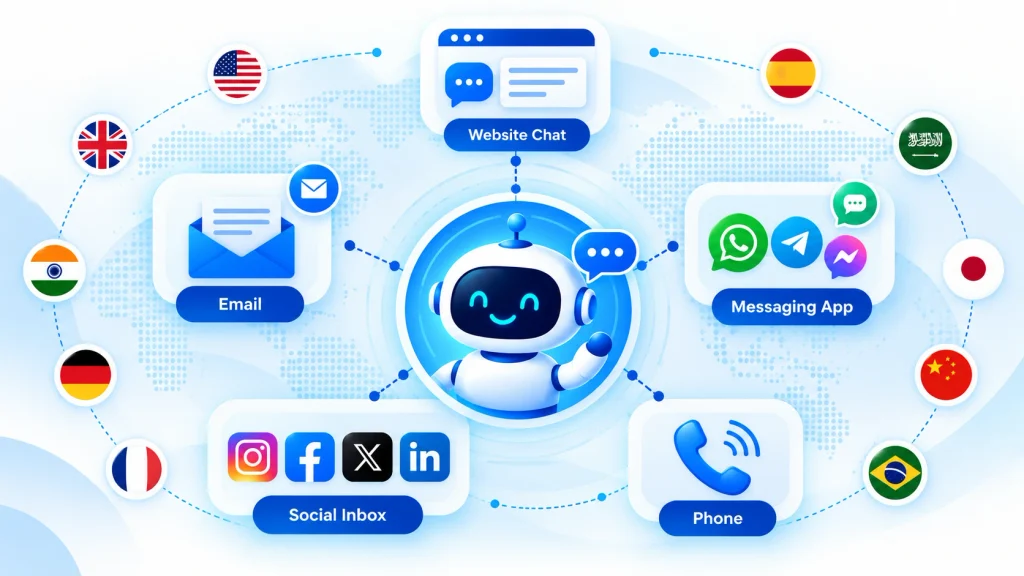
Omnichannel and Multilingual Support Across Every Touchpoint
Shoppers move between website chat, email, social messaging, marketplaces and voice. A fragmented setup forces repeated explanations and produces contradictory answers.
One Brain Across Every Channel
A single knowledge base and one customer identity should power every channel. Policy changes then appear everywhere at once, and conversation history follows the shopper from a chat window to an email thread without gaps.
Language Coverage and Tone Control
Cross-border stores need accurate replies in several languages. Translation quality varies by language, so native speakers should review high-volume intents before launch. Consistent tone rules keep the brand voice steady in every market.
Accessibility Standards
Chat widgets must work with keyboards and screen readers. The Web Content Accessibility Guidelines give practical criteria for contrast, focus order and text alternatives. An always-visible route to a human agent supports shoppers who find automated flows difficult.
Cost, ROI and Metrics of AI Customer Support for Ecommerce
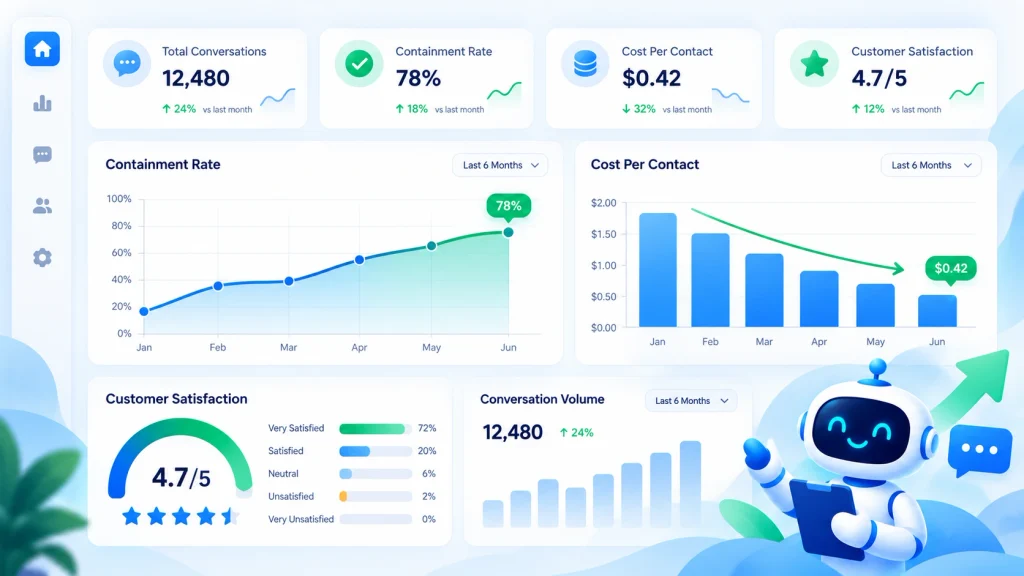
Leaders evaluating AI customer support for ecommerce need numbers, not promises. A simple model keeps expectations realistic.
A Simple Cost Model
Consider a store with 10,000 monthly contacts. If a human-handled contact costs $5 and an automated contact costs $0.50, containing 40% of volume saves 4,000 × $4.50, or $18,000 per month.
Figures are illustrative, yet the formula shows where savings come from: volume, containment and cost gap.
Metrics That Matter
- Containment rate: share of conversations resolved without an agent
- First contact resolution: issues solved in a single interaction
- Customer satisfaction score: rating collected after each case
- Average handle time: drops sharply with agent assist
- Escalation accuracy: share of handoffs that truly needed a human
- Revenue influenced: orders completed after a support interaction
Industry research such as the Salesforce State of Service report, Gartner customer service research and McKinsey operations insights offers benchmarks for comparing results.
Revenue Protection at Checkout
Support quality also affects sales. Data from the Baymard Institute cart abandonment research shows that unexpected costs and checkout complexity drive many lost orders. An assistant that answers delivery and payment questions instantly protects revenue that slow email replies would lose.
Platform Fit: Magento, Shopify, WooCommerce, BigCommerce, Adobe Commerce and Headless
Each platform offers a different integration path. Choosing a platform for AI customer support for ecommerce depends on catalog size, customization needs and engineering capacity.
Shopify
Shopify offers a large app ecosystem and a well-documented Admin API. Launch is fast, though deep customization has limits.
WooCommerce
WooCommerce pairs open plugins with a flexible REST API. Hosting quality strongly affects response speed, so server resources deserve early attention.
BigCommerce
BigCommerce provides open SaaS APIs with strong catalog and webhook support, which suits assistants that need real-time product and order data.
Magento and Adobe Commerce
Magento and Adobe Commerce expose GraphQL, REST and events through the Adobe developer documentation. Flexibility is the highest of any option, along with the engineering demand.
Large catalogs, B2B pricing and multi-store setups often point toward magento enterprise development, where custom modules expose order, customer and inventory data to an assistant securely.
Teams planning magento ecommerce development from scratch should include support data requirements in the first architecture review. Specialist adobe commerce development services connect service tools to quotes, company accounts and approval workflows that off-the-shelf plugins rarely cover.
Headless Commerce
A headless stack is API-first and works with any front end. Full control comes with more integration work, a trade-off covered further in the technical section below.
Technical Foundation: Backend, APIs and Performance
API Integration for Accurate Answers
An assistant is only as accurate as the systems feeding it. Order, inventory, shipment, loyalty and subscription data must be available through stable endpoints with clear permissions.
Mature ecommerce api integration services define authentication, rate limits, error handling and audit logs, so an assistant reads data safely and acts only within approved scope. GraphQL suits such work well, since one query can return exactly the order and customer fields needed.
Speed and Core Page Performance
A chat widget adds scripts to every page. Poorly loaded widgets slow rendering and hurt conversion.
Ecommerce performance optimization should treat support tools as a measured budget: lazy loading, deferred initialization and regular audits with Google Lighthouse. Stores on Adobe’s platform gain from magento 2 performance optimization such as full-page caching, optimized indexing and lean front-end bundles.
A managed setup like magento 2 commerce cloud adds built-in scaling and monitoring, described in the Adobe Commerce on cloud infrastructure documentation.
Headless Architectures
Decoupled storefronts separate presentation from commerce logic, which makes conversational interfaces easier to embed across web, app and messaging channels.
Headless ecommerce development also lets one support layer serve every touchpoint through shared APIs. The MACH Alliance outlines the composable principles behind such builds.
Common Mistakes in AI Customer Support for Ecommerce and How to Avoid Them
Even strong teams stumble when launching AI customer support for ecommerce. Most failures trace back to a short list of avoidable errors.
Strategy Mistakes
- Launching without escalation rules. Shoppers with urgent problems get trapped in loops. Fix: define triggers and a visible human option before go-live.
- Automating sensitive cases too early. Chargebacks, safety issues and large refunds need judgment. Fix: start with low-risk intents and expand slowly.
- Hiding the human option. Buried contact links breed anger. Fix: keep an agent request available in every flow.
Technical Mistakes
- Feeding outdated policies to the assistant. Old return windows produce wrong promises. Fix: assign an owner for knowledge upkeep and review monthly.
- Skipping integration work. An assistant with no live data guesses. Fix: invest in ecommerce api integration services and a clean ecommerce backend before chasing advanced features.
- Ignoring page speed. Heavy widgets lower conversion. Fix: apply ecommerce performance optimization and test every script change.
Measurement Mistakes
- Tracking containment only. High containment can mask abandoned shoppers. Fix: pair it with satisfaction, repeat contact rate and escalation accuracy.
- Never reading transcripts. Dashboards miss nuance. Fix: review a sample of conversations every week.

Building a Commerce Website with Support Designed In
A new commerce website gains most when service design starts alongside catalog and checkout planning. Key decisions include:
- Clean, structured product attributes that an assistant can quote
- Policy pages written in plain, unambiguous language
- Event hooks for orders, returns and shipments
- A unified customer identity across channels
- Role-based access for agents and automated tools
Whether the build uses magento ecommerce development, a SaaS platform or headless ecommerce development, retrofitting such foundations later costs far more than planning them upfront.
Rollout Roadmap for AI Customer Support for Ecommerce
- Audit: rank inbound contact reasons by volume and risk.
- Pilot: automate two or three low-risk intents, such as order status and return eligibility.
- Ground: connect approved knowledge and live store data.
- Test: run adversarial prompts, edge cases and multilingual checks.
- Shadow launch: let AI draft replies while agents approve.
- Expand gradually: add intents only when accuracy and satisfaction hold.
- Review monthly: update knowledge, thresholds and escalation rules.
Visibility in AI Search: AEO and GEO Practices for Support Content
Shoppers increasingly ask conversational questions in AI search tools and voice assistants. Support content about AI customer support for ecommerce earns citations when it is clear, structured and factual.
Effective practices include short definitions at the top of help articles, one question per heading, consistent policy wording across pages and visible authorship. Google’s guidance on creating helpful, people-first content supports the same approach.
Naming the brand, return window, shipping regions and contact methods explicitly helps generative engines attribute answers correctly. Fresh dates and original data strengthen trust signals further.
Frequently Asked Questions
What is AI customer support for ecommerce?
It is the use of chatbots, virtual agents and automation to answer shopper questions, process returns, track orders and hand complex issues to humans.
Is AI customer support for ecommerce suitable for small stores?
Yes. Small stores benefit from instant order and return answers without hiring extra staff, and many platform apps allow a low-cost start.
Which tasks suit automation best?
Order tracking, return eligibility, shipping policy questions, product specification lookups and account help suit automation best, since answers rely on clear rules and structured data.
When should a conversation move to a human agent?
Escalation fits when a shopper requests a person, shows strong frustration, repeats a failed request, raises legal or safety concerns, or involves a high-value order or refund.
Does AI customer support for ecommerce replace human agents?
No. Automation absorbs repetitive volume, while agents focus on complex, emotional and high-value cases that need judgment.
Can AI support work on Magento and Adobe Commerce?
Yes. Magento and Adobe Commerce expose GraphQL and REST APIs, events and extensible modules that connect assistants to orders, customers and inventory securely. Teams often pair the setup with magento 2 performance optimization to keep pages fast.
Does a chat assistant slow down a store?
A poorly loaded widget can. Lazy loading, script deferral and regular speed testing keep the impact minimal.
How long does a launch take?
A focused pilot covering two or three intents typically takes a few weeks, while full multichannel rollout with deep integrations takes several months.
Conclusion
AI customer support for ecommerce delivers real gains in speed, coverage and cost when scoped carefully. Order tracking, returns, product guidance and agent assist are proven starting points.
Hallucination, privacy exposure and weak integrations remain real risks, and clear human escalation rules keep automation from damaging loyalty. Retailers that invest in a sound ecommerce backend, reliable APIs and measured performance build support that shoppers actually trust.
For help planning an architecture, explore custom ecommerce development services and Magento performance audits.