

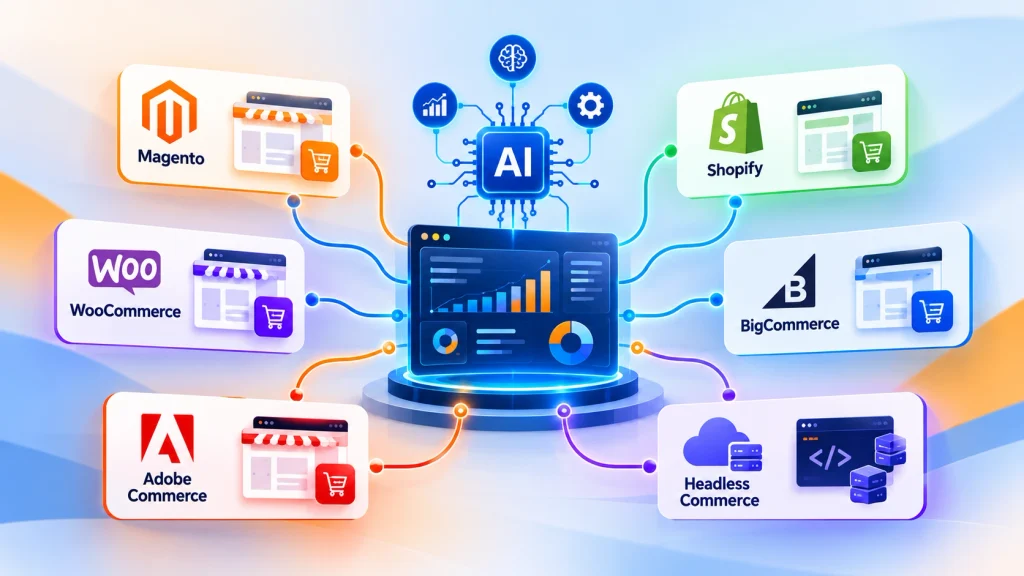
AI implementation ROI is the financial return that artificial intelligence delivers compared with the full cost of building, integrating, and running it. Accurate measurement needs clean baselines, reliable attribution, and a cost model that extends beyond software licences. Retailers on Magento, Shopify, WooCommerce, BigCommerce, Adobe Commerce, or a headless architecture face the same challenge. Spending must be proven to create profit, not just activity.
Quick Answer: AI implementation ROI equals net gain (incremental revenue plus cost savings minus total investment) divided by total investment, multiplied by 100. A pre-launch baseline or a control group keeps the result honest.
What Is AI Implementation ROI in eCommerce?
AI implementation ROI shows how much value AI adds to an online store relative to project cost. Common use cases include product recommendations, dynamic pricing, search personalization, chatbots, demand forecasting, fraud detection, and automated content creation.
Short answer: AI ROI is the profit produced by AI features after subtracting development, integration, data, and maintenance costs.
A paid ad campaign delivers value in one place. AI works differently, because value appears in several layers at once. Conversion improves. Order value grows through smarter bundling. Operating costs shrink through automation. A complete measurement approach captures all three.
Why Measuring AI Implementation ROI Matters
Many AI budgets are approved on promise rather than proof. As a result, weak tools stay live while strong tools never receive extra funding. Reliable data supports four decisions:
- Which AI features deserve expansion
- Which pilots should end
- How engineering and marketing time should be split
- How spending is justified to finance leaders
Measurement also guards against vanity metrics. A chatbot with thousands of conversations looks impressive. Only resolved tickets, retained revenue, and saved support hours reveal real return.
The Core Formula for AI Implementation ROI
The standard return on investment formula is simple:
AI ROI (%) = ((Total Return − Total Investment) ÷ Total Investment) × 100
Accuracy depends on how each side of the equation is built.
Calculating Total Investment
Total investment covers every cost tied to the AI initiative:
- Software licences, API usage fees, and model hosting
- Development and integration labour
- Data preparation, cleaning, and storage
- Cloud infrastructure and compute
- Staff training and change management
- Monitoring, retraining, and maintenance
Hidden costs, such as data engineering and model tuning, often exceed licence fees. Leaving them out inflates ROI and damages credibility.
Calculating Total Return
Total return combines direct and indirect gains:
- Incremental revenue: extra sales attributed to AI features
- Average order value lift: gains from recommendations and bundles
- Cost savings: fewer support hours, lower return rates, less manual merchandising
- Loss prevention: fraud blocked and stockouts avoided
- Retention value: higher repeat purchase rate and customer lifetime value
Only incremental gains count. Revenue that would have happened without AI must be excluded.
Payback Period and Time to Value
Percentage ROI tells only part of the story. The payback period shows how quickly spending is recovered, and a quick glossary of payback period logic helps finance teams compare projects on equal terms.

Key Metrics for Tracking AI Implementation ROI
A balanced scorecard prevents narrow conclusions. Metrics fall into three groups.
Revenue Metrics
- Conversion rate for exposed versus unexposed sessions
- Average order value and items per order
- Revenue per visitor
- Click-through rate on AI recommendations
- Cart abandonment recovery rate
Traffic and conversion data can be pulled from Google Analytics. Benchmarks from Baymard Institute cart abandonment research show whether recovery tools beat typical results.
Efficiency Metrics
- Support tickets resolved without human help
- Hours saved on product descriptions and catalogue tagging
- Forecast accuracy and inventory turnover
- Time needed to launch new campaigns
Customer Experience Metrics
- Customer satisfaction and Net Promoter Score
- Repeat purchase rate
- Search success rate and zero-result searches
- Return rate on AI-recommended products
Market-level growth context is available through U.S. Census Bureau retail eCommerce data.
Building a Baseline Before AI Goes Live
Every ROI calculation depends on a trustworthy “before” picture. A baseline should span 8 to 12 weeks and include normal trading plus seasonal peaks.
Short answer: A baseline is the recorded performance of key metrics before AI launches, used as the comparison point for every later gain.
Steps for a reliable baseline:
- Document conversion rate, average order value, support volume, and operating costs.
- Segment results by device, traffic source, and customer type.
- Record seasonality and promotional calendars.
- Freeze other major site changes during the measurement window.
Attribution Methods That Isolate AI Impact
Attribution separates AI-driven gains from everything else happening in the store.
- A/B testing: Half of visitors see the AI experience, and half see the standard version. Guidance from Harvard Business School Online on A/B testing explains the design.
- Holdout groups: A small share of traffic never sees AI features, which tracks long-term lift.
- Before-and-after comparison: However, this method is useful when testing is impossible, although seasonal changes can distort the results.
- Incrementality testing: Measures conversions that would not have happened without the AI touchpoint.
- Cohort analysis: Compares customers who used AI features with matched customers who did not.
Small samples and short tests produce misleading lift figures. Therefore, teams should report results only after they reach statistical significance.
Measuring AI Implementation ROI by eCommerce Platform
Each platform offers different tooling, data access, and customization depth. Measurement strategy should match the architecture.
Magento Enterprise Development and Adobe Commerce
Large catalogues and complex B2B workflows make Magento and Adobe Commerce strong candidates for AI-driven search, pricing, and recommendations. Investment tracking should include extension licences, custom module work, and hosting.
Teams investing in Magento enterprise development or Magento eCommerce development should tie each AI module to a defined metric before deployment. Stores on Magento 2 Commerce Cloud gain staging environments that make controlled experiments easier. Extension points and data access patterns are documented in the Adobe Commerce developer documentation. Specialist Adobe Commerce development services can build the tracking layer that connects AI events to revenue data.
Shopify
The Shopify app ecosystem allows rapid AI adoption, yet subscription costs add up fast. Each app’s monthly fee should be compared with the revenue attributed to it. Built-in reporting options are explained in the Shopify Help Center. Adding UTM tagging makes experiment tracking cleaner.
WooCommerce
WooCommerce offers flexibility through plugins and custom code. Furthermore, teams manage hosting and performance themselves, so they must include infrastructure costs in the total investment. The official WooCommerce documentation describes analytics and extension options for event tracking.
BigCommerce
BigCommerce pairs open APIs with multi-storefront capability. AI initiatives can be measured per storefront, which allows clean comparisons between markets. The BigCommerce developer center outlines webhook and API options for pulling order and behaviour data into analytics tools.
Headless eCommerce Development
Decoupled storefronts give full control over where AI components run and how events are captured. Projects built through headless eCommerce development can instrument every interaction at the API layer. As a result, attribution becomes clearer and easier to manage than in monolithic setups. Composable principles are outlined by the MACH Alliance. The trade-off is higher build and maintenance cost, which must appear in the investment calculation.
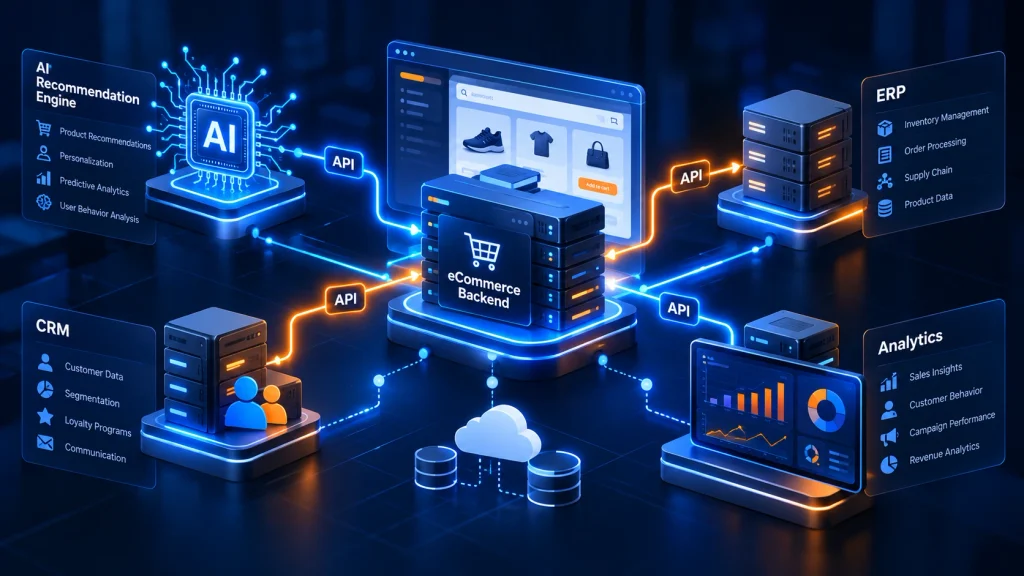
eCommerce Backend and API Integration for Accurate AI ROI
Measurement quality depends on data quality. A fragmented ecommerce backend with disconnected order, inventory, customer, and marketing systems produces unreliable ROI figures.
Strong data foundations include:
- A unified customer identifier across channels
- Consistent event names and tracking schemas
- Real-time sync between catalogue, inventory, and AI services
- Server-side event capture to reduce data loss from browser restrictions
Professional eCommerce API integration services connect AI engines, ERPs, CRMs, and analytics platforms. Revenue, cost, and behaviour data then flow into one reporting layer. Poor integration is among the most common reasons AI projects appear to underperform.
Performance Optimization as an AI Implementation ROI Multiplier
AI features add scripts, API calls, and processing load. Slow pages erode the gains AI is meant to create. Faster storefronts convert better, so speed work directly lifts AI implementation ROI.
Short answer: Site speed influences conversion, so performance bottlenecks reduce the measurable return from AI features.
Key actions include:
- Loading AI widgets asynchronously
- Caching recommendation and search responses
- Tracking Core Web Vitals with web.dev guidance and testing pages in PageSpeed Insights
- Prioritizing ecommerce performance optimization before and alongside AI rollouts
- Applying Magento 2 performance optimization practices, such as full-page caching, database tuning, and efficient indexing
Page speed tracked beside conversion metrics reveals whether AI features help or hinder the shopping experience.
Common Mistakes When Measuring AI Implementation ROI
- Ignoring hidden costs: data work, maintenance, and retraining are often omitted.
- Measuring too early: models improve with data, so a two-week window understates long-term value.
- No control group: gains cannot be separated from seasonality and promotions.
- Tracking vanity metrics: impressions and interactions do not equal profit.
- Ignoring margin: revenue lift on low-margin products may produce little real return.
- Skipping governance: the NIST AI Risk Management Framework shows how unmanaged risk creates hidden cost through errors, bias, and compliance issues.
Steps to Create an eCommerce Website Ready for AI ROI Tracking
Retailers planning to create an eCommerce website with AI in mind can build measurement in from day one:
- Define business goals and the metrics that represent them.
- Choose a platform that matches scale, budget, and customization needs.
- Plan analytics, event tracking, and a consistent data schema before development.
- Select a modular architecture so AI components can be tested and replaced.
- Set baselines and testing infrastructure before launch.
- Schedule monthly ROI reviews and quarterly strategy updates.
Early planning avoids expensive retrofitting after AI features are already live.
Tracking AI-Driven Discoverability as a Return Signal
Shoppers increasingly find products through conversational assistants and AI-generated search summaries. Visibility in those answers is now a measurable return signal. Google explains how AI features appear in Search, which helps shape content for answer-style results.
Practical ways to monitor and improve discoverability:
- Review impressions, clicks, and query patterns in Google Search Console for question-style searches
- Mark up FAQ content with Schema.org FAQPage
- Write concise, factual answers directly under question-based headings
- Keep product, pricing, and policy details consistent across the site and external listings
- Track branded mentions and referral traffic from AI assistants in analytics

Frequently Asked Questions About AI Implementation ROI
What is a good AI implementation ROI in eCommerce?
A good return pays back total investment within a defined period, commonly 6 to 18 months, while beating alternative uses of the same budget.
How long does it take to see AI implementation ROI?
Recommendations and chatbots can show lift within 8 to 12 weeks. Forecasting or custom models may need 6 to 12 months to reach payback.
Which metrics matter most for AI ROI in online stores?
Conversion rate, average order value, revenue per visitor, support cost per ticket, return rate, and customer lifetime value.
How can AI ROI be separated from seasonal sales growth?
A/B tests and holdout groups compare exposed and unexposed shoppers during the same period, which removes seasonal noise.
Does platform choice affect AI implementation ROI?
Yes. Architecture determines integration cost, data access, testing flexibility, and speed. Magento and Adobe Commerce suit complex catalogues, Shopify and BigCommerce favour fast deployment, WooCommerce offers flexibility, and headless setups give maximum control at higher build cost.
What costs are commonly missed in AI ROI calculations?
Data preparation, integration work, model retraining, monitoring, cloud compute, and staff training.
Can small eCommerce stores measure AI ROI effectively?
Yes. Built-in analytics, simple A/B tests, and monthly before-and-after comparisons are enough to judge individual tools.
Why does site speed matter for AI ROI?
AI features add processing load. Slower pages lower conversion, which cancels gains from personalization.
How does backend integration influence AI ROI measurement?
Connected systems supply unified, accurate data. Fragmented backends cause incomplete attribution and unreliable figures.
How can AI visibility in search and assistants be improved?
Question-based headings, concise factual answers, structured data, consistent product information, and regular Google Search Console monitoring raise the chance of appearing in search results and AI-generated answers.
Conclusion
Measuring AI implementation ROI in eCommerce demands discipline. A full cost model, a clean baseline, controlled experiments, and profit-linked metrics form the foundation. Platform choice shapes the tooling, yet the principles stay constant across Magento, Adobe Commerce, Shopify, WooCommerce, BigCommerce, and headless builds.
Strong backend integration and fast storefront performance protect the gains AI creates. Structured, answer-ready content extends reach into search and AI-driven discovery. Retailers that measure rigorously can scale winning initiatives with confidence and retire weak ones quickly.