

AI product data enrichment is the use of machine learning, natural language processing and computer vision to complete, correct and standardize catalog information at scale. Online stores with thousands of SKUs often struggle with missing specifications, mismatched naming and conflicting values across supplier feeds. Automated attribute extraction, validation and normalization replace slow manual cleanup. The outcome is a catalog that ranks higher, converts better and feeds every sales channel with trustworthy information.
Product data is no longer a back-office chore. Search, filtering, recommendations, marketplace feeds and AI shopping assistants all depend on it.
Key Takeaways
- Enrichment fills missing attributes, fixes wrong values and standardizes formats across the whole catalog.
- Complete, consistent attributes improve on-site search, layered navigation, ad feeds and structured data.
- Validation rules plus human review keep automated output accurate.
- Platform-aware mapping is essential for Magento, Adobe Commerce, Shopify, WooCommerce, BigCommerce and headless builds.
- Clean, structured facts also raise visibility in AI-generated answers and conversational search.
What Is AI Product Data Enrichment?
AI product data enrichment adds missing detail to raw product records and repairs flawed detail already present. A supplier spreadsheet might list a jacket as “Blk Wtrprf Jckt L” with no material, fit or care information. Enrichment models read the title, description and product photos, then produce clean attributes such as color, material, size, gender, season and water resistance rating.
Core capabilities include:
- Attribute extraction: pulling structured values from unstructured titles, descriptions, PDFs and images.
- Normalization: converting “Blk,” “BLACK” and “black/matte” into one approved value.
- Classification: assigning each item to the correct category and taxonomy node.
- Content generation: producing descriptions, bullet points and meta details aligned to brand voice.
- Quality scoring: flagging records that fall below completeness or accuracy thresholds.
How AI Product Data Enrichment Differs from Traditional Data Cleansing
Traditional cleansing relies on fixed rules, find-and-replace macros and spreadsheet formulas. Rules break when a new supplier format arrives. Machine learning recognizes patterns, handles unfamiliar phrasing and improves as reviewers approve or reject suggestions. Rule engines still play a role, but models handle the long tail of messy inputs that rules cannot anticipate.
- Manual editing: slow, inconsistent between editors and very costly at scale.
- Rule-based cleansing: fast, but fragile whenever a new format appears.
- AI-driven enrichment: fast, adaptable to new formats and highly consistent once validation is in place.
Which Data Sources Feed the Process
Enrichment draws from many inputs: supplier spreadsheets, manufacturer datasheets, ERP exports, product photos, user manuals, customer reviews and existing storefront content. Each source carries different reliability. Strong pipelines record the origin of every value so conflicts can be resolved by policy rather than guesswork.
Why Product Attributes Decide Ecommerce Performance
Attributes power almost every shopper interaction. Layered navigation, comparison tables, on-site search relevance, structured data and ad feeds all depend on attribute completeness. A missing “screen size” value removes a television from a filtered search. An incorrect “compatible model” value triggers returns.
Search and Filtering Depend on Attribute Depth
Faceted navigation only works when values are populated and consistent. Stores with sparse attributes show short, unhelpful filter lists. Stores with enriched attributes let shoppers narrow thousands of items in three clicks. Strong attribute depth also helps internal search engines match long, specific queries such as “waterproof trail running shoes wide fit.”
Accuracy Protects Revenue and Trust
Wrong specifications create returns, support tickets and negative reviews. Marketplace policies also penalize mismatched or incomplete listings. Accurate attributes reduce friction before checkout and lower post-purchase costs.
Consistency Builds Brand Credibility
Mixed units, spelling variants and inconsistent capitalization make a catalog look unreliable. Uniform formatting signals professionalism and makes cross-product comparison simple for shoppers.

How AI Product Data Enrichment Improves Product Attributes
Modern pipelines combine several techniques. Each technique targets a specific weakness in raw catalog data.
Extracting Attributes from Text and Images
Language models parse titles and descriptions to detect dimensions, materials, ingredients and compatibility. Vision models analyze photos to identify color, pattern, neckline, heel height or product shape. Combining both signals raises confidence. When text says “navy” and the image shows dark blue, the value is confirmed. When the two disagree, the record is routed for review.
Mapping Values to a Controlled Taxonomy
Free-text values are matched to approved lists. Synonyms, abbreviations and typos collapse into canonical options. A controlled vocabulary keeps filters tidy and keeps feeds compliant with channel requirements such as Google Merchant Center product data rules and marketplace category schemas.
Detecting and Filling Gaps with AI Product Data Enrichment
Completeness scoring highlights which records lack required attributes by category. Models then propose values with confidence scores. High-confidence suggestions publish automatically. Low-confidence suggestions enter a review queue.
Improving Accuracy with Validation and Human Review
Automation without safeguards creates new errors. Reliable AI product data enrichment depends on layered validation.
Rule-Based Guardrails
Business rules catch impossible outputs: a laptop weighing 40 kg, a shoe size outside the category range, or a voltage value attached to a non-electrical item. Unit checks, range checks and mandatory-field checks run after every model pass.
Confidence Thresholds and Human-in-the-Loop Review
Each generated value carries a confidence score. Values above a high threshold publish directly. Mid-range values go to merchandisers for approval. Corrections feed back into the model, raising accuracy over time. Human review is most valuable on high-revenue, high-return or regulated categories such as supplements, electronics and children’s products.
Source Reconciliation
When manufacturer feeds, distributor sheets and internal records conflict, a source-priority policy decides which value wins. Audit logs record where each attribute originated, which simplifies compliance checks and troubleshooting.
Achieving Consistency Across Channels and Storefronts
Consistency matters most when one catalog feeds many destinations: the main website, mobile apps, marketplaces, social shops, comparison engines and B2B portals.
- Unified attribute dictionary: one definition for every attribute, unit and allowed value.
- Locale-aware formatting: automatic conversion between inches and centimeters, or between regional size charts.
- Channel-specific mapping: a single enriched source record transformed into the exact format each marketplace requires.
- Version control: change history for every attribute so rollbacks remain possible.

AI Product Data Enrichment Across Ecommerce Platforms
Every commerce platform stores and exposes attributes differently. A successful strategy respects platform structure instead of forcing a single template.
Magento and Adobe Commerce
Magento relies on attribute sets, attribute groups and EAV architecture. Large catalogs with hundreds of configurable attributes benefit greatly from automated enrichment. Specialized magento enterprise development teams can connect enrichment pipelines to the catalog through APIs, import queues and scheduled jobs. Experienced magento ecommerce development also ensures that new attributes are searchable, filterable and mapped correctly to layered navigation. Businesses planning custom pipelines often rely on adobe commerce development services to align enrichment workflows with extensions, indexers and admin roles.
Attribute growth can slow indexing and category pages, so magento 2 performance optimization must run alongside enrichment. Practical steps include limiting filterable attributes to those shoppers actually use, tuning indexers and caching aggressively. Brands hosted on magento 2 commerce cloud can use staging environments to test bulk attribute imports before pushing changes to production.
Shopify
Shopify uses product options, tags, metafields and metaobjects. Enrichment pipelines write structured values into metafields so themes, search apps and feeds can read them. Limits on variants and options require careful planning when attribute-heavy catalogs are migrated.
WooCommerce
WooCommerce supports global attributes and custom product fields. Enrichment tools populate attribute taxonomies so layered filtering plugins return accurate results. Performance tuning matters on large WordPress catalogs because attribute lookup tables can grow quickly.
BigCommerce
BigCommerce provides custom fields, product options and robust catalog APIs. Enrichment services push cleaned values through the API while respecting rate limits, then trigger feed refreshes for connected channels.
Headless Commerce
Headless storefronts separate the presentation layer from the commerce engine. Clean, well-structured attributes become even more important because front-end applications consume raw API data directly. Headless ecommerce development projects benefit from enrichment at the data layer, where GraphQL or REST responses deliver consistent attribute payloads to web, mobile and kiosk experiences.
Backend Architecture and Integration for Enrichment
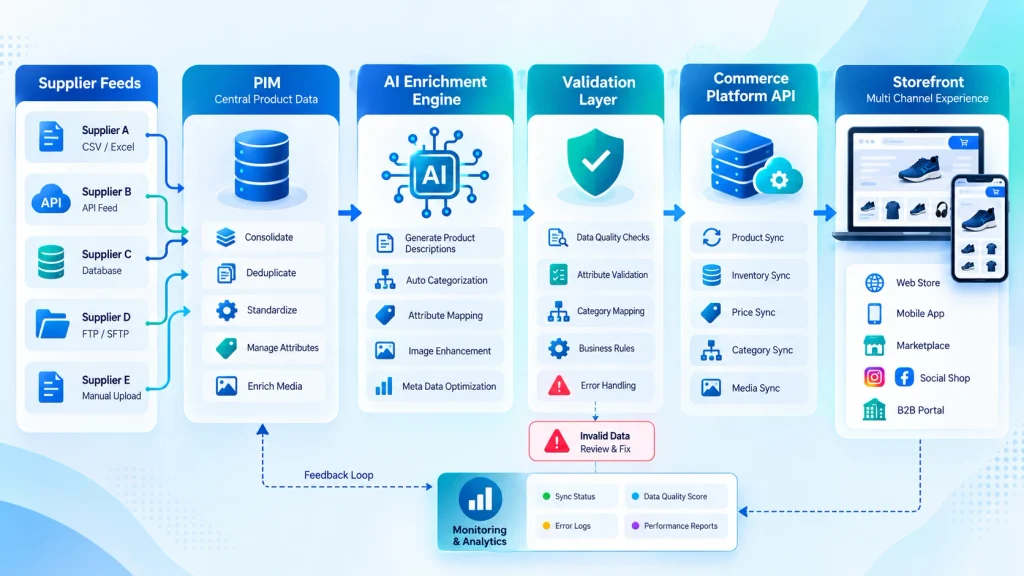
Enrichment quality depends on solid plumbing. A dependable ecommerce backend needs queue-based processing, retry logic, validation layers and monitoring dashboards. Reliable ecommerce api integration services connect PIM systems, ERP platforms, supplier portals, DAM libraries and marketplaces so enriched values flow automatically in both directions.
Recommended architecture principles:
- Keep a single source of truth, typically a PIM or the commerce catalog itself.
- Process enrichment asynchronously so storefront speed stays unaffected.
- Store confidence scores and source tags beside every attribute value.
- Expose enriched data through versioned APIs.
- Monitor failures, drift and unusual value distributions.
Speed matters as much as data quality. Ecommerce performance optimization covers image compression, edge caching, lean queries and efficient attribute indexing, all aligned with Core Web Vitals. Richer catalogs should never come at the cost of slow category pages.
Industry Use Cases for Enriched Product Data
Attribute needs for AI product data enrichment vary sharply by vertical. Vocabularies, rules and review thresholds should be tuned to each category.
Fashion and Apparel
Fashion catalogs depend on visual attributes: fit, neckline, sleeve length, pattern, fabric and occasion. Vision models detect many of these directly from photos. Size normalization across brands and regions removes one of the biggest causes of returns.
Consumer Electronics
Electronics shoppers compare technical specifications line by line. Processor type, memory, port types, battery capacity and compatibility lists must be exact. Enrichment extracts values from datasheets and flags contradictions between manufacturer and distributor sources.
Grocery, Beauty and Health Products
Ingredients, allergens, certifications, dietary labels and usage instructions carry regulatory weight. Automated extraction speeds up onboarding, while mandatory human review protects accuracy on claims and safety information.
B2B and Industrial Catalogs
Industrial buyers search by part number, tolerance, material grade and standard. Catalogs often contain tens of thousands of near-identical items. Enrichment links cross-references, supersessions and compatible parts, which shortens purchase paths for procurement teams.

Governance, Security and Responsible AI in Catalog Data
Automation at scale demands clear ownership and safeguards. Governance keeps AI product data enrichment dependable long after the first rollout.
Data Ownership and Approval Workflows
Every attribute needs an accountable owner, whether merchandising, product management or compliance. Defined approval paths prevent unreviewed changes from reaching live pages. Role-based permissions limit who can edit, approve and publish.
Privacy, Security and Vendor Risk
Catalog data often includes cost prices, supplier terms and unreleased products. Encryption in transit and at rest, access logging and contractual limits on model training protect sensitive records. The NIST AI Risk Management Framework offers a practical structure for assessing risks in automated systems.
Transparency and Claim Safety
Generated descriptions must never invent features, certifications or health claims. Prompt constraints, fact-checking against source records and mandatory review on regulated categories reduce that risk. Disclosure policies should be set according to local advertising and consumer protection rules.
Build, Buy or Partner: Choosing the Right Approach
Three paths exist for delivering enrichment: building in-house, buying a ready-made platform or partnering with a development agency. Each fits a different maturity level.
Criteria for Evaluating Solutions
- Accuracy on the actual catalog: results from a pilot matter more than demos.
- Platform fit: native connectors or APIs for the existing commerce stack.
- Control: ability to edit taxonomies, thresholds and prompts.
- Explainability: visible confidence scores and source tracking.
- Scalability: throughput for large imports and ongoing updates.
- Total cost: licensing, integration effort, review labor and maintenance.
Questions Worth Asking Vendors and Agencies
How are errors detected and corrected? Where does data reside, and is it used to train shared models? Which platforms have been integrated before? How is performance impact on the storefront controlled? Clear answers to those four questions separate mature providers from experimental ones.
Step-by-Step Roadmap for Implementation
- Audit the catalog. Measure completeness, duplication and inconsistency by category.
- Define the attribute model. Establish required attributes, units and allowed values per category.
- Prioritize categories. Begin with high-traffic or high-return product groups.
- Pilot with sample data. Compare automated output against manually verified records.
- Set confidence thresholds and review workflows.
- Integrate through APIs. Connect enrichment to PIM, ERP and storefront.
- Roll out gradually. Expand category by category while tracking quality metrics.
- Retrain and refine. Feed reviewer corrections back into the models.
Measuring the Impact of Enrichment
Clear metrics prove the value of AI product data enrichment and guide tuning:
- Attribute completeness rate per category
- Accuracy rate from sampled audits
- Consistency score based on value variance
- Filter usage and search exit rate
- Conversion rate and revenue per session on enriched products
- Return rate linked to specification errors
- Time to publish for new products
Many retailers see the biggest gains in long-tail products, where manual curation was previously too expensive.
Preparing Product Data for AI Search and Answer Engines
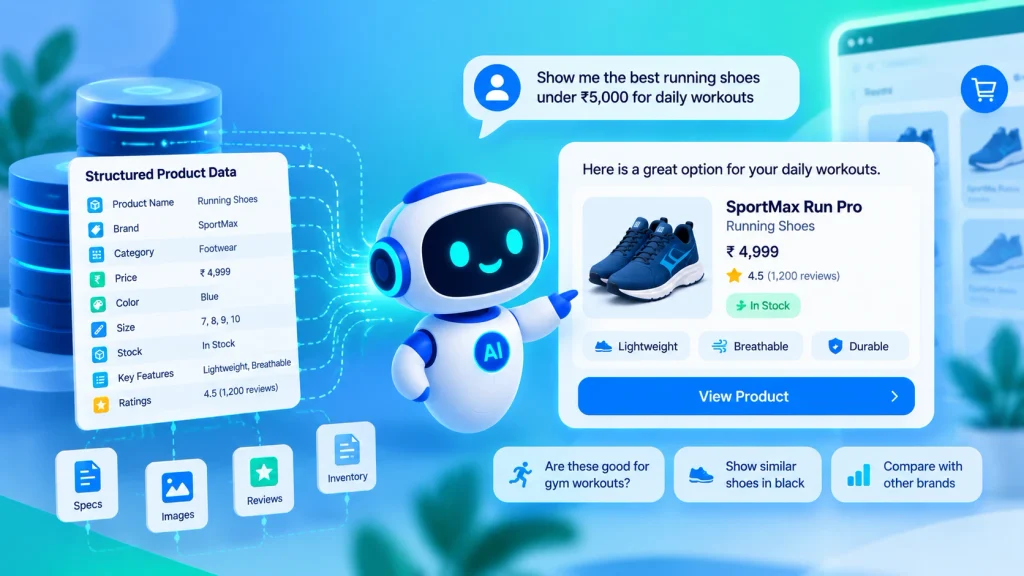
Search is shifting from ten blue links toward generated answers from conversational assistants and AI overviews. Answer engines favor sources with clear entities, explicit facts and structured markup. Enriched catalogs supply exactly that.
Practical steps for stronger visibility in answer engines:
- Publish complete structured data. Implement Product, Offer, Review and Brand markup in JSON-LD with accurate attribute values, following the schema.org vocabulary and Google’s product guidelines.
- Use plain, factual phrasing. Short, specific sentences about dimensions, materials and compatibility are easier for generative systems to quote.
- Add question-and-answer content. Product pages with concise FAQs match conversational queries.
- Maintain identifiers. Valid GTIN, MPN and brand values help systems recognize products as distinct entities.
- Keep facts synchronized. Price, availability and specifications must match across the site, feeds and markup.
- Strengthen entity signals. Consistent brand naming, author attribution and reliable external citations improve trust.
AI product data enrichment supports every one of the signals above, which is why catalog quality now influences visibility in both classic search and generative results.
Common AI Product Data Enrichment Pitfalls to Avoid
- Publishing generated values without validation rules
- Ignoring category-specific attribute requirements
- Allowing duplicate or near-duplicate attribute names to multiply
- Skipping reviewer feedback loops
- Overloading storefront filters with rarely used attributes
- Treating enrichment as a one-time project instead of ongoing governance
Frequently Asked Questions About AI Product Data Enrichment
What is AI product data enrichment?
AI product data enrichment is the automated improvement of product records using machine learning. Missing attributes are filled, inconsistent values are standardized, and errors are flagged for correction, producing complete and reliable catalog data.
How does AI product data enrichment improve accuracy?
Accuracy improves through cross-checking text and image signals, applying validation rules, assigning confidence scores and routing uncertain values to human reviewers. Corrections then train the models further.
Can enrichment work with Magento, Shopify, WooCommerce and BigCommerce?
Yes. Enrichment connects through platform APIs, import tools or a PIM layer. Attribute structures differ by platform, so mapping must respect each system’s data model.
Does enrichment affect site speed?
Enrichment itself runs in the background and does not slow the storefront. Larger attribute sets can affect indexing and filtering, so performance tuning should accompany any major catalog expansion.
Is AI product data enrichment suitable for headless commerce?
Absolutely. Headless front ends consume catalog data directly through APIs, so clean and consistent attributes deliver immediate benefits across every channel.
How long does implementation take?
A focused pilot on a few categories often takes a few weeks. Full catalog rollout depends on catalog size, data quality, integrations and review workflow design.
Does enrichment replace merchandisers?
No. Automation handles repetitive extraction and normalization, while merchandisers focus on strategy, exceptions, brand voice and quality oversight.
How does enriched data help AI search visibility?
Answer engines quote sources with explicit, structured and consistent facts. Enriched attributes, valid identifiers and accurate schema markup make product pages easier to interpret and cite.
Which product data should be enriched first?
Best-selling, high-return and high-margin categories deliver the fastest payback. Long-tail items follow once validation rules and review workflows are proven.
Conclusion
AI product data enrichment turns fragmented catalogs into structured, dependable assets. Complete attributes sharpen search and filtering. Validation raises accuracy. Standardized values keep every channel consistent. Paired with solid architecture, platform-aware mapping, strong governance and performance discipline, enrichment improves conversions, lowers returns and prepares a store for the next generation of AI-driven discovery.
The strongest results come when AI product data enrichment is treated as a continuous program rather than a one-time cleanup. New suppliers, seasonal ranges and marketplace rule changes constantly introduce fresh inconsistencies. Ongoing monitoring, reviewer feedback and regular taxonomy updates keep quality high as the catalog grows.
Brands that adopt AI product data enrichment early gain a durable advantage in both traditional search and answer-based shopping. Practical next steps are simple:
- Audit attribute completeness in the top revenue categories.
- Define required attributes, units and allowed values.
- Pilot automated extraction with validation and human review.
- Connect the enriched source to every storefront and feed through APIs.
- Track completeness, accuracy, conversion and return rate every month.
Clean, complete and consistent product data supports shoppers, search engines and AI assistants alike, and the investment compounds with every product added.