
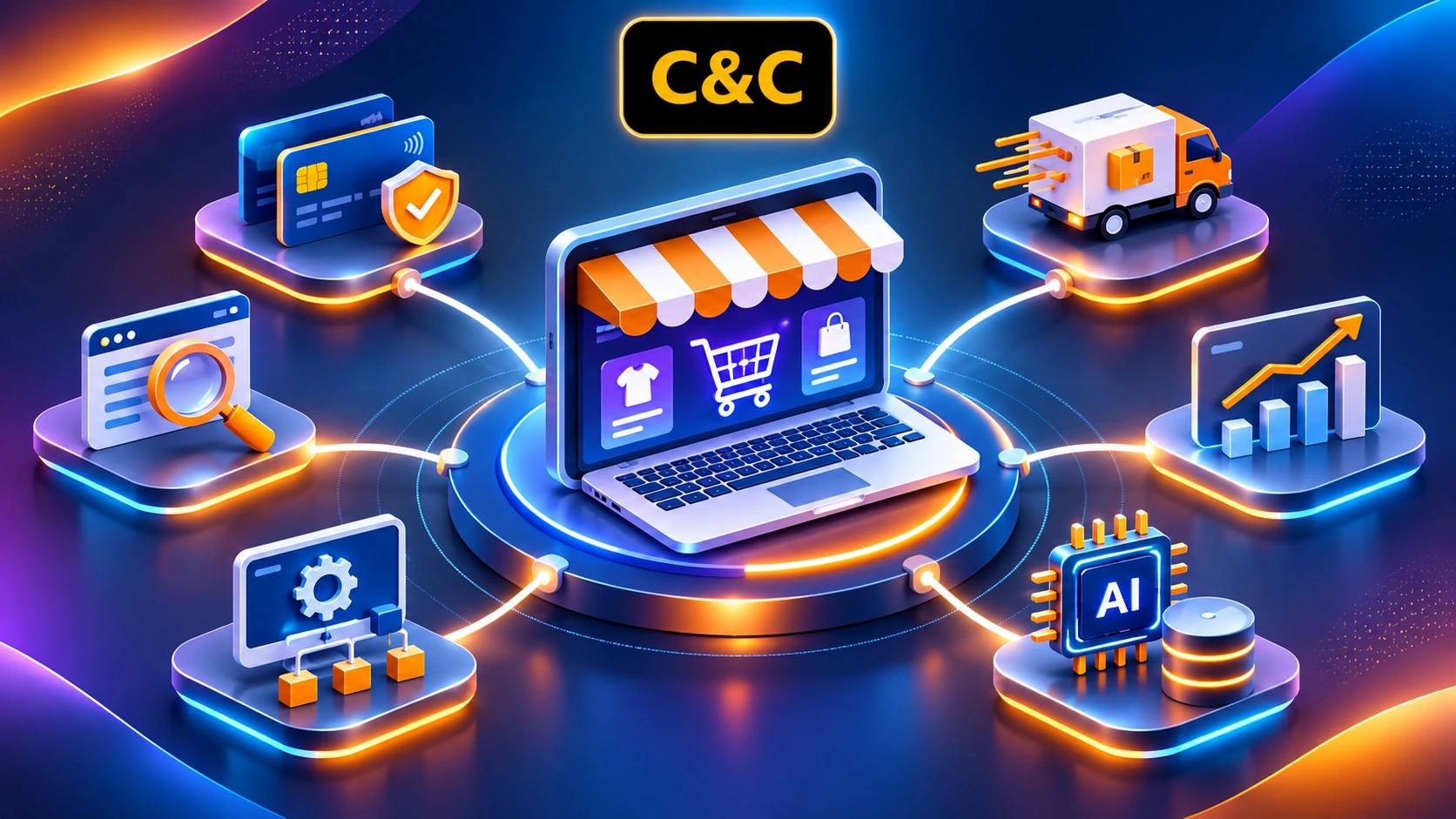
Ecommerce vendor management is the discipline of choosing, contracting, connecting, monitoring, and retiring the outside technology partners behind an online store. Payment gateways, search tools, tax engines, ERP connectors, review apps, and development agencies all belong to the stack. Every partner adds cost, risk, and dependency. A store running dozens of apps without a named owner for each usually ends up slow, fragile, and expensive to change.
What Is Ecommerce Vendor Management?
Quick answer: Ecommerce vendor management is a repeatable process for selecting, governing, and replacing third-party technology partners. As a result, businesses can protect store speed, strengthen security, and maintain revenue while managing external services effectively.
Short answer: Know every vendor, assign an owner, measure performance, and keep an exit plan ready.
A complete program answers five questions for each vendor:
- What business problem does the vendor solve?
- Who owns the relationship internally?
- What customer or product data is shared?
- Which metric proves the vendor is worth the price?
- How can the vendor be removed without downtime?
Why Do Third-Party Technology Vendors Need a Formal Process?
Quick answer: Unmanaged vendors slow pages, widen security gaps, and inflate monthly spend.
Most stores add vendors one urgent request at a time. For example, a marketer might introduce a popup tool, while a developer installs a shipping plugin. Meanwhile, an agency may add another tracking script. As a result, within a year, nobody can clearly explain why so many scripts load during checkout or whether they are still necessary.
Four problems appear again and again:
- Hidden speed cost. External scripts compete for load time, which affects conversion and rankings. Google’s Core Web Vitals documentation explains the metrics that outside code can damage, and the MDN web performance guide covers measurement fundamentals.
- Security exposure. Each vendor with data access widens the attack surface. The OWASP Top Ten and the OWASP API Security project list weaknesses common in insecure plugins and integrations.
- Privacy liability. Vendors that process shopper data create legal duties. The GDPR information portal outlines processor obligations, and the FTC privacy and security guidance covers expectations for US businesses.
- Contract drift. Auto-renewals, unused seats, and overlapping tools quietly raise costs.
Supply chain thinking from the public sector fits commerce well. NIST’s supply chain risk management publication offers a supplier assessment framework that adapts easily to store technology.
How Does Vendor Risk Differ Across eCommerce Platforms?
Quick answer: Platform architecture decides which vendors matter most. Shopify leans on app developers, Magento on module authors and hosting partners, and headless builds on many API providers at once.
Magento and Adobe Commerce
Open-source Magento offers deep customization, yet every extension is code that must be reviewed, patched, and upgraded. Businesses relying on magento enterprise development or magento ecommerce development partners should demand code ownership clauses, coding standard compliance, and documented deployment procedures.
Quick answer (Magento 2 vs Adobe Commerce Cloud): Open-source Magento 2 gives full control with full responsibility. Adobe Commerce Cloud moves hosting, deployment pipelines, and some security duties to Adobe, which shortens the vendor list but raises the importance of integration quality.
With Magento 2 Commerce Cloud, fewer hosting vendors are needed, yet agencies and extension authors still require oversight. Teams evaluating Adobe Commerce development services should confirm certified developers, upgrade track records, and familiarity with the Adobe Commerce developer documentation and the Adobe Experience League guides.
Speed deserves its own contract clause. Magento 2 performance optimization work such as full-page caching, indexer tuning, and database cleanup should carry measurable targets instead of vague promises.
Shopify
Shopify limits server-side access, so vendor risk concentrates in apps and theme code. App sprawl is the main danger because each installed app can inject storefront scripts. A quarterly audit against the Shopify developer documentation confirms which apps still use supported endpoints.
WooCommerce
WooCommerce runs on WordPress, so plugin quality varies widely. Update frequency, active installs, and support responsiveness are the best early signals of vendor health. Integrations should use the official WooCommerce REST API instead of direct database writes, and plugin authors should follow the WordPress plugin developer handbook.
BigCommerce
BigCommerce favors an API-first model with built-in features that reduce plugin dependence. Reviews should focus on marketplace listings, webhook reliability, and compliance with the BigCommerce developer platform standards.
Headless Commerce Setups
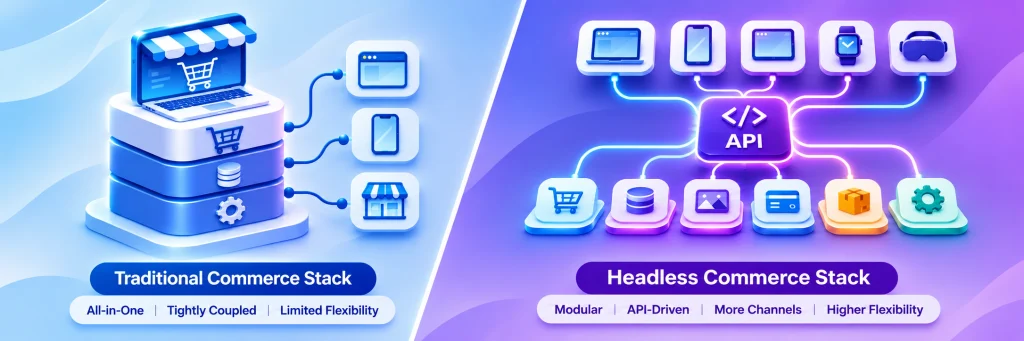
Headless builds separate the storefront from the commerce engine, increasing the number of vendors involved, including a frontend host, content system, search provider, and commerce backend. With Headless eCommerce architecture, businesses can replace individual components more easily when contracts and API specifications are designed for flexibility and future changes. Specifications built on the OpenAPI standard or described through GraphQL make vendor swaps far less painful. A partner for headless ecommerce development should show proven experience with API versioning, caching layers, and observability.
Headless vs Traditional Commerce: Which Needs More Vendor Oversight?
Quick answer: Headless commerce needs more oversight because more vendors and more integration points are involved.
Short answer: Fewer moving parts mean lighter governance. More freedom means heavier governance.
Choosing the right eCommerce platform 2026 depends less on feature checklists and more on how many vendors a team can realistically govern. Headless vs traditional commerce is mainly a question of operational capacity.
| Factor | Traditional Commerce | Headless Commerce |
|---|---|---|
| Number of vendors | Lower | Higher |
| Frontend flexibility | Moderate | Very high |
| Integration workload | Moderate | Heavy |
| Governance effort | Lighter | Heavier |
| Best fit | Small to mid-size teams | Engineering-led brands |
What Is the Best Framework for Ecommerce Vendor Management?
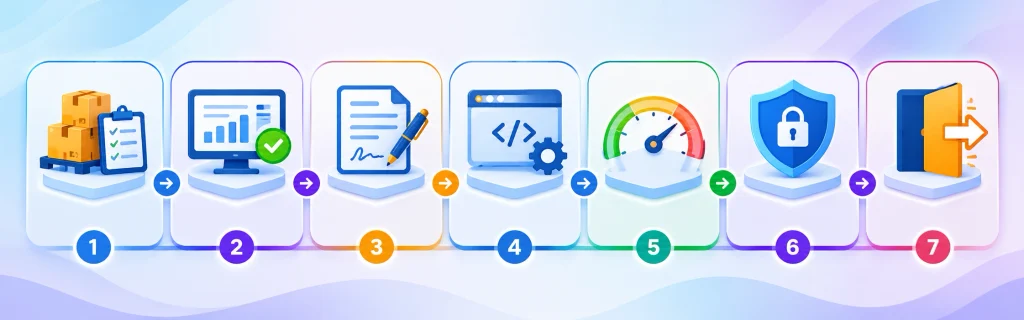
Quick answer: A seven-step cycle works best: inventory, score, contract, integrate, monitor, review, and plan the exit.
Step 1: Build a Complete Vendor Inventory
List every tool, script, plugin, agency, and API connection. Record owner, cost, renewal date, data accessed, and business purpose. Unowned vendors are the first candidates for removal.
Step 2: Score Vendors Before Signing
Use a weighted scorecard covering security posture, performance impact, support quality, pricing clarity, and exit difficulty. Certifications such as ISO 27001 signal mature security practice, and any vendor touching card data should align with the PCI Security Standards Council requirements. Accessibility matters too, so vendor widgets should be checked against the W3C WCAG guidelines.
Step 3: Write Contracts That Protect the Store
Strong agreements include uptime commitments, response times, data ownership, breach notification windows, source code escrow for custom work, and a defined offboarding period.
Step 4: Standardize Integrations and the Ecommerce Backend
Disorganized connections create the most expensive failures. Well-structured ecommerce API integration services use versioned endpoints, retry logic, rate limit handling, and shared logging.
Quick answer: A clean ecommerce backend treats every vendor as a replaceable adapter instead of hard-wiring vendor logic into core code.
The AWS Well-Architected Framework, the Google Cloud Architecture Framework, and the Microsoft Azure Well-Architected guidance all offer reliability patterns worth borrowing.
Step 5: Monitor Speed and Uptime Continuously
Ecommerce performance optimization is an ongoing responsibility, not a one-time project. Track script weight by vendor, measure checkout latency, and set alerts for API timeouts.
Short answer: Any vendor that pushes load time past the agreed budget should face a remediation deadline.
Step 6: Review Security and Compliance Quarterly
Revoke unused access tokens, rotate credentials, confirm patch levels, and review data sharing agreements. Quarterly reviews catch problems long before an incident does.
Step 7: Plan the Exit from Day One
Document how data is exported, which endpoints must be rerouted, and how long migration takes. A vendor that resists exit planning is a warning sign.
How Often Should Vendors Be Reviewed?
Quick answer: Quarterly for security and speed, annually for contracts and pricing.
Short answer: Review sooner after any breach, major outage, or ownership change at the vendor.
How Does Vendor Management Work for AI Product Data Enrichment?
Quick answer: AI product data enrichment vendors need extra scrutiny because catalog data flows into external models. Verify data usage terms, error detection, and export rights before adoption.
AI enrichment tools generate attributes, descriptions, categories, and tags from raw supplier feeds. The value is real, but governance matters. Questions to settle first:
- Which model or provider processes the catalog data?
- Is product data used to train external models?
- How are errors caught before publication?
- Can enriched data be exported if the vendor is replaced?
Treat enrichment output as reviewed content, not final truth. Sampling reviews by a human editor protect brand accuracy. Google’s guidance on helpful, people-first content applies to machine-assisted product copy as well, and structured data should follow schema.org Product markup.
What Are the Most Common Vendor Management Mistakes?
Quick answer: Adding tools without retiring overlapping ones and granting more access than needed.
- Adding tools without removing duplicates
- Granting admin access when read-only access is enough
- Skipping staging tests for vendor updates
- Ignoring renewal dates until the invoice arrives
- Judging vendor value by price instead of revenue impact and risk
- Keeping no record of why a vendor was chosen
Ecommerce Vendor Management FAQ
What is ecommerce vendor management in simple terms?
The process of choosing, supervising, and replacing the outside technology providers behind an online store.
How many vendors should an online store use?
No fixed number exists. The right count is the smallest set that covers business needs, with a named owner for each.
Which platform needs the most vendor oversight?
Headless setups, because separate frontend, backend, search, and content vendors multiply integration points.
What is the biggest risk of third-party plugins?
Unpatched code and heavy scripts that slow checkout while widening the attack surface.
Does vendor management improve ecommerce performance optimization results?
Yes. Removing unused scripts and enforcing speed budgets for each vendor directly improves load time and checkout completion.
How does an ecommerce backend affect vendor risk?
A backend built around replaceable adapters limits damage when a vendor fails, changes pricing, or shuts down.
What is AI product data enrichment, and does it need vendor review?
AI product data enrichment uses models to generate product attributes and descriptions. Vendor review is essential to confirm data usage terms, accuracy checks, and export rights.
What should a vendor scorecard include?
Security posture, speed impact, support quality, pricing clarity, and exit difficulty.
How does vendor management help search and AI visibility?
Faster pages, cleaner structured data, and accurate product information make content easier for search engines and AI answer systems to read and trust.
When should a vendor be replaced?
When performance targets are missed repeatedly, security fixes are delayed, or costs outgrow the revenue the tool produces.
Conclusion
Ecommerce vendor management turns a messy pile of plugins and contracts into a controlled system. Stores that inventory vendors, score them before purchase, standardize integrations, monitor speed, and plan exits protect revenue and gain room to grow. Teams on Magento 2 Commerce Cloud, Shopify, WooCommerce, BigCommerce, Adobe Commerce, or a headless build face the same rule: every vendor must earn its place.