
Headless commerce Black Friday planning comes down to one question: can the storefront, the APIs, and the ecommerce backend stay fast when traffic multiplies within minutes? Black Friday falls on November 27, 2026, and Cyber Monday follows on November 30. A slow page or a failed checkout during those days loses revenue immediately.
Quick answer: Yes, headless commerce can handle Black Friday traffic when pages are served from a CDN, only cart, price, stock, and checkout requests reach the backend, and the full shopper journey has been load tested. Headless does not guarantee performance by itself, and a poorly cached headless storefront can fail faster than a tuned traditional store.
Key Takeaways
- Headless separates the storefront from the commerce backend, so each scales independently.
- Cache hit ratio, not raw traffic, decides how much load reaches the backend.
- Checkout must be protected first, because browsing can degrade gracefully and payment cannot.
- Payment failover, inventory reservations, and monitoring decide whether a sale ends in revenue or refunds.
- A full replatform in the final weeks before a sale is rarely safe.
What Is Headless Commerce, and Why Does Black Friday Test It?
Definition: Headless commerce is an architecture where the customer-facing storefront is separated from the commerce backend and connected to it through APIs. The storefront handles presentation. The backend handles catalog, pricing, inventory, carts, orders, and promotions.
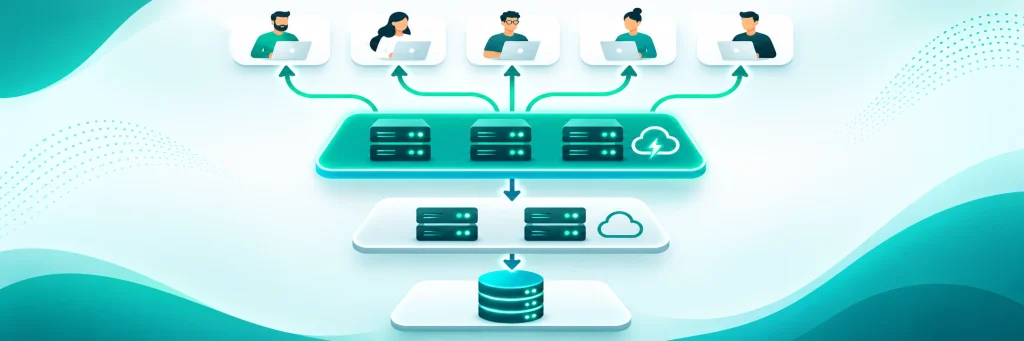
The two parts communicate through REST or GraphQL APIs. A headless eCommerce architecture usually has four layers: the experience layer (website or app), an API and orchestration layer, the commerce backend, and supporting services such as search, payments, tax, and ERP. The MACH Alliance describes the same modular approach. Because each layer scales separately, a surge of product-page views can be absorbed by edge caching without touching the order database.
Headless vs Traditional Commerce
| Factor | Traditional | Headless |
|---|---|---|
| Page delivery | Often rendered by the application server | Pre-rendered pages served from a CDN |
| Scaling | Tiers scale together | Storefront, API, and backend scale separately |
| Main peak risk | Cache misses hitting the database | Cache bypass, API limits, orchestration latency |
| Complexity | Fewer components | More components to monitor |
Short answer: Headless pushes most work to the edge, while a monolith concentrates work on the application server and database.
Can Headless Commerce Handle Black Friday Traffic?
Direct answer: Yes, if most requests never reach the origin. A CDN serves cacheable pages, and the backend receives only the dynamic calls that must be live.
The Cache Bypass Budget
Backend load at peak is roughly storefront requests per second multiplied by the share that bypasses the cache. The figures below are hypothetical and show the mechanics only.
- 10,000 requests per second with a 95% cache hit ratio sends about 500 requests per second to the origin.
- The same traffic with a 70% hit ratio sends about 3,000, six times the load.
Cache hit ratio therefore matters more than headline traffic forecasts.
Where Headless Builds Still Fail
Uncacheable GraphQL queries, personalization on every page, server rendering without a cache, live stock calls on every product card, cache purge storms, heavy third-party scripts, and integrations that use up API limits needed by checkout.
Why Online Stores Fail Under Peak Load
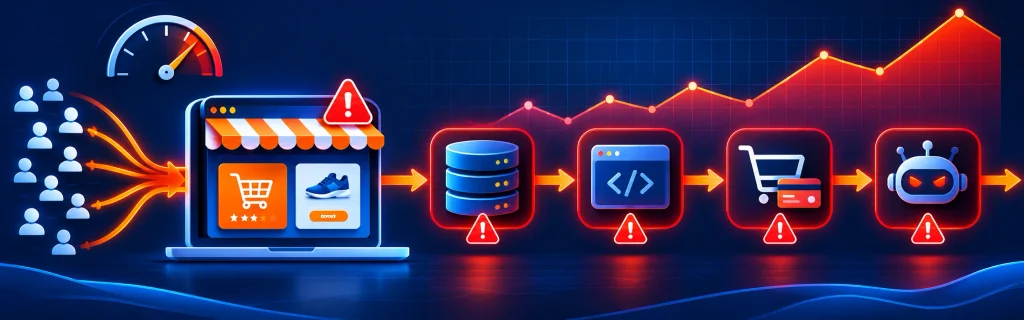
Thousands of shoppers adding the same discounted item cause collisions in inventory and cart writes, and database connections run out. Google’s guidance on handling overload explains why graceful degradation protects critical functions better than serving every request at full fidelity. Slow pages also hurt: Google’s Core Web Vitals set good experience at Largest Contentful Paint within 2.5 seconds, Interaction to Next Paint at or below 200 milliseconds, and Cumulative Layout Shift at or below 0.1. Sale events also attract scalper bots, cataloged by the OWASP Automated Threats project.
Headless Commerce Black Friday Platform Readiness
Magento 2 vs Adobe Commerce Cloud
Choosing between Magento 2 vs Adobe Commerce Cloud largely depends on who manages the infrastructure and operational responsibilities. With Magento Open Source, merchants must handle hosting, scaling, CDN configuration, and performance monitoring themselves or through a hosting partner. In contrast, Adobe Commerce on cloud infrastructure provides Adobe-managed services. The platform also includes Fastly CDN and security services at no additional cost, while Pro projects run across three replicated availability zones. For businesses with large product catalogs, B2B pricing requirements, and multi-store operations, Magento 2 Commerce Cloud can help reduce infrastructure management risks.
The phrase Magento enterprise development is the older name for work now done on Adobe Commerce. Teams hiring for Adobe Commerce development services should ask for proof of load-testing experience. For headless builds, Adobe’s documentation strongly recommends using Fastly to cache GraphQL responses.
Magento 2 Performance Optimization Checklist
Magento 2 performance optimization before a sale usually covers: production mode with pre-deployed static content, Varnish full page cache with Redis for cache and sessions, scheduled indexers run outside peak hours, tuned OpenSearch, disabled unused modules, optimized images through a CDN, and queues for email, exports, and stock sync. Good Magento ecommerce development repeats the list before every sale. Version-specific settings should be confirmed in Adobe’s documentation.
Shopify, BigCommerce, and WooCommerce
Shopify hosts checkout and infrastructure. Its documentation states that buyer traffic through the Storefront API is not rate-limited, but bots and crawlers are rate-limited, with unsigned anonymous bots facing the strictest limits, and checkout creation through the Storefront API is throttled per minute. The GraphQL Admin API uses calculated query cost, so ERP syncs and exports should be batched away from peak hours. See Shopify’s API limits.
BigCommerce is managed, and its headless documentation covers storefront connections. Limits vary by plan and should be confirmed. WooCommerce runs on WordPress hosting, so server capacity, object caching, and plugin quality decide peak readiness, even with the REST API decoupling the front end.
| Platform | Hosting | Headless path | Main peak risk |
|---|---|---|---|
| Magento Open Source | Self-managed | REST and GraphQL | Infrastructure and caching setup |
| Adobe Commerce Cloud | Adobe-managed | GraphQL with Fastly | Custom code, integration load |
| Shopify | Shopify-managed | Storefront API, Hydrogen | Admin API cost limits, bot throttling |
| BigCommerce | BigCommerce-managed | GraphQL and REST | Plan-based API limits |
| WooCommerce | Self-managed | REST API or WPGraphQL | Hosting capacity, plugins |
Details change between releases, so each row should be verified against current vendor documentation.
Building a Headless Stack That Survives Peak Demand

The ecommerce backend deserves the strongest protection. Checkout, payment, and order creation need dedicated capacity and strict timeouts, while recommendations, reviews, and personalization should fail quietly. Reliable ecommerce API integration services use idempotent writes, queued webhooks, and a rate-limit budget for each consumer.
CDN vs Server-Side Caching for Ecommerce
Direct answer: A CDN caches response at the edge near shoppers, while server-side caching stores pages, objects, and queries inside the origin. Stores need both: the CDN absorbs traffic volume, and server-side caching protects the application when the CDN misses.
| Aspect | CDN (edge) | Server-side (origin) |
|---|---|---|
| Main job | Absorb traffic, cut latency | Reduce application and database work |
| Best content | Assets, category and product pages, public API responses | Sessions, fragments, configuration, query results |
| Invalidation | Purge by URL or tag | Cleared by the application |
| Examples | Fastly, Cloudflare | Varnish, Redis, OPcache |
Cart, checkout, and account responses should bypass shared caches entirely. Cache lifetimes follow RFC 9111, and stale-serving directives are defined in RFC 5861, with CDN support varying by provider. Purging by tag instead of flushing everything prevents a purge from sending the whole load to the origin.
Ecommerce API Failure Recovery Strategies
Direct answer: Combine short timeouts, limited retries with backoff and jitter, idempotency keys, circuit breakers, queues for non-urgent work, and graceful fallbacks, so that one failing dependency never blocks checkout.
- Retries: apply only to safe or idempotent calls, with jitter. The AWS Builders’ Library explains why in its guide to timeouts, retries, and backoff.
- Idempotency: Stripe’s documentation explains that the result of the first request with a given key is saved and returned for retries.
- Circuit breakers: stop calls to a failing service temporarily. Martin Fowler’s description is the standard reference.
- Queues: ERP sync, email, and analytics belong in queues, with a dead-letter queue for repeated failures and the outbox pattern for reliable publishing.
- Fallbacks: hide failed reviews, show static bestsellers when recommendations fail, and validate cached stock at add-to-cart.
- Webhooks: acknowledge fast, verify signatures, deduplicate by event ID, and process asynchronously. See Stripe webhooks.
Payment Gateway Failover During Black Friday
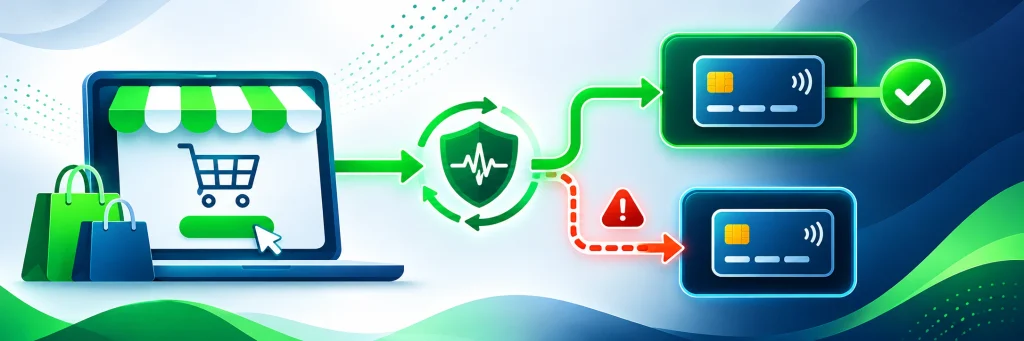
Direct answer: Payment gateway failover automatically routes payment attempts to a secondary provider or method when the primary provider is failing, while preventing double charges. It applies to outages and timeouts, not to normal issuer declines.
The hardest case is a timeout where the card may already have been charged. The safe sequence is:
- Look up the first attempt by idempotency key or order reference.
- If it succeeded, complete the order and skip failover.
- If it failed, route to the secondary provider with a new idempotency key.
- Reconcile all attempts later through webhooks and settlement reports.
A solid setup includes a payment orchestration layer, health checks and circuit breakers per provider, routing rules, and a wallet option as a recovery path. Before the sale, test provider failure in a sandbox, confirm that stored tokens work with the secondary provider (tokens are often provider-specific), review 3-D Secure flows, check PCI scope with the PCI Security Standards Council, and write a manual switch runbook. Shopify’s managed checkout limits custom gateway routing, while Adobe Commerce, BigCommerce, and WooCommerce support multiple payment methods through their own mechanisms, so options should be verified per platform.
Inventory Management and Overselling Prevention
Direct answer: Prevent overselling with one authoritative inventory source, stock validation at add-to-cart and checkout, atomic reservations, hold release on payment failure or cart expiry, and reconciliation after the sale.
A cached storefront may show an item as available after the last unit sells, so the display can be cached but the final decision must come from the inventory service.
| Reserve at | Benefit | Risk |
|---|---|---|
| Add-to-cart | Strong protection for scarce items | Abandoned carts lock stock |
| Checkout start | Balanced for most stores | Needs expiry timers |
| Order placement | Simple | Late failures |
| Payment capture | No unpaid holds | Highest oversell risk |
Adobe Commerce uses reservations: purchased products are reserved against salable quantity until invoicing and shipping, when the reservation converts into a deduction from actual quantity, and compensating reservations place or clear holds as orders ship, cancel, or refund. Commands for fixing inconsistencies are in the Inventory Management CLI guide.
For limited-stock drops, use a waiting room, per-customer quantity limits, bot protection, and hold timers. A hypothetical example: a 50-unit product is shown “In stock” from the CDN, add-to-cart reserves a unit for ten minutes through the inventory service, payment success converts the hold to a sale, and failure or timeout releases it. A scheduled reconciliation between commerce, ERP, and warehouse counts catches drift from extensions or failed payment flows. Teams needing reliable system connections can see inventory and ERP integration services.
Ecommerce Monitoring and Observability
Direct answer: Ecommerce observability combines metrics, logs, and traces across the storefront, API layer, backend, and third parties, with alerts tied to shopper outcomes such as checkout success, not only server health.
Google’s SRE guidance on monitoring distributed systems names four golden signals: latency, traffic, errors, and saturation.
| Layer | What to watch |
|---|---|
| Storefront | Core Web Vitals, JavaScript errors |
| CDN | Cache hit ratio, origin request rate |
| API | p95 and p99 latency, 429 and 5xx counts |
| Backend | Database load, queue depth, checkout duration |
| Payments | Authorization rate, provider errors |
| Business | Checkout conversion, revenue per minute |
Real user monitoring shows actual shopper experience, and synthetic checks run scripted journeys every minute to catch broken flows. OpenTelemetry traces requests end to end. Alerts should fire on shopper-facing symptoms, use thresholds from the store’s own load-test baseline, and route to a named owner with a runbook. For Adobe Commerce Pro projects, the New Relic Logs service can be used to review Fastly CDN and WAF log data, though tooling varies by plan.
Headless Commerce Black Friday Load Testing and Final-Week Plan

Ecommerce performance optimization only counts when verified under load. With a tool such as k6, test full journeys (browse, search, add to cart, promo code, checkout) using production-like data at peak concurrency plus a margin. Fix the biggest bottleneck, retest, then rehearse failure by disabling a dependency and triggering a purge.
- Nine to seven days before: freeze non-essential releases, confirm cache rules, verify API limits.
- Six to four days before: run the full load test, remove non-essential scripts, enable bot protection, test payment failover.
- Three to two days before: check pricing, inventory feeds, analytics tags, and prepare a static fallback page.
- Day before: set the on-call rotation, confirm dashboards, alerts, and rollback steps.
- During the sale: watch errors, latency, cache hit ratio, payment authorization, and checkout conversion, and avoid full-cache purges.
AI Product Data Enrichment for Peak Season
Direct answer: AI product data enrichment uses machine learning to complete missing attributes, standardize values, draft consistent descriptions, and assign categories across a large catalog. Better data improves filtering, reduces returns from unclear specifications, and supports accurate Product structured data. Human review stays essential for materials, compatibility, and safety claims.
Choosing the Right eCommerce Platform in 2026
Choosing the right eCommerce platform in 2026 starts with business needs: large B2B catalogs favor Adobe Commerce, small teams do well on Shopify or BigCommerce, unusual workflows may justify Magento or a composable build, and content-led stores suit WooCommerce. Headless ecommerce development pays off when performance, multi-channel delivery, or design freedom are strategic goals. It is the wrong choice when the catalog is simple, engineering capacity is thin, or launch is close.
Frequently Asked Questions About Headless Commerce Black Friday
Is headless commerce good for Black Friday?
Yes, headless commerce Black Friday setups work well when caching and load testing are done properly. Poor caching removes the benefit.
What is headless eCommerce architecture?
It separates the front end from the commerce backend and connects the two through APIs, so each layer scales independently.
Is Magento 2 or Adobe Commerce Cloud better for peak traffic?
Adobe Commerce Cloud usually carries less operational risk because infrastructure and CDN are managed. Magento Open Source can perform well with expert hosting and caching.
Does the Shopify Storefront API have rate limits?
Shopify states that buyer traffic is not rate-limited, while bots are, and checkout creation is throttled. The Admin API uses cost-based limits.
What is the difference between CDN and server-side caching?
A CDN caches at the edge near shoppers. Server-side caching stores data inside the origin. Stores need both.
What are ecommerce API integration services?
They connect storefronts to ERP, inventory, payment, shipping, and marketing systems, with rate limiting, retries, and monitoring.
What is payment gateway failover?
It sends a payment attempt to a backup provider when the primary fails, with controls that prevent double charges.
Conclusion
Headless commerce Black Friday readiness offers real gains in speed and resilience, but only with disciplined execution. A high cache hit ratio, a protected checkout path, tested payment failover, trustworthy inventory, and clear observability separate stores that profit from peak demand from stores that apologize for outages.