
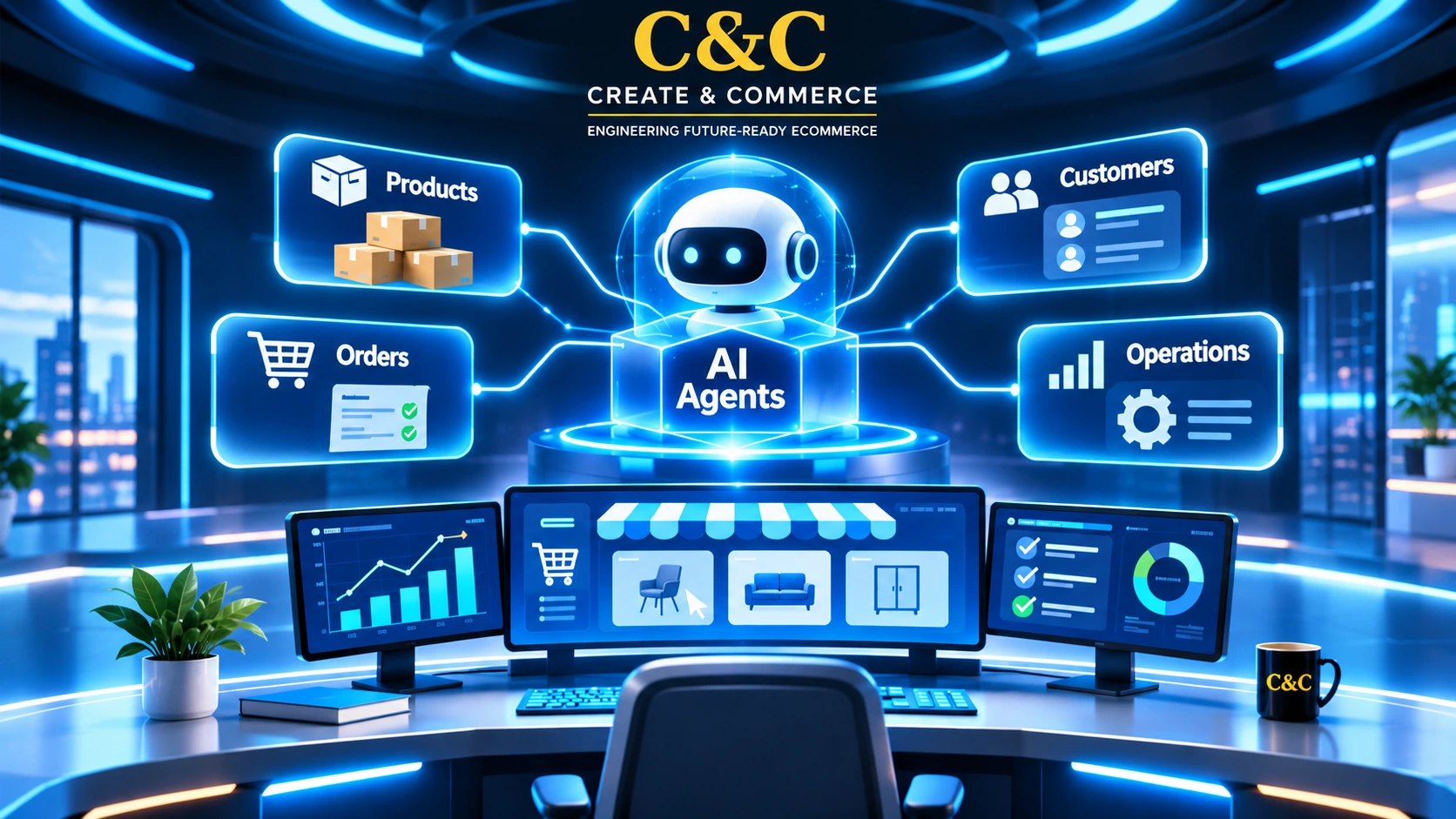
AI agents in ecommerce are autonomous software systems that plan, decide, and act across store operations with minimal manual input. A basic script follows fixed steps. An agent reads data, reasons about a goal, calls tools through APIs, and verifies the result before moving on. Retailers on Magento, Adobe Commerce, Shopify, WooCommerce, and BigCommerce are adopting the approach to remove repetitive work and scale faster.
Quick answer: AI agents automate multi-step eCommerce workflows such as product data enrichment, order routing, customer support, pricing updates, and inventory planning. Results depend on clean APIs, a stable ecommerce backend, and human approval for high-risk actions.
What Are AI Agents in eCommerce?
Short answer: An AI agent is a goal-driven program that combines a language model, business rules, and connected tools to finish tasks without step-by-step instructions.
A chatbot answers questions. An agent completes work. A support agent can read an order, check carrier tracking, issue a refund within policy, and update the CRM in one run. A merchandising agent can scan competitor prices, propose changes, and push approved updates to the catalog.
Three components make the model work:
- Reasoning layer: a large language model that interprets goals and plans steps.
- Tool layer: secured connections to the store, ERP, shipping, and payment systems.
- Memory and rules: business policies, past outcomes, and approval thresholds.
Developer documentation on function calling from OpenAI and Anthropic’s guide to building effective agents explain how tool use works in practice.
Why Do Manual Ecommerce Workflows Break at Scale?
Short answer: Manual workflows fail because catalog size, order volume, and channel count grow faster than headcount.
A store with 50,000 SKUs, five marketplaces, and three warehouses produces thousands of daily decisions. Spreadsheets, copy-paste edits, and email approvals create delays, errors, and stale data. Research from the Baymard Institute places average cart abandonment near 70%, and slow, inconsistent operations add to lost sales through stockouts, wrong prices, and late answers. Usability research from Nielsen Norman Group also shows that inconsistent product information erodes shopper trust.
Which eCommerce Workflows Can AI Agents Automate?
How Does AI Product Data Enrichment Work?
Short answer: Agents write titles, descriptions, attributes, and categories from supplier files and images.
AI product data enrichment fills missing attributes, standardizes units, generates structured descriptions, and flags duplicates. Complete data also supports rich results, since Google’s product structured data guidelines and Schema.org Product markup depend on consistent fields.
Can AI Agents Manage Orders and Fulfillment?
Short answer: Yes. Agents route orders, detect address errors, split shipments, and notify customers about delays.
Exceptions reach a human only when rules cannot resolve the case.
Can AI Agents Handle Customer Support and Returns?
Short answer: Agents resolve status checks, exchanges, and policy questions, then log every action.
Complex or emotional cases move to a person with a full summary attached.
Can AI Agents Control Pricing, Promotions, and Inventory?
Short answer: Agents monitor demand, margin, and stock, then recommend price changes or purchase orders.
Margin floors and approval limits keep decisions safe.
Where Do Fraud Review and Marketing Operations Fit?
Agents score suspicious orders, segment audiences, and draft campaign variants for review. Guidance from Moz and Ahrefs on search-friendly content helps shape the marketing output.
| Workflow | What the AI Agent Does | Human Approval | Risk Level |
|---|---|---|---|
| Product data enrichment | Writes titles, fills attributes, flags duplicates | Sample review | Low |
| Order routing | Selects warehouse, splits shipments, fixes address errors | Exceptions only | Low to medium |
| Customer support | Resolves status checks, exchanges, policy questions | Complex cases | Medium |
| Pricing and promotions | Recommends price changes within margin floors | Required above set limits | High |
| Inventory planning | Forecasts demand, drafts purchase orders | Required for purchase orders | Medium to high |
| Fraud review | Scores suspicious orders, holds risky transactions | Required for cancellations | High |
How Do AI Agents Connect to the eCommerce Backend?
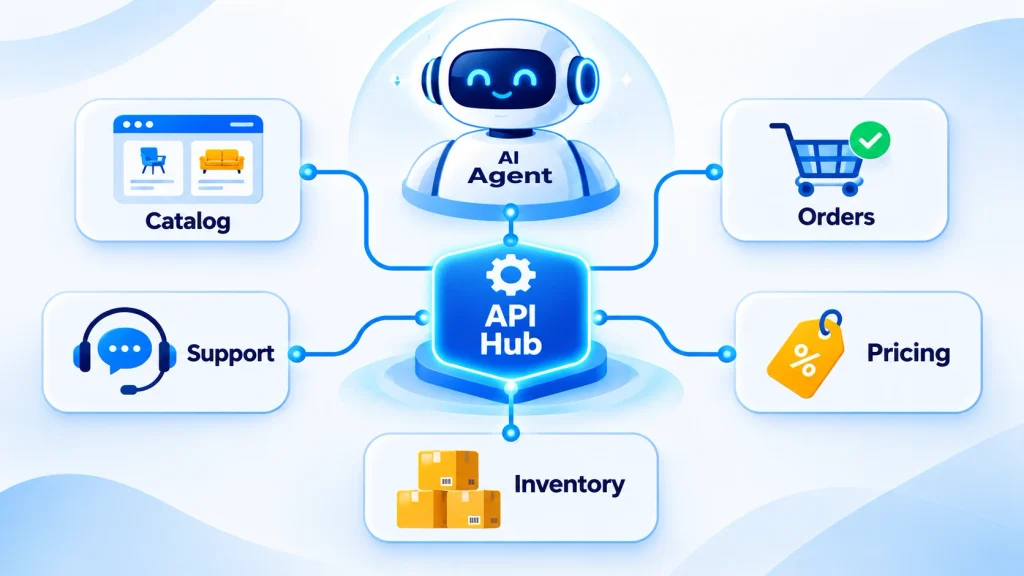
Short answer: Agents act through APIs, so the ecommerce backend must expose reliable endpoints for products, orders, customers, and inventory.
Every agent action is an API call. Weak documentation, inconsistent data, or slow endpoints limit what automation can achieve. Strong ecommerce API integration services connect the store to ERP, PIM, WMS, CRM, and payment tools through governed interfaces. Three practices matter most:
- Event-driven design: webhooks trigger agents when orders, stock, or prices change.
- Scoped permissions: each agent receives only the access a task requires.
- Idempotent calls: repeated requests never create duplicate orders or refunds.
Background on HTTP standards from MDN and Martin Fowler’s article on microservices covers the integration patterns involved. Google Cloud’s overview of AI agents adds further context.
Which Platform Fits Best: Magento, Adobe Commerce, Shopify, WooCommerce, or BigCommerce?
Short answer: Magento and Adobe Commerce suit complex, custom agent workflows. Shopify, WooCommerce, and BigCommerce suit faster, lighter deployments.
Platform choice shapes automation depth. Magento ecommerce development offers full control over data models and business logic. Magento enterprise development and Adobe Commerce development services add B2B features, staging, and enterprise support. Choosing the right ecommerce platform 2026 means weighing flexibility against speed and cost.
| Platform | Agent Readiness | Best For | Typical Development Effort |
|---|---|---|---|
| Magento Open Source | High with custom development | Custom catalogs, complex business rules | High |
| Adobe Commerce | Very high with enterprise tooling | B2B, multi-store enterprises | High |
| Adobe Commerce Cloud | Very high with managed scaling | Agent-heavy operations, large catalogs | Medium to high |
| Shopify | Strong through apps and APIs | Fast launches, standard flows | Low to medium |
| WooCommerce | Flexible through plugins | Content-led stores on WordPress | Low to medium |
| BigCommerce | Strong through open SaaS APIs | Mid-market, multi-channel brands | Medium |
Quick answer on Magento 2 vs Adobe Commerce Cloud: Magento 2 Commerce Cloud adds managed hosting, CI/CD, and auto-scaling, which reduces infrastructure work for agent-heavy operations. Open-source Magento offers more hosting freedom but demands more DevOps effort.
Official references include Adobe Developer documentation, Shopify Dev Docs, BigCommerce Developer Center, and the WooCommerce developer docs.
Headless vs Traditional Commerce: Which Is Better for AI Agents in eCommerce?
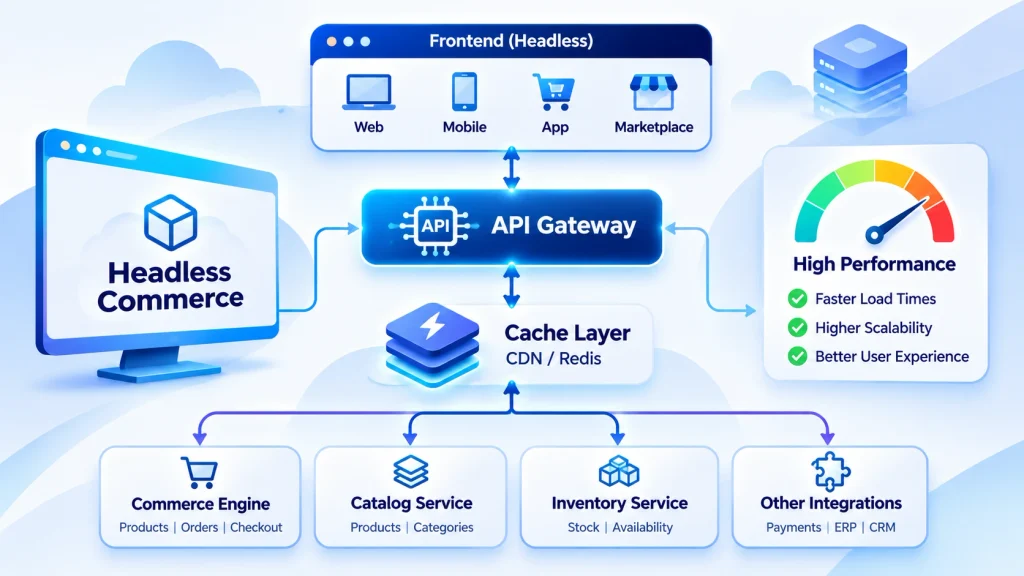
Short answer: Headless architecture separates the storefront from the backend through APIs, which makes agent integration cleaner than in tightly coupled builds.
In the headless vs traditional commerce debate, traditional platforms bundle front end and back end together. Headless ecommerce architecture splits the two, so agents, mobile apps, marketplaces, and storefronts all consume one API layer. Headless ecommerce development costs more upfront but adds freedom for AI-driven personalization and multi-channel automation. Traditional setups still work well when workflows are simple and traffic is moderate.
| Factor | Headless Commerce | Traditional Commerce |
|---|---|---|
| Architecture | Storefront and backend separated by APIs | Storefront and backend bundled |
| Agent integration | Clean, one shared API layer | Depends on platform API quality |
| Upfront cost | Higher | Lower |
| Multi-channel automation | Excellent | Limited |
| Front-end flexibility | Very high | Moderate |
| Best fit | Complex, multi-channel, AI-driven stores | Simple workflows, moderate traffic |
How Does Performance Affect AI Agent Automation?
Short answer: Agents multiply API traffic, so performance tuning must come first.
Ecommerce performance optimization protects speed under heavy automated load. Priorities include caching, database indexing, queue-based processing, and monitoring. Magento 2 performance optimization typically centers on full-page caching, Redis, Varnish, indexer configuration, and lean extensions. Google’s Core Web Vitals guidance defines the speed benchmarks that influence rankings and conversions.
What Is the Step-by-Step Rollout Plan?
- Audit workflows. List repetitive, rules-based tasks with high volume.
- Rank by value and risk. Start with low-risk tasks such as data enrichment.
- Fix data and APIs. Clean catalog data and document endpoints.
- Pilot one agent. Measure accuracy, time saved, and error rate.
- Add human approval gates. Require sign-off on refunds, pricing, and bulk edits.
- Scale gradually. Expand only after results stay stable.
| Stage | Goal | Success Metric |
|---|---|---|
| Audit | Identify repetitive, high-volume tasks | Prioritized workflow list |
| Pilot | Run one agent on a low-risk task | Accuracy and time saved |
| Guardrails | Add approval gates and limits | Zero unapproved high-risk actions |
| Scale | Expand to more workflows | Stable error rate across workflows |
What Risks and Guardrails Apply?
Short answer: The main risks are wrong decisions, data leaks, and unchecked spending. Each has a practical control.
- Apply spending, refund, and price-change limits.
- Log every agent action for audit.
- Protect customer data with encryption and least-privilege access.
- Review output samples weekly.
The OWASP Top 10 for LLM Applications and the NIST AI Risk Management Framework outline security and governance controls. McKinsey’s State of AI research and IBM’s explanation of AI agents cover adoption trends.
Frequently Asked Questions About AI Agents in eCommerce
What are AI agents in eCommerce?
Autonomous software systems that plan and complete store tasks, such as order routing, support, and catalog updates, through connected APIs.
How do AI agents differ from chatbots?
Chatbots answer questions. Agents take actions across multiple systems and verify results.
Which workflow should be automated first?
Product data enrichment. Risk is low and gains are immediate.
Do AI agents work with Magento and Shopify?
Yes. Both expose APIs that agents use for products, orders, and customers.
Is headless commerce required for AI agents?
No. Headless simplifies integration, but traditional platforms with good APIs also work.
Are AI agents safe for customer data?
Yes, when permissions are scoped, data is encrypted, and actions are logged.
How long does a pilot take?
Most single-workflow pilots take four to eight weeks.
Can AI agents improve ecommerce performance?
Yes, by automating repetitive work. Performance gains still depend on caching, indexing, and a well-tuned backend.
What does an AI agent need to work with a store?
Clean product data, documented APIs, scoped permissions, and clear approval rules.
Which platform is best for AI agent automation?
Adobe Commerce and Magento suit custom, complex workflows. Shopify and BigCommerce suit quicker launches.
Conclusion
AI agents in ecommerce turn slow, manual operations into connected, self-correcting workflows. Strong results come from clean data, dependable APIs, a fast backend, and clear human oversight. Starting with one low-risk workflow, proving the gains, and expanding step by step delivers measurable returns without disruption.