
Magento GraphQL vs REST API is one of the earliest architecture decisions in any serious Magento enterprise development project. The choice shapes page speed, development effort, third-party connectivity, and long-term maintenance cost. A wrong pick often surfaces months later as slow storefronts, bloated responses, or fragile integrations.
Both interfaces expose catalog, cart, customer, and order data, but each is built for a different job. Understanding where each fits makes it possible to design a faster, cleaner ecommerce backend and avoid expensive rework.
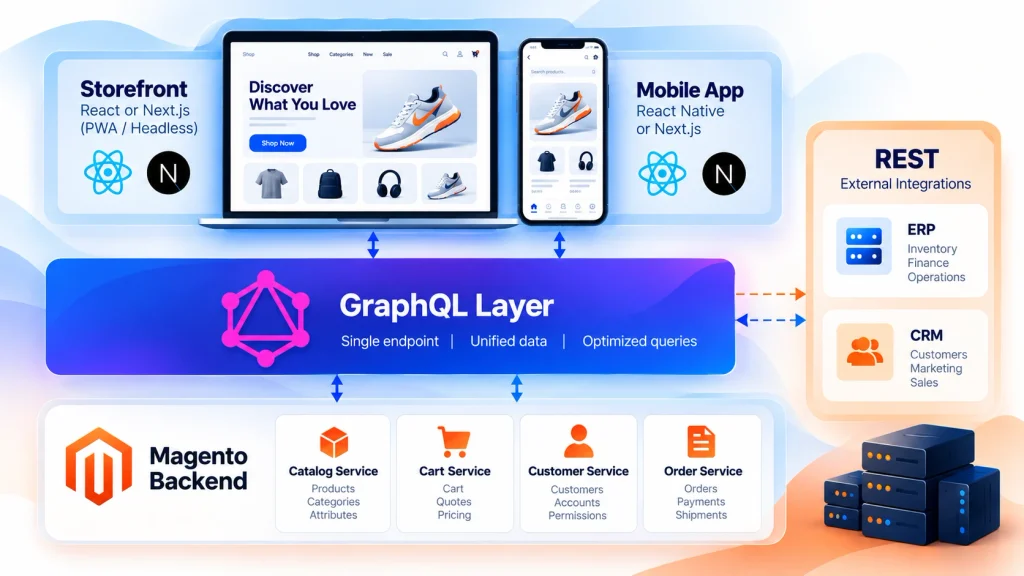
Quick answer: REST suits system-to-system integration, ERP and CRM sync, and administrative tasks. GraphQL suits storefronts, mobile apps, and headless builds that need small, precise responses. Most enterprise Magento stores use both: GraphQL for the customer-facing front end and REST for back-office operations.
Key Takeaways:
- REST uses many fixed endpoints and covers a wider range of admin operations.
- GraphQL uses one endpoint and returns only the requested fields.
- GraphQL reduces round trips for headless and mobile storefronts.
- Caching, query depth limits, and authentication review matter as much as the interface itself.
- A hybrid model is the most common outcome for large Adobe Commerce and Magento projects.
What Is Magento GraphQL vs REST API in Ecommerce Integration?
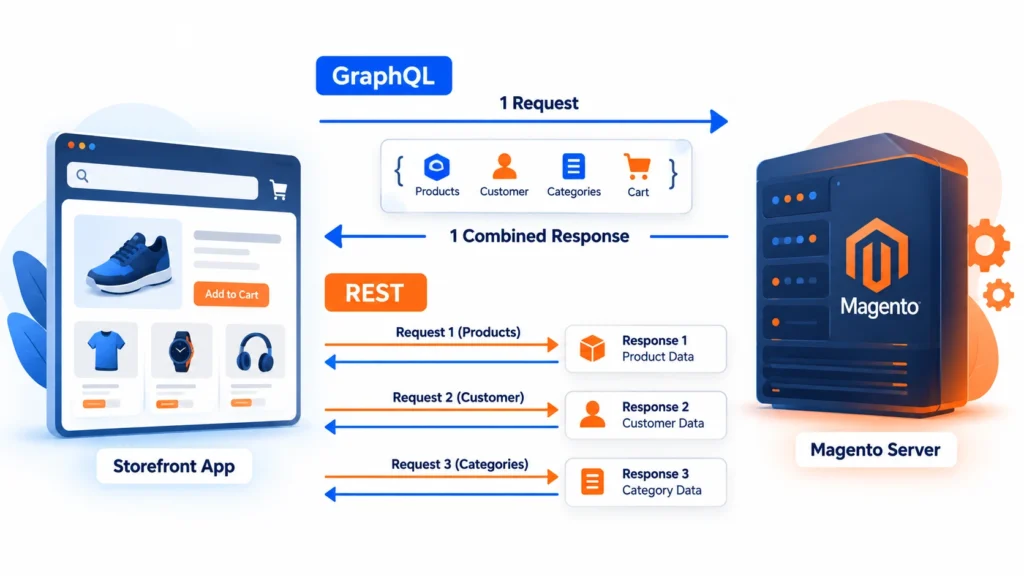
Magento 2 ships with several web API options, and REST and GraphQL handle most modern integration work. REST is a resource-based interface where each endpoint returns a fixed data structure. GraphQL is a query language where the client specifies exactly which fields the server should return. The difference comes down to how data is requested and delivered.
How the Magento REST API Works
REST organizes data around fixed endpoints. Every resource, such as products, orders, or customers, sits at its own address, and each endpoint returns a predefined structure. Authentication uses tokens, OAuth, or session credentials, and JSON is the default format. The approach is mature, well documented in the official Adobe Commerce REST reference, and supported by nearly every middleware tool on the market.
How the Magento GraphQL API Works
GraphQL uses a single endpoint. The client sends a query describing exactly which fields are needed, and the server returns only those fields. A product page that would need several REST calls can often be served with one query covering name, price, images, stock status, and related products. Mutations handle changes such as adding items to a cart. The core concepts are explained in the GraphQL learning guide, and Magento-specific schema details live in the Adobe Commerce GraphQL documentation.
Magento GraphQL vs REST API: Side-by-Side Comparison
Key differences at a glance:
- Endpoints: REST uses many fixed endpoints. GraphQL uses one flexible endpoint.
- Response size: REST returns the full resource. GraphQL returns only the requested fields.
- Round trips: REST often needs multiple calls. GraphQL typically needs one.
- Caching: REST benefits from simple HTTP caching. GraphQL queries sent as GET can use full-page cache and Varnish, while POST requests bypass it.
- Coverage: REST handles broad admin and back-office operations. GraphQL focuses on storefront data.
- Learning curve: REST is lower. GraphQL is higher and requires schema knowledge.
- Best fit: REST suits ERP, CRM, inventory, and bulk jobs. GraphQL suits headless, PWA, mobile, and custom storefronts.
When the REST API Is the Better Choice
ERP, CRM, and Inventory Synchronization
Back-office systems usually exchange structured batches of data on a schedule. REST handles these jobs well because endpoints are predictable and easy to monitor. Teams delivering ecommerce api integration services for ERP, warehouse, and accounting tools generally rely on REST for exactly that reason.
Admin Operations and Bulk Updates
Creating products, updating stock levels, managing orders, and configuring customer groups are administrative tasks. The REST API exposes these capabilities more completely than GraphQL, and asynchronous bulk endpoints make large catalog updates practical.
When the GraphQL API Is the Better Choice
Headless Ecommerce Development
Headless ecommerce development separates the storefront from the Magento backend. React, Vue, Next.js, and PWA Studio front ends all benefit from GraphQL because components request only the fields rendered on screen. Fewer calls and smaller payloads translate directly into faster perceived load times.
Mobile Apps and Custom Storefronts
Mobile networks punish oversized responses. GraphQL trims payloads to the essentials, which reduces data usage and speeds up screens. Product listings, search results, and checkout steps can each be fetched with precisely shaped queries.
Security, Authentication, and Rate Limiting in Magento GraphQL vs REST API
Security deserves equal weight with speed. Both interfaces support token-based authentication for customers and integrations, but the risk profile differs.
REST API Security Practices
Fixed endpoints make access rules easy to scope. Integration tokens should carry only the permissions required, and admin credentials should never be shared across systems. Regular token rotation and IP allow-listing for server-to-server traffic reduce exposure.
GraphQL API Security Practices
A single flexible endpoint invites deeply nested or expensive queries. Query depth limits, complexity limits, and rate limiting protect the server from abuse. The OWASP API Security Project lists broken authorization and unrestricted resource consumption among the top risks, and both apply directly to GraphQL schemas.
Common safeguards across both interfaces:
- Enforce HTTPS everywhere.
- Validate and sanitize all input.
- Log and monitor unusual request patterns.
- Review permissions after every major Magento upgrade.
Magento 2 Performance Optimization: GraphQL and REST Compared
Magento 2 performance optimization depends on reducing the work done per request. GraphQL cuts over-fetching, while REST benefits from simple, cacheable responses. Google’s Core Web Vitals guidance highlights loading speed, interactivity, and visual stability as the metrics that matter most for user experience, and the API layer influences all three.
Practices that apply to both interfaces:
- Enable Varnish and full-page cache wherever responses are cacheable.
- Use GET requests for GraphQL queries that do not change data.
- Keep queries shallow and avoid deeply nested requests.
- Apply query complexity and depth limits.
- Index data properly and use Redis for session and cache storage.
- Monitor slow endpoints with an application performance tool.
Broader ecommerce performance optimization also covers image compression, a CDN, and lean front-end code. Understanding HTTP caching fundamentals helps teams configure cache headers correctly. The API layer is only one part of the speed equation, but a poorly chosen one can undo gains made everywhere else.
Adobe Commerce and Magento 2 Commerce Cloud Considerations
Adobe Commerce includes the same REST and GraphQL foundations as Magento Open Source, plus enterprise features such as B2B tools, staging, and advanced segmentation. Many of those features expose GraphQL schema extensions for company accounts, shared catalogs, and requisition lists.
Projects on Magento 2 commerce cloud benefit from built-in Fastly CDN caching and managed infrastructure, which makes cacheable GraphQL GET queries especially effective. Larger merchants frequently pair Adobe Commerce with API Mesh to merge several services behind one GraphQL gateway. Specialized Adobe Commerce development services help teams design schemas, extend resolvers, and plan cloud deployments without compromising stability.
How Other Platforms Compare: Shopify, WooCommerce, BigCommerce, and Headless Commerce
Platform choice influences API strategy, so a quick comparison puts Magento in context:
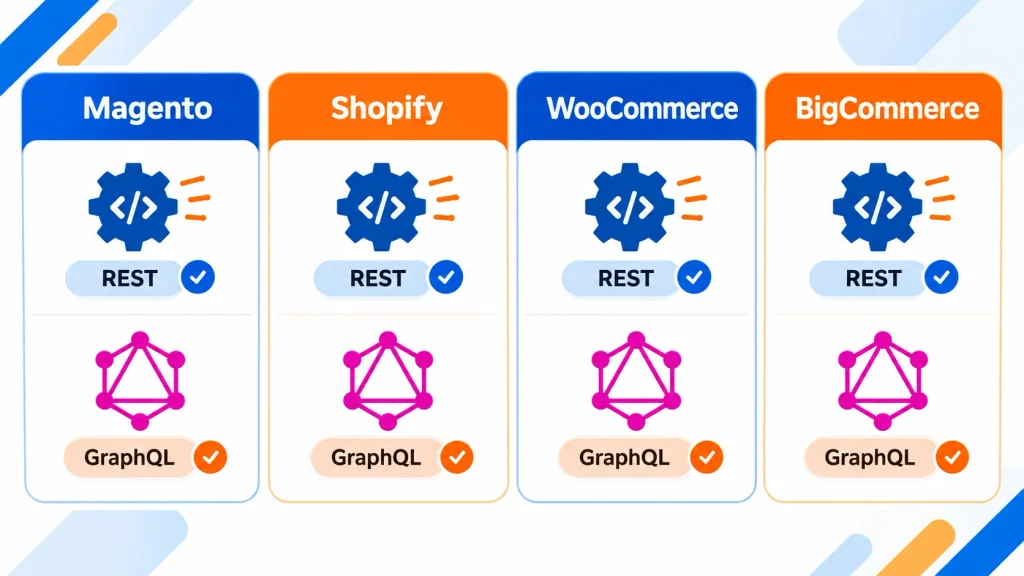
- Shopify: Offers Admin and Storefront GraphQL APIs, with GraphQL as the preferred path for new development.
- WooCommerce: Provides a native REST API, with GraphQL available through the WPGraphQL plugin.
- BigCommerce: Combines a REST Management API with a GraphQL Storefront API, similar to Magento’s split between back-office and storefront needs.
- Magento and Adobe Commerce: Offer the deepest customization, with REST, GraphQL, and SOAP in one platform.
- Headless commerce platforms: Typically expose API-first backends where GraphQL or REST feeds any front end.
Merchants running several storefronts or planning a migration often need ecommerce api integration services that unify data across platforms.
Real-World Use Cases for Magento GraphQL vs REST API
Practical scenarios make the decision clearer.
Use Case 1: B2B Wholesale Store with ERP Sync
A wholesale merchant needs nightly inventory and pricing updates from an ERP. REST handles the scheduled batches, while GraphQL powers the customer portal where buyers browse shared catalogs and reorder quickly.
Use Case 2: Fashion Retailer with a Next.js Storefront
A fashion brand wants an app-like experience with instant filtering and smooth checkout. GraphQL feeds the Next.js front end with lean queries, while REST connects the warehouse and returns systems behind the scenes.
Use Case 3: Multi-Brand Enterprise on Adobe Commerce
A company managing several brands combines Adobe Commerce, API Mesh, and a central GraphQL gateway for storefronts. REST integrations keep finance, shipping, and analytics systems aligned. Strong Magento ecommerce development planning at the start prevents duplicated logic later.
Choosing an Approach When Creating a New Ecommerce Website
Anyone planning to create an ecommerce website should start with business needs rather than technology trends:
- A standard theme-based store with a few integrations works well with REST alone.
- A fast, app-like experience with custom front-end design points toward GraphQL.
- A large catalog, multiple channels, and complex integrations usually call for both.
Budget and team skills matter too. Strong front-end developers adapt quickly to GraphQL, while integration engineers typically prefer REST. A thoughtful ecommerce backend plan evaluates both before committing to an architecture.
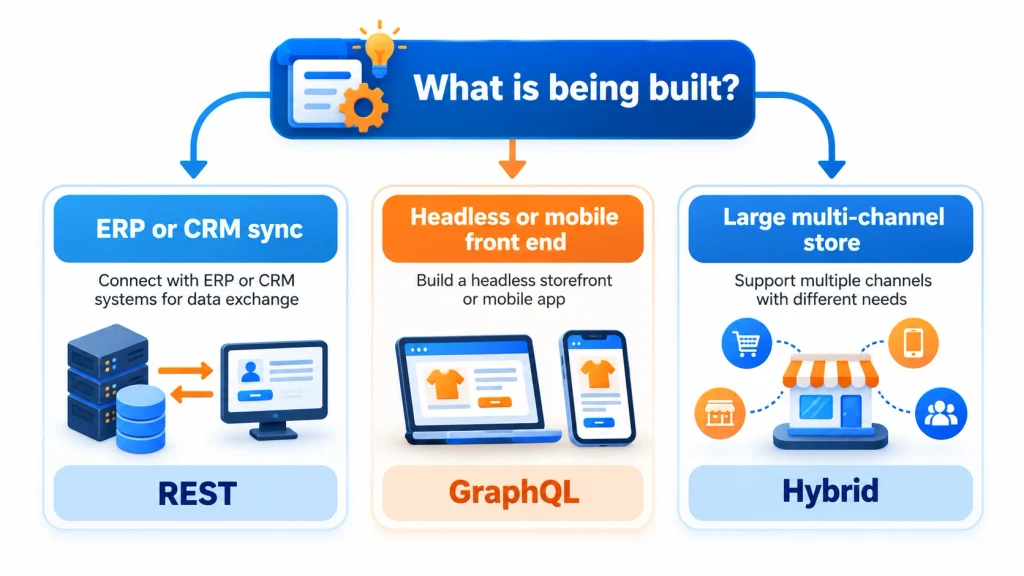
Decision Framework for Magento GraphQL vs REST API
A short checklist helps settle the question:
- Identify the primary consumer: a machine system or a customer-facing interface.
- List required operations and confirm GraphQL covers them.
- Estimate traffic and decide how much caching is achievable.
- Review team expertise and available time.
- Plan a hybrid model if storefront speed and back-office coverage both matter.
In practice, most enterprise stores land on a hybrid model: GraphQL for the storefront, REST for operations and integrations.
Common Mistakes in Magento GraphQL vs REST API Decisions
- Forcing GraphQL into back-office workflows that are not fully covered.
- Sending every GraphQL request as POST and losing cache benefits.
- Writing oversized queries that request every available field.
- Skipping rate limiting and authentication review.
- Ignoring schema changes after Magento upgrades.
- Treating the interface choice as a substitute for caching strategy.
Frequently Asked Questions About Magento GraphQL vs REST API
Is GraphQL faster than REST in Magento 2?
GraphQL is often faster for storefront pages because one request can replace several REST calls and payloads stay small. REST can still perform better for simple, highly cacheable requests.
Can Magento use GraphQL and REST at the same time?
Yes. Both interfaces run side by side, and many stores use GraphQL for the front end and REST for ERP, CRM, and admin automation.
Does GraphQL replace REST in Adobe Commerce?
No. GraphQL focuses on storefront data, while REST covers a wider set of administrative operations.
Which approach suits headless ecommerce development best?
GraphQL is generally the better fit because front-end components request only the required data, which improves speed and simplifies development.
Is the Magento REST API still relevant?
Yes. REST remains essential for integrations, bulk operations, and third-party tools that expect conventional endpoints.
Is GraphQL more secure than REST?
Neither is inherently more secure. GraphQL needs depth and complexity limits, while REST needs scoped tokens and strict endpoint permissions.
Does GraphQL work with Magento full-page cache?
Yes, when queries are sent as GET requests. POST requests generally bypass full-page cache.
How does the choice affect Magento 2 performance optimization?
The right interface reduces unnecessary data transfer and server load. Combined with Varnish, Redis, and a CDN, the correct choice contributes to measurably faster pages.
Conclusion
Magento GraphQL vs REST API is not a contest with a single winner. REST remains the dependable choice for ERP and CRM integrations, bulk updates, and administrative tasks. GraphQL delivers the precision that headless storefronts, PWAs, and mobile apps demand, with fewer round trips and smaller payloads.
The strongest results come from matching each interface to the job handled best, then backing the architecture with careful caching, query limits, secure authentication, and regular monitoring. For stores aiming at scalable growth, a well-planned hybrid approach (GraphQL for the storefront, REST for operations) supported by experienced Magento enterprise development expertise is usually the safest long-term investment.