
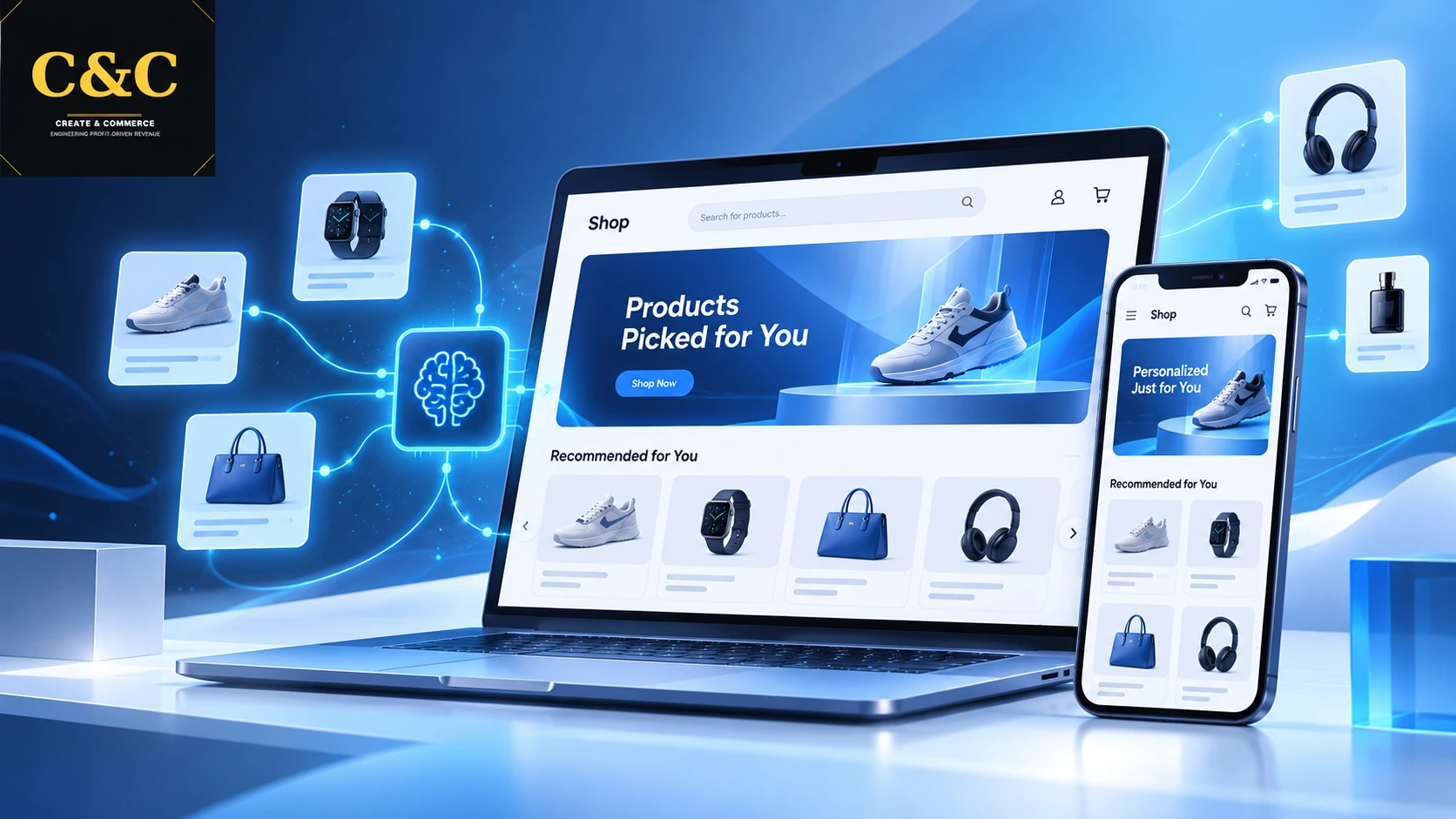
AI product recommendations turn casual browsing into relevant, satisfying shopping journeys. Online shoppers face thousands of choices on every storefront. Brands that guide attention toward the right items at the right moment earn higher conversions, larger baskets, and stronger loyalty.
Smart suggestion engines study behavior, context, and catalog data. As a result, every visitor receives a personalized experience at scale.
Quick Answer: AI product recommendations use machine learning to predict which products each shopper is most likely to want. Predictions rely on browsing, purchase history, and real-time behavior. The outcome is faster discovery, higher relevance, larger orders, and more repeat visits on Shopify, WooCommerce, BigCommerce, Magento, Adobe Commerce, and headless commerce stores.
Key Takeaways
- AI product recommendations shorten the path from landing to purchase.
- Hybrid and real-time models perform best for large or fast-changing catalogs.
- Fast pages, clean data, and low technical debt decide whether personalization succeeds.
- Answer-first, structured content earns visibility in ChatGPT, Google AI Overviews, Perplexity, and Gemini.
What Are AI Product Recommendations?
AI product recommendations are automated suggestions created by machine learning models. Each suggestion predicts which product a specific shopper will value most.
A recommendation engine is a specialized recommender system. It ranks catalog items one shopper at a time. Signals include:
- Browsing history
- Purchase patterns
- Search queries
- Device type and location
- Real-time clicks
The technology replaces manual merchandising rules with continuous learning. A rule might say “show accessories with every phone.” A trained model goes further. For example, it may learn that weekend shoppers who view a certain camera lens often buy a tripod, a cleaning kit, and a memory card.
Patterns of that depth are nearly impossible to maintain by hand. Managed cloud services such as Amazon Personalize and Google Cloud Vertex AI Search for commerce now make enterprise-grade models widely available.

Why AI Product Recommendations Improve the Customer Experience
A strong customer experience has three parts. Shoppers should find what they need quickly, feel understood, and trust the store enough to return. Intelligent product suggestions can support all three by making the shopping journey faster, more relevant, and more personalized.
Faster Product Discovery with AI Product Recommendations
Large catalogs overwhelm visitors. Relevant suggestions shorten the path between landing and buying. Related, complementary, and trending items appear without extra searching.
Less friction means lower bounce rates and longer, more productive sessions. Research from the Baymard Institute shows how product-finding friction drives abandonment. Similarly, the Nielsen Norman Group has documented the link between findability and usability for years.
Relevance That Builds Trust
Useful suggestions make a brand look attentive instead of pushy. Accurate recommendations feel like a knowledgeable sales associate who remembers preferences. Consequently, trust grows with every repeat visit.
Higher Order Value and Retention
Cross-sell and upsell placements raise average order value without heavy discounting. Personalized post-purchase emails and “complete the look” modules also bring customers back, which lifts lifetime value.
Analysis from McKinsey on personalization links tailored experiences to revenue growth. Likewise, Harvard Business Review regularly covers how data-driven personalization shapes loyalty.
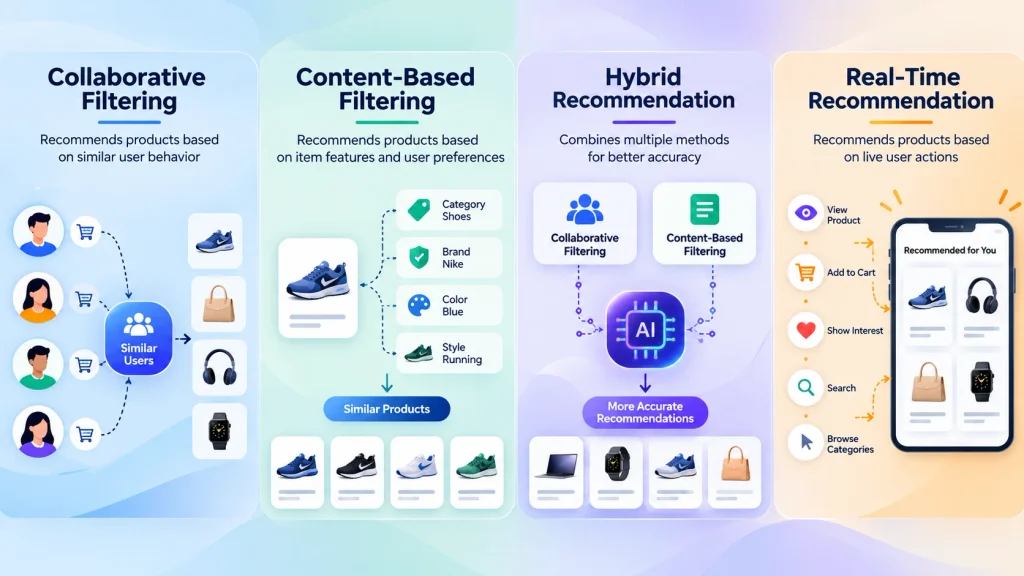
Types of AI Product Recommendation Engines
Different models solve different merchandising problems. The right choice depends on catalog size, traffic volume, and data quality.
- Collaborative filtering finds patterns among shoppers with similar behavior.
- Best for: stores with rich purchase history.
- Limitation: struggles with brand-new products.
- Content-based filtering matches attributes such as brand, color, material, and price to demonstrated tastes.
- Best for: catalogs with detailed product data.
- Limitation: can narrow variety.
- Hybrid models combine both methods and handle new products and new visitors more gracefully.
- Best for: mid-size to enterprise catalogs.
- Limitation: higher setup complexity.
- Session-based and real-time models react to the current visit.
- Best for: anonymous and mobile traffic.
- Limitation: needs fast, reliable infrastructure.
Hybrid and real-time approaches usually deliver the strongest results for large or fast-changing catalogs.
AI Product Recommendations Across Major Commerce Platforms
Every platform supports intelligent merchandising differently. Platform choice decides how deeply recommendation logic can be customized.
Shopify
Shopify offers native recommendation features. The Shopify Search & Discovery app lets merchants activate related and complementary product sections quickly. For deeper control, third-party apps add advanced personalization.
WooCommerce
WooCommerce runs on WordPress and relies on extensions for AI-driven suggestions. Flexibility is high. However, plugin quality and server resources need careful review to protect page speed.
BigCommerce
BigCommerce provides an open SaaS architecture with strong API access. Integrations with specialized personalization vendors are straightforward, which suits growing mid-market brands.
Magento and Adobe Commerce
Adobe Commerce and the open-source Magento Open Source edition suit complex catalogs, multiple storefronts, and B2B workflows.
Adobe Commerce includes native product recommendations powered by Adobe Sensei. Details appear in the official Adobe Commerce developer documentation. Open-source stores can connect third-party engines through extensions or APIs.
Headless Commerce and AI Product Recommendations
Headless commerce separates the storefront from the backend. Recommendation widgets then travel through APIs to websites, mobile apps, kiosks, and marketplaces from a single intelligence layer. The MACH Alliance promotes the composable, API-first principles behind the approach.
Teams investing in headless ecommerce development gain freedom to design unique discovery experiences without template limits. In addition, headless commerce development makes it easier to swap recommendation vendors as needs change.
Quick platform guide
- Shopify: native features plus apps, ideal for fast launches and direct-to-consumer brands.
- WooCommerce: plugins and extensions, ideal for WordPress-based stores.
- BigCommerce: API-first integrations, ideal for growing mid-market brands.
- Magento and Adobe Commerce: native engine or custom modules, ideal for complex catalogs and B2B.
- Headless: API-delivered widgets, ideal for omnichannel experiences.
Magento Ecommerce Development and AI Product Recommendation Engines
Brands with complex catalogs often rely on magento ecommerce development to build recommendation logic around precise business rules. Custom modules connect product feeds, customer segments, and behavioral events to a machine learning service. Results then appear on category pages, product pages, carts, and emails.
Expert help matters here. Many organizations choose adobe magento development services for architecture planning, extension audits, and secure integrations. Large retailers go further with magento enterprise development, which adds multi-store management, advanced permissions, and custom pricing logic. Every personalized suggestion must stay consistent with that pricing logic.
Hosting also plays a role. Magento 2 Commerce Cloud offers a managed environment with built-in scaling. Recommendation requests therefore stay fast during traffic spikes. Meanwhile, strong magento devops practices keep releases safe. Automated deployments, staging parity, and monitoring prevent model updates from breaking checkout.
Teams planning a rebuild can explore Magento ecommerce development and compare approaches for headless commerce development before choosing an architecture. Further guidance on ecommerce performance optimization helps protect speed after personalization launches.

Ecommerce Performance Optimization and Infrastructure for AI Product Recommendations
Suggestions only help when pages load quickly. Slow widgets damage the very experience meant to improve. Effective ecommerce performance optimization follows Google’s Core Web Vitals guidelines and includes five steps:
- Load recommendation blocks asynchronously so core content appears first.
- Cache popular suggestion sets at the edge with a content delivery network such as Cloudflare.
- Compress and lazy-load product images inside carousels.
- Limit third-party scripts that duplicate tracking events.
- Check Core Web Vitals after every release with PageSpeed Insights.
Reliable ecommerce infrastructure is equally important. Scalable APIs, resilient databases, and observability tools reveal latency inside the recommendation pipeline. Without that foundation, personalization becomes a bottleneck instead of a benefit.
Avoiding Ecommerce Technical Debt While Adding Personalization
Rushed integrations create ecommerce technical debt. Hard-coded widgets, duplicated tracking code, outdated extensions, and undocumented customizations make future upgrades expensive and risky.
Several habits keep debt under control:
- Choose API-based integrations over heavy template changes.
- Document data flows between the catalog, analytics, and recommendation engine.
- Retire unused plugins and extensions on a regular schedule.
- Write automated tests for recommendation placements.
- Review the architecture every quarter.
In short, clean engineering today means faster experimentation tomorrow.
Building AI Product Recommendations for a New Commerce Website
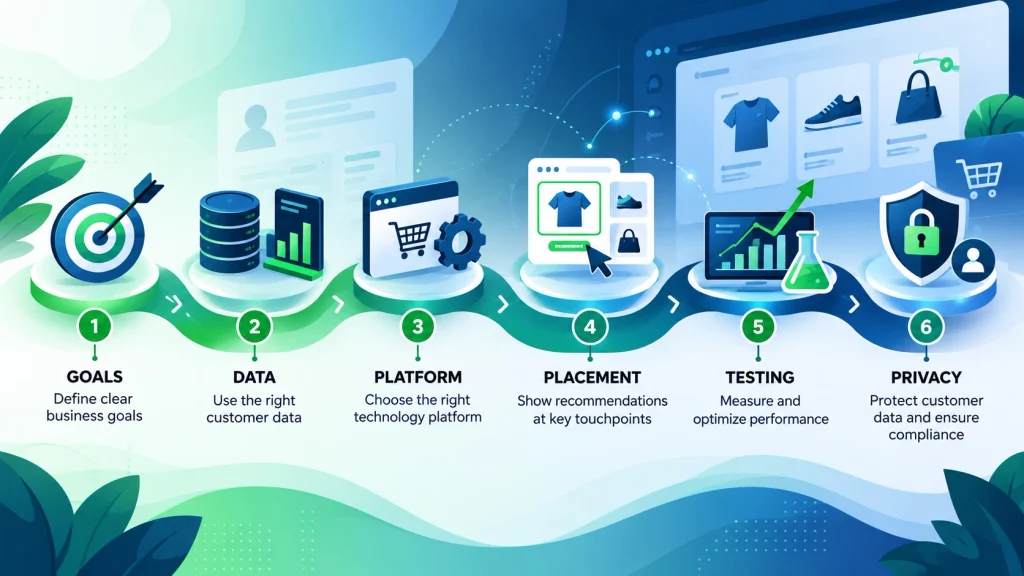
A new store can design personalization from day one. A practical roadmap follows six steps:
- Define goals. Pick the top priority: conversion rate, average order value, retention, or discovery.
- Prepare clean data. Accurate attributes, categories, and inventory feeds decide recommendation quality.
- Select the platform. Match business size and complexity to Shopify, WooCommerce, BigCommerce, Adobe Commerce, Magento, or a headless build.
- Start with high-impact placements. Product pages, cart pages, and post-purchase emails usually win early.
- Test continuously. A/B tests reveal the best placements, layouts, and algorithms.
- Respect privacy. Consent practices aligned with the GDPR and the CCPA protect customer trust.
Measuring the Impact of Personalized Recommendations
Clear metrics prove value and guide improvement. Useful indicators include:
- Click-through rate on recommendation widgets
- Conversion rate for sessions that interact with suggestions
- Average order value
- Revenue per visitor
- Repeat purchase rate
- Customer satisfaction scores
Google Analytics 4 ecommerce reporting keeps measurement consistent. Finally, comparing a control group with a personalized group isolates the true lift.
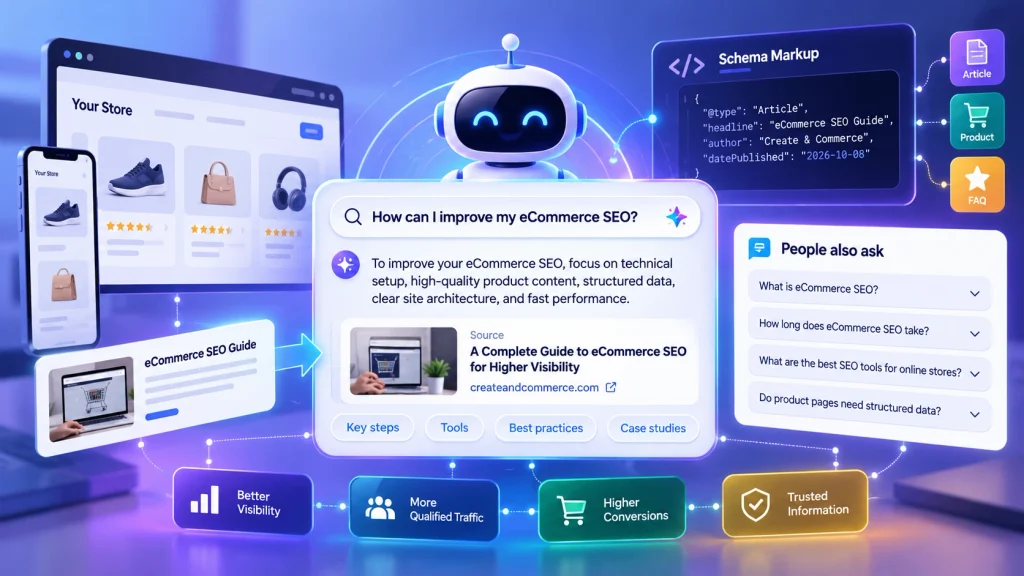
AI Product Recommendations and AI Search Visibility (AEO and GEO)
Shoppers increasingly research products through answer engines and generative search. Two practices support visibility there:
- Answer Engine Optimization (AEO) supplies direct, extractable answers.
- Generative Engine Optimization (GEO) builds trust so AI tools cite the source.
Stores and publishers that explain AI product recommendations clearly gain exposure in both classic rankings and AI summaries.
Answer-First Content for AEO
Answer engines favor concise definitions placed right under question-style headings. A strong pattern opens each section with a 40 to 60 word answer. Supporting detail, examples, and data follow. Lists and numbered steps help machines extract facts accurately.
Entity Clarity and Authority for GEO
Generative engines reward precise entity names such as Shopify, Adobe Commerce, Magento 2 Commerce Cloud, and headless commerce. Each entity should connect to a verifiable source.
Named authors, current dates, and trusted citations strengthen credibility. Google’s guidance on helpful, people-first content and E-E-A-T supports the same approach.
Structured Data That Machines Can Read
Schema markup removes ambiguity. Schema.org vocabulary for Article, FAQPage, and Product helps search engines and AI systems interpret content correctly. Google’s structured data documentation explains supported formats.
Product pages that expose price, availability, reviews, and brand through valid markup are easier for AI shopping assistants to surface.
The Future of AI Product Recommendations
Generative AI, visual search, and conversational shopping assistants are expanding what recommendation systems can do. Future storefronts will likely assemble whole pages dynamically for each visitor, blending text, images, and offers based on intent.
Brands with flexible architecture, clean data, and healthy ecommerce infrastructure will adopt such capabilities fastest.
Frequently Asked Questions
What are AI product recommendations in ecommerce?
AI product recommendations are machine learning–driven suggestions that show each shopper the products most likely to match personal interests, based on behavior, preferences, and context.
How do AI product recommendations improve the customer experience?
Relevant suggestions reduce search effort, speed up discovery, and make shopping feel personal. Satisfaction, conversions, and repeat visits rise as a result.
Which platform is best for AI product recommendations?
The best choice depends on business needs. Shopify and BigCommerce suit fast launches. WooCommerce suits WordPress-based stores. Adobe Commerce and Magento suit complex catalogs. Headless commerce suits brands needing omnichannel flexibility.
Does headless commerce help with personalization?
Yes. A headless setup delivers recommendation data through APIs to any channel. Web, mobile, and in-store touchpoints then share one consistent, personalized experience.
Can recommendation engines slow down an online store?
Poorly built engines can. Asynchronous loading, edge caching, optimized images, and monitored ecommerce infrastructure keep pages fast.
How does ecommerce technical debt affect personalization?
Technical debt makes upgrades slower and riskier. Hard-coded widgets and outdated extensions complicate recommendation updates, while API-based integrations keep changes simple.
How long does it take to see results from AI product recommendations?
Many stores notice early engagement changes within weeks. Model accuracy and revenue impact typically improve as more behavioral data accumulates.
How can content about AI product recommendations appear in AI search results?
Answer-first formatting, FAQ sections, valid schema markup, named authorship, current dates, and citations to authoritative sources increase the chance of being referenced by AI answer engines.
What is the difference between AEO and GEO?
AEO targets direct answers in featured snippets and voice results. GEO targets citations and mentions inside AI-generated responses from tools such as ChatGPT, Gemini, and Perplexity.
Conclusion
AI product recommendations give online retailers a reliable way to improve the customer experience from first visit to repeat purchase. Shopify, WooCommerce, BigCommerce, Magento, Adobe Commerce, and headless builds can all support intelligent merchandising. Success depends on solid engineering, fast infrastructure, disciplined data practices, and low technical debt.
Stores that invest in relevance, speed, clean architecture, and answer-ready content position for sustained growth in both classic search and AI-driven discovery.