

Every online store runs on code, integrations, and platform decisions made months or years ago. Over time, shortcuts taken to launch faster, patches applied to fix urgent bugs, and outdated plugins left untouched all pile up into something known as technical debt. Left unmanaged, technical debt in eCommerce becomes one of the most expensive, invisible line items on a balance sheet, quietly slowing checkout speed, breaking integrations, and pushing shoppers toward competitors.
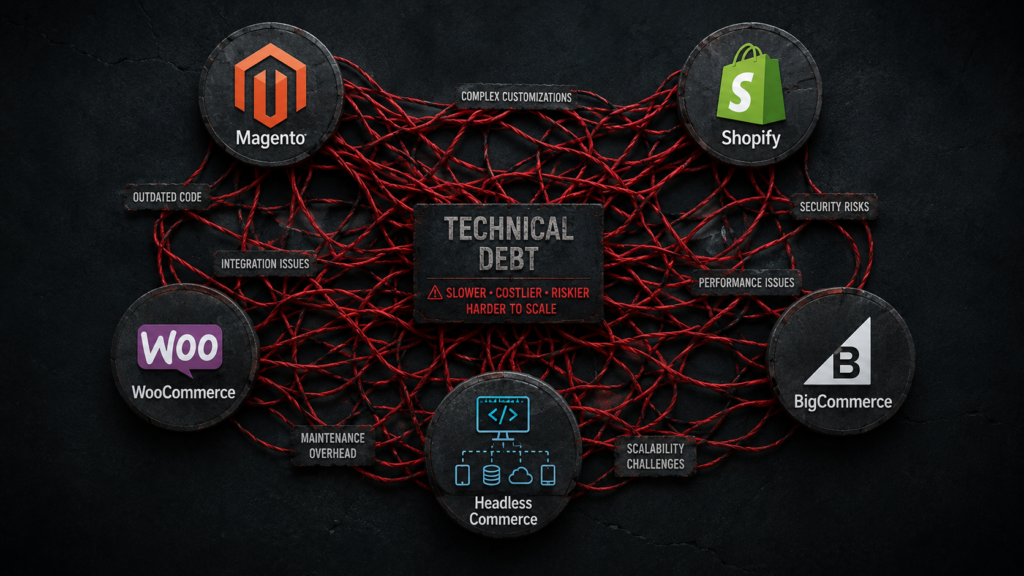
This breakdown explores what technical debt really costs an online retail business, how it shows up across Magento, Shopify, WooCommerce, BigCommerce, and headless commerce builds, and what a practical, long-term path toward resolution looks like.
What Is Technical Debt in eCommerce?
The cumulative cost of selecting a quick, temporary solution over a slower, more sustainable one throughout development is referred to as technical debt. This could refer to an eCommerce store with an antiquated theme, an out of date plugin stack, or custom code stacked on top of custom code without the necessary documentation.
Much like financial debt, this “interest” compounds. A minor shortcut during a product launch can, within a year, evolve into a checkout flow that fails under traffic spikes or a backend that no longer supports a new payment gateway. The longer resolution is delayed, the more expensive and riskier the eventual fix becomes.
Why Technical Debt Is Often Invisible Until It Is Costly
In contrast to a broken page or an obvious defect, technical debt seldom manifests itself immediately. It builds silently inside the codebase, inside outdated dependencies, undocumented workarounds, and legacy integrations, until a triggering event, such as a traffic spike or a plugin update, exposes the underlying fragility all at once.

The Hidden Costs of Technical Debt
Lost Revenue From Site Slowdowns
Page speed is directly tied to conversion rates. Stores burdened by legacy code, bloated plugins, or unoptimized databases often see load times creep past the three-second mark, a threshold after which cart abandonment rises sharply. A single second of delay, compounded across thousands of monthly visitors, can translate into a measurable percentage of lost annual revenue. A detailed breakdown of load-time benchmarks is available through the Portent page speed study, an external resource on conversion benchmarking.
Increased Development Costs Over Time
A codebase weighed down by technical debt makes every new feature harder to ship. Development teams spend more hours untangling dependencies than building new functionality, which raises the cost per feature and slows time-to-market for seasonal campaigns or new product launches. What could have been a two-day update often stretches into a two-week project once dependencies must be unwound first.
Security Vulnerabilities Caused by Technical Debt in eCommerce
Outdated plugins, unsupported extensions, and unpatched core files are common entry points for security breaches. In eCommerce, a single vulnerability can expose customer payment data, trigger compliance penalties, and cause long-term reputational damage that is far costlier than routine maintenance would have been. Security-related technical debt is consistently among the most expensive categories to leave unresolved. Guidance on common vulnerability categories is outlined by the OWASP Top Ten project, a widely referenced external security resource.
Poor Customer Experience
Glitchy checkout pages, broken filters, and inconsistent mobile rendering are often symptoms of accumulated technical debt. Customer experience issues rarely stay isolated; they show up in reviews, abandoned carts, and declining repeat-purchase rates. Significant revenue leakage results from even small friction that is repeated over thousands of sessions.

How Technical Debt Shows Up Across Platforms
Magento
Magento stores, particularly those still running on Magento 1 or heavily customized Magento 2 instances, frequently carry significant technical debt. Fragile environments are created by custom modules constructed without adhering to coding standards, unsupported extensions, and delayed core upgrades, where a single change can disrupt unrelated functionality. Migration to supported versions and modular, well-documented custom code significantly reduces this burden. Platform migration strategy is covered in more depth through the Magento to Magento 2 migration guide, an internal resource on platform upgrades.
Shopify
Shopify’s managed infrastructure limits some forms of technical debt, but liquid theme customizations, excessive third-party apps, and abandoned custom scripts still accumulate over time. Stores that layer app upon app without periodic audits often experience slower load times and conflicting scripts that degrade the storefront experience. Related insight on Shopify app management is available through the Shopify optimization resources, an internal link covering platform-specific best practices.
WooCommerce
Being built on WordPress, WooCommerce stores are especially prone to plugin-related technical debt. Outdated plugins, theme conflicts, and unmanaged updates to WordPress core can create compounding compatibility issues. A disciplined plugin audit and version control strategy is essential for long-term stability. Additional WooCommerce maintenance guidance can be found in the WooCommerce store health resources, an internal link on ongoing store maintenance.
BigCommerce
Although BigCommerce‘s SaaS model lowers certain infrastructure-related debt, risk is still introduced by obsolete apps, custom API interfaces, and legacy Stencil theme code. Stores expanding into multi-channel selling often accumulate technical debt in the form of inconsistent inventory sync logic across integrations.
Headless Commerce
Headless commerce architectures offer flexibility but shift technical debt into the API layer and frontend framework. Poorly maintained API contracts, undocumented custom endpoints, and frontend frameworks left unpatched can create fragility that is harder to detect than traditional monolithic platform issues, since the frontend and backend evolve independently of one another. A technical overview of headless architecture trade-offs is available through the MACH Alliance resources, an external reference on modern commerce architecture.
Calculating the True Cost
It is necessary to look beyond development hours when estimating the financial impact of technical debt. A realistic calculation considers:
- Lost conversions from slow or broken pages
- Developer hours spent on maintenance instead of growth features
- Security incident risk and potential compliance costs
- Customer churn driven by poor experience
- Opportunity cost of delayed feature releases during peak selling seasons
Many growth-focused agencies, including Create and Commerce, emphasize regular technical debt audits as part of an ongoing eCommerce strategy rather than a one-time cleanup project.
Why a One-Time Fix Is Not Enough
Resolving technical debt once and assuming the problem is permanently solved is a common mistake. New features, plugin updates, and evolving integrations continuously introduce fresh debt. Treating debt reduction as a recurring discipline, rather than a single project, keeps costs predictable over time. A related internal resource on ongoing eCommerce strategy planning expands on building maintenance into a broader growth roadmap.
According to a widely cited Google Web. dev report on page speed, an external resource, even a 100-millisecond improvement in load time can meaningfully lift conversion rates, underscoring why unresolved technical debt carries a direct revenue cost. Further data on the relationship between performance and revenue is available through the Deloitte “Milliseconds Make Millions” study, another external reference on site speed and revenue impact.
Reducing Technical Debt: A Practical Approach
- Conduct a Technical Audit: Reviewing code, plugins, and integrations quarterly helps surface debt before it compounds.
- Prioritize by Business Impact: Not all debt needs immediate resolution; ranking issues by revenue and risk impact focuses resources effectively.
- Modernize Incrementally: Replacing legacy components in stages avoids the risk and cost of a full platform overhaul.
- Document Custom Code: Clear documentation prevents future shortcuts from becoming untraceable debt.
- Invest in Automated Testing: Automated regression testing catches new debt-related bugs before they reach customers.

Building a Culture Around Debt Prevention
Beyond one-time fixes, sustainable debt management requires a cultural shift within development teams. Establishing coding standards, requiring documentation for custom work, and scheduling routine maintenance windows prevents new debt from accumulating as quickly as old debt is resolved. A related internal guide on building a maintenance-first development culture offers additional strategic direction.
Frequently Asked Questions About Technical Debt in eCommerce
What is technical debt in eCommerce?
Technical debt in eCommerce refers to the accumulated cost of shortcuts, outdated code, and unmaintained integrations that make a store harder and more expensive to update over time.
How does technical debt affect conversion rates?
Slow load times, broken features, and inconsistent checkout experiences caused by technical debt directly reduce conversion rates and increase cart abandonment.
Which eCommerce platform has the least technical debt risk?
No platform is entirely immune. Managed platforms like Shopify and BigCommerce reduce infrastructure-related debt, while Magento, WooCommerce, and headless commerce setups require more proactive maintenance to prevent debt accumulation.
How often should a technical debt audit be performed?
A quarterly audit is generally recommended, though high-traffic stores or those undergoing frequent feature releases may benefit from more frequent reviews.
Can technical debt be eliminated completely?
Complete elimination is unrealistic, since some debt is a natural byproduct of fast-moving development. The goal is managing debt strategically rather than letting it compound unchecked.
Conclusion
Technical debt in eCommerce rarely announces itself with a single dramatic failure; instead, it erodes site speed, security, and customer trust gradually, one shortcut at a time. Recognizing the signs across Magento, Shopify, WooCommerce, BigCommerce, and headless commerce environments is the first step toward protecting revenue. Regular audits, prioritized fixes, and disciplined documentation transform technical debt from a hidden liability into a manageable part of long-term platform health.