When comparing Magento vs Shopify in 2026, the same two names keep showing up in every ecommerce discussion: Magento (now known as Adobe Commerce) and Shopify. Both are giants in the online retail space, but they solve very different problems for very different businesses.
This is not another recycled list of features. It is the honest Magento vs Shopify breakdown, one that lays out what each platform actually costs today, who each one is genuinely built for, and where each one quietly falls short. By the end, it will be clear exactly which platform deserves the budget and the next three years of growth.
Quick Answer: Which One Wins the Magento vs Shopify Debate?
Shopify makes sense for a fast launch, predictable monthly costs, built-in hosting, and a platform that now plugs directly into AI shopping assistants like ChatGPT and Gemini out of the box.
Magento, whether through Adobe Commerce or Magento Open Source, makes sense for large, complex, or highly customized B2B or B2C operations with an in-house or agency development team and a need for full control over the codebase and infrastructure.
The next sections explain exactly why.
What Is Shopify? (Magento vs Shopify 2026)
Shopify is a fully hosted, cloud-based ecommerce platform designed to get a store online quickly without needing a development team. Hosting, security, updates, and infrastructure are all bundled into the subscription, which makes it the go-to choice for solopreneurs, small businesses, and even large enterprise brands running Shopify Plus.
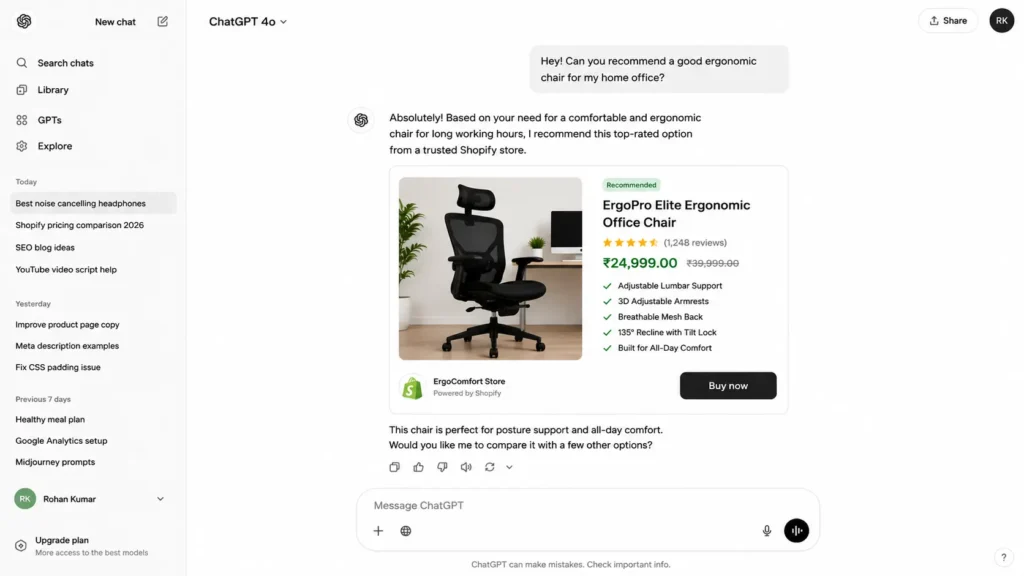
In 2026, Shopify used AI-driven commerce more frequently. Every paid plan now includes access to a feature called Agentic Storefronts, which lets products surface directly inside AI assistants like ChatGPT, Google’s AI Mode, Microsoft Copilot, and Perplexity. This turns conversational AI into an actual sales channel, not just a research tool.
Key Shopify Highlights
- Fully hosted, no server management
- Beginner-friendly admin dashboard
- Native AI shopping assistant integration (Agentic Storefronts)
- Scales from solopreneur stores to Shopify Plus enterprise brands
What Is Magento, Also Known As Adobe Commerce?
Magento is an open-source ecommerce framework originally built for developers who wanted total control over a store’s functionality and design. Adobe acquired Magento in 2018 and rebranded the paid enterprise tier as Adobe Commerce, while the free version remains Magento Open Source.
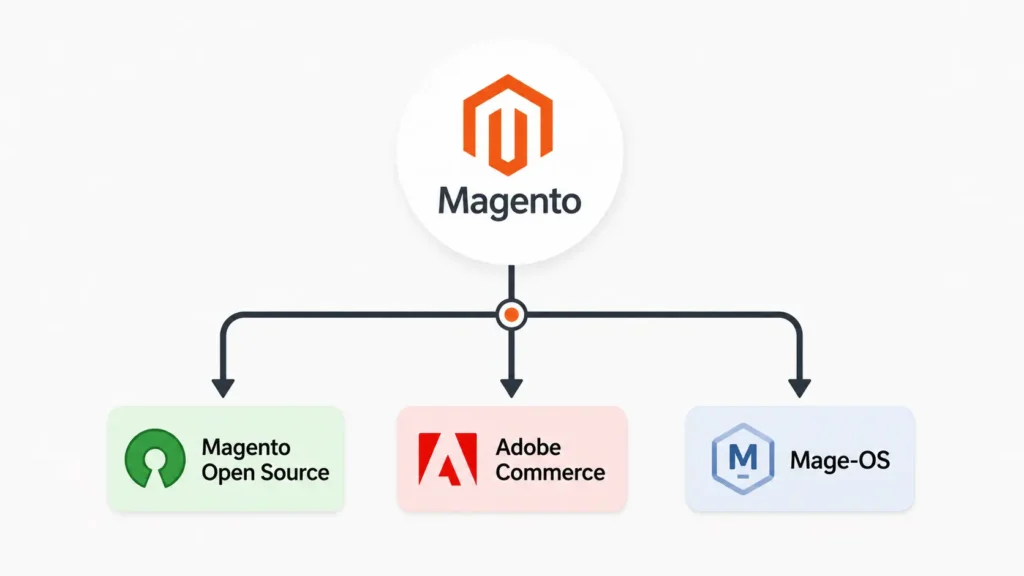
Today, the Magento ecosystem really has three paths:
The Three Magento Paths
- Magento Open Source, free to download, self-hosted, and infinitely customizable, though hosting, security, and development remain the site owner’s responsibility.
- Adobe Commerce, the paid enterprise tier with built-in B2B tools, AI-powered search through Adobe Sensei, staging, segmentation, and dedicated support.
- Mage-OS, a newer, community-maintained, nonprofit fork of Magento Open Source. It ships faster security patches and broader PHP support without an Adobe contract, and it has reached solid production maturity in 2026.
Magento vs Shopify: Pricing Breakdown in 2026
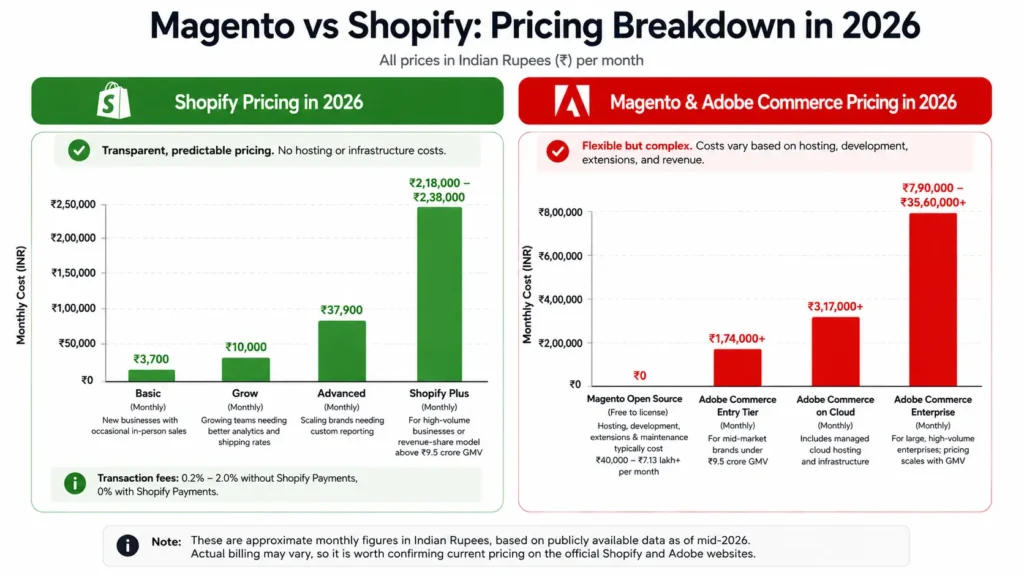
This is where the two platforms diverge the hardest. If only one section of this Magento vs Shopify comparison gets remembered, it should be this one.
Shopify Pricing in 2026
- Basic, around ₹3,700/month, suited to new businesses with occasional in-person sales
- Grow, around ₹10,000/month, suited to growing teams needing better analytics and shipping rates
- Advanced, around ₹37,900/month, suited to scaling brands needing custom reporting
- Shopify Plus, roughly ₹2.18 lakh to ₹2.38 lakh/month, or a revenue-share model above ₹9.5 crore in monthly gross merchandise value
Transaction fees range from roughly 0.2% to 2% without Shopify Payments, dropping to zero with Shopify’s own payment processor. There are no separate hosting or infrastructure costs since it is all bundled in.
Magento and Adobe Commerce Pricing in 2026
- Magento Open Source, free to license
- Adobe Commerce entry tier, roughly ₹1.74 lakh/month, for mid-market brands under ₹9.5 crore in gross merchandise value
- Adobe Commerce on Cloud, starting around ₹3.17 lakh+/month, bundling managed cloud hosting
- Adobe Commerce Enterprise, roughly ₹7.9 lakh to ₹35.6 lakh+/month, for large, high-volume enterprises
Here is the catch that trips up a lot of buyers: free Magento Open Source is not actually free once hosting, development, extensions, and ongoing maintenance enter the picture. Realistic monthly budgets typically land between ₹40,000 and ₹7.13 lakh+, depending on store complexity. Adobe Commerce licensing also scales with gross merchandise value, meaning the bill increases automatically as the store grows.
To be honest, Shopify’s pricing is clear and consistent. Magento’s pricing is a moving target that depends heavily on revenue, development resources, and hosting choices.
Customization and Flexibility
This is where Magento pulls ahead for the right kind of business.
Developers can tweak absolutely everything because Magento is open-source at its core: the checkout flow, the database structure, the catalog logic, third-party integrations, all of it. This makes it a favorite for businesses with unusual workflows such as multi-brand operations, complex B2B pricing tiers, ERP-heavy environments, or highly specific compliance requirements.
Shopify works more like a guided platform by comparison. An enormous app marketplace exists, and on Shopify Plus, access to Functions and Checkout Extensibility allows pricing logic, discounts, and checkout flows to be customized without forking the core code. Even so, everything still runs within Shopify’s architecture. Multi-vendor marketplaces are a good example of a business model that simply does not fit that architecture natively.
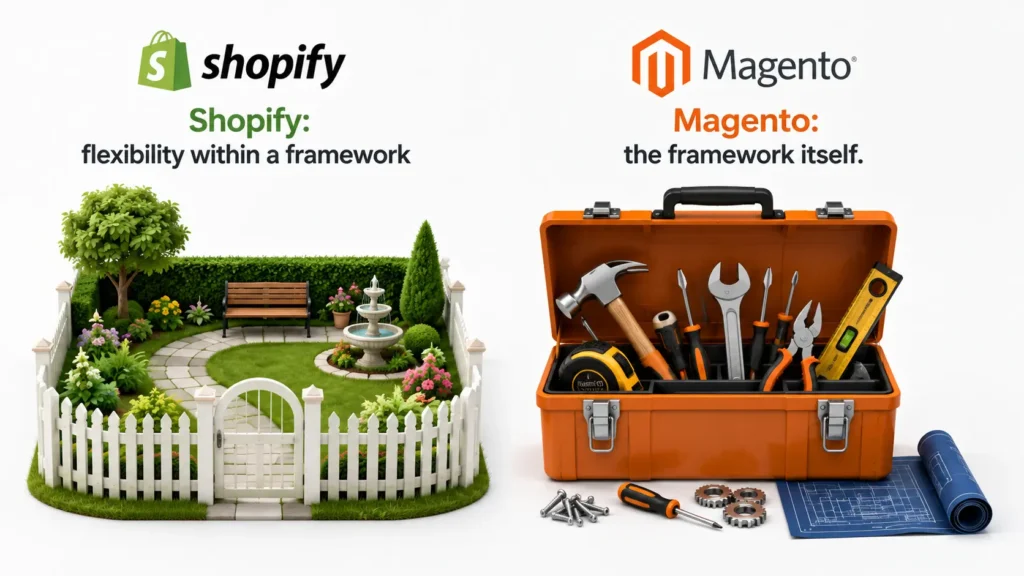
In short: Shopify offers flexibility within a framework. Magento offers the framework itself.
B2B Features Compared
One of the fastest-moving battlegrounds between these two platforms in 2026 is B2B commerce.
Adobe Commerce B2B Tools
A mature B2B suite has been part of Adobe Commerce since 2020, including company accounts with sub-account hierarchies, negotiated quotes, shared catalogs with company-specific pricing, and requisition lists. This has historically been one of Magento’s strongest selling points against Shopify.
Shopify B2B Tools
That gap has been closing fast on Shopify’s side. As of April 2026, every Shopify plan not just Shopify Plus offers fundamental B2B capabilities like company profiles, personalized price lists, and net payment conditions such Net 30, 60, or 90. Advanced B2B functionality, such as unlimited catalogs, complex approval chains, and deep ERP punchout integrations, still remains a Shopify Plus exclusive.
When highly specialized B2B logic is needed, Magento and Adobe Commerce continue to have an advantage. Shopify has become a genuinely viable option for more straightforward B2B needs, something that was not true even two years ago.
AI and the New Shopping Landscape in the Magento vs Shopify Debate
Arguably the most important shift in ecommerce in 2026 favors Shopify right now.
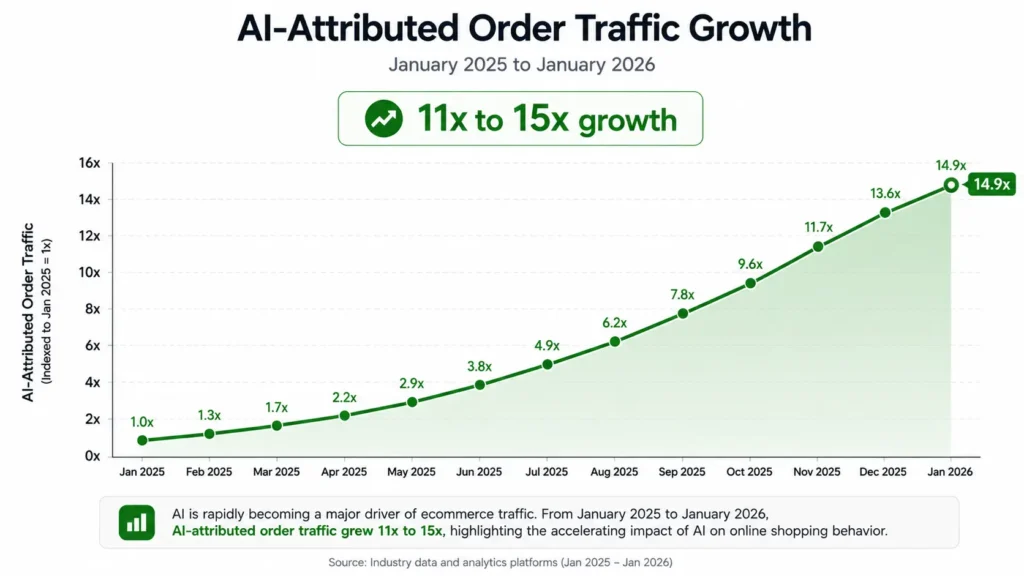
Native infrastructure for what the industry calls Agentic Storefronts has been built into Shopify, allowing AI assistants like ChatGPT, Gemini, and Copilot to recommend and even complete purchases from Shopify stores directly. Industry data shows AI-attributed order traffic on Shopify grew roughly 11 to 15 times between January 2025 and January 2026, and this capability now ships on every paid plan, not just enterprise tiers.
Adobe Sensei does provide AI tools for product recommendations and content generation within Adobe Commerce, but more advanced agentic AI capabilities require a separate Adobe Experience Platform license. That is an additional cost layer that can significantly increase total investment.
Where AI-driven discovery and conversational commerce are a growth priority, Shopify currently holds a meaningful head start.
Hosting, Security, and Maintenance
All Shopify plans include hosting, SSL, PCI compliance, and infrastructure scaling. No server ever needs to be touched. Security patches and uptime become Shopify’s responsibility, not the merchant’s.
Magento Open Source requires managing hosting independently, which can range anywhere from ₹380/month for a bare-bones setup to ₹47,500+/month for something production-ready. Security patches and PCI compliance also fall to the site owner.
Some of that burden is removed with Adobe Commerce on Cloud, which bundles managed AWS hosting, but at a substantial premium over the on-premise license.
A much more active patching cadence is also enforced by Magento in 2026. Monthly isolated security patches are now standard, and running an outdated version is a real vulnerability risk. Without a developer keeping watch, this becomes a genuine liability.
Scalability: Which Platform Grows Faster?
Serious scale can be handled by both platforms, but the mechanics look different.
Enterprise-level gross merchandise volume is supported by Shopify Plus through a contractual uptime service level agreement, expansion stores for international markets, and infrastructure that scales without any server management. The tradeoff is a revenue-share pricing model once monthly gross merchandise value crosses ₹9.5 crore.
Adobe Commerce is architected for scale at the code level, with support for multiple databases and complex multi-storefront setups. Scalability here means more infrastructure to manage, not less, and the license fee scales upward automatically as gross merchandise value grows. Many merchants find this turns into unpredictable, creeping costs at renewal time.
Support and Community
Official support around the clock across all plans is offered by Shopify, along with a massive user community, extensive documentation, and thousands of Shopify Experts and agencies available for hire.
There is no official dedicated support for Magento Open Source. Community forums, documentation, and a development partner become the main resources instead. Dedicated Adobe support is included for Adobe Commerce customers, which is part of what that license fee actually pays for.
Final Verdict: The Honest Truth About Magento vs Shopify 2026
No universal winner exists here.
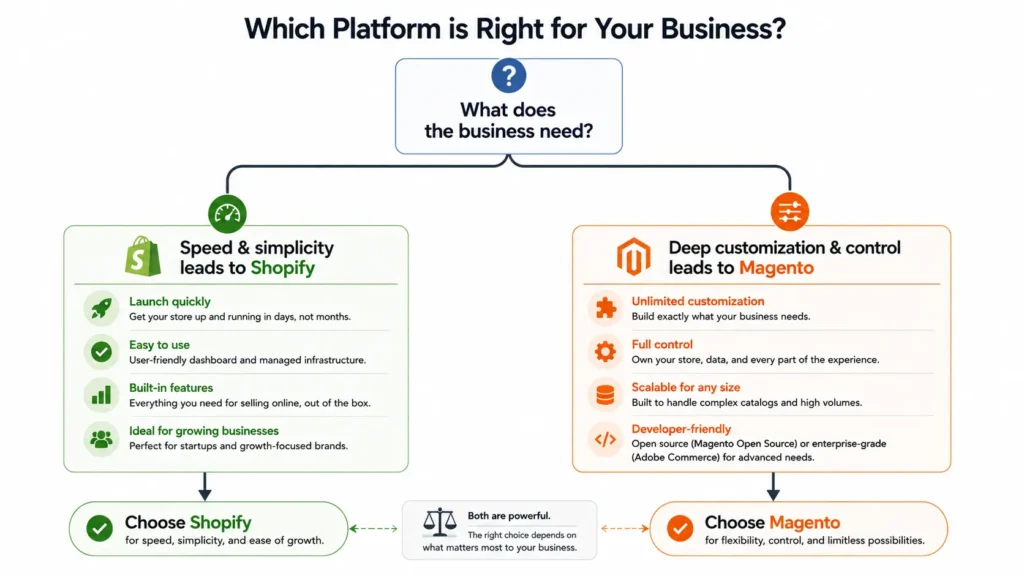
Speed, predictable costs, and access to the newest AI-driven sales channels are where Shopify wins, especially for teams without an in-house development team. It remains the smarter default for most small-to-mid-sized brands, and even a lot of large ones.
Genuinely complex requirements are where Magento wins, including multi-brand operations, deep ERP integrations, highly specific B2B workflows, or a need for total ownership of the codebase, provided the technical team or budget exists to support it.
Picking the wrong platform is not really the risk to worry about. The real risk is picking a platform that does not match the team’s technical capacity or the business’s growth stage. Honesty about both matters before committing.
Magento vs Shopify 2026 Frequently Asked Questions
Is Magento free?
Magento Open Source is free to download and use, but hosting, development, extensions, and maintenance are not free. Realistic monthly costs typically range from a few hundred rupees in the low thousands to well over ₹3.8 lakh depending on complexity.
Is Shopify cheaper than Magento?
For most small-to-mid-sized businesses, yes. Shopify’s all-in monthly pricing in the low thousands of rupees is far more predictable than Magento’s combination of free licensing plus variable development and hosting costs, or Adobe Commerce’s revenue-based enterprise licensing running into lakhs per month.
Can Shopify handle B2B businesses?
Yes. As of 2026, foundational B2B features are included on every Shopify plan, though advanced B2B capabilities remain exclusive to Shopify Plus.
Which platform is better for SEO?
Both platforms support strong SEO fundamentals. Shopify’s ease of use results in less technical SEO errors for non-technical site owners, while Magento’s full code access allows advanced developers more precise control.
Is Magento being discontinued?
No. Magento Open Source is actively maintained, and Adobe Commerce continues to receive regular updates. A community-driven fork called Mage-OS has also emerged as a credible alternative path in 2026.
Conclusion
Choosing between Magento and Shopify in 2026 really comes down to one honest question: does the business need speed and simplicity, or does it need total control and deep customization? In this Magento vs Shopify comparison, Shopify has closed the gap on B2B and pulled ahead on AI-driven shopping, making it the stronger all-round choice for most growing brands. Magento still holds its ground for large, complex, highly technical operations that can support the cost and the development work it demands.
Whichever platform gets chosen, the decision should rest on the team’s real technical capacity and the business’s actual growth stage, not just the sticker price on the homepage.
Disclaimer: Pricing figures are shown in Indian Rupees, based on publicly available data and industry estimates as of mid-2026, and are subject to change. Current pricing should always be confirmed directly with Shopify and Adobe before any purchasing decision.