

A Magento 2 product catalog rarely stays small. A store that launches with 500 products can reach 50,000 within a few years through new suppliers, variants, bundles, and marketplace feeds. Growth signals business success. However, growth also places steady pressure on the database, indexers, search engine, page speed, and admin panel. Knowing what changes at each stage helps merchants plan before shoppers notice problems.

Why a Growing Magento 2 Product Catalog Changes Everything
Every layer of an ecommerce stack feels the weight of a growing Magento 2 product catalog. More products mean more database rows, more attributes to index, more URLs to generate, and more filter combinations. Magento 2 was built for flexibility, and flexibility carries a cost as data volume rises.
Three areas change first:
- Data volume: Each simple product, configurable option, and custom attribute adds records across many tables.
- Processing time: Indexing, cache warming, and imports take longer with every new batch of SKUs.
- Operational complexity: Pricing, merchandising, and inventory updates need tighter coordination.
Stores rarely fail overnight. Performance usually slips gradually. Early monitoring therefore matters more than emergency repair.
How Catalog Growth Affects the Magento Database
EAV Structure Pressure on a Large Magento 2 Product Catalog
Magento stores product data with the Entity-Attribute-Value (EAV) model. Each attribute value sits in its own table row instead of one wide product row. The model allows unlimited custom attributes. However, queries must join many tables to assemble a single product. As a result, joins become heavier as the Magento 2 product catalog grows, and slow queries can start appearing in server logs.
Magento 2 Product Catalog Table Growth and Storage Demands
Related tables expand as well: URL rewrites, stock records, price indexes, catalog rules, and media gallery entries. URL rewrite tables alone can reach millions of rows on stores with many categories and store views. Regular cleanup and database tuning keep storage costs and query times under control.
Indexing Challenges in a Growing Magento 2 Product Catalog
Longer Reindex Times
Indexers convert raw product data into optimized tables that the storefront reads. For smaller catalogs, a full reindex may finish in minutes. However, with a large Magento 2 product catalog, a full reindex can run for hours and compete with customer traffic for server resources. For more information, the Adobe Commerce developer documentation explains indexer behavior and configuration.
Update on Save vs. Update by Schedule
Indexers run in two modes. The Update on Save mode refreshes data instantly but adds load during admin edits and imports. By contrast, Update by Schedule processes changes in batches through cron jobs. Large catalogs almost always benefit from scheduled mode paired with reliable cron monitoring.
Storefront Speed and Category Page Performance at Scale
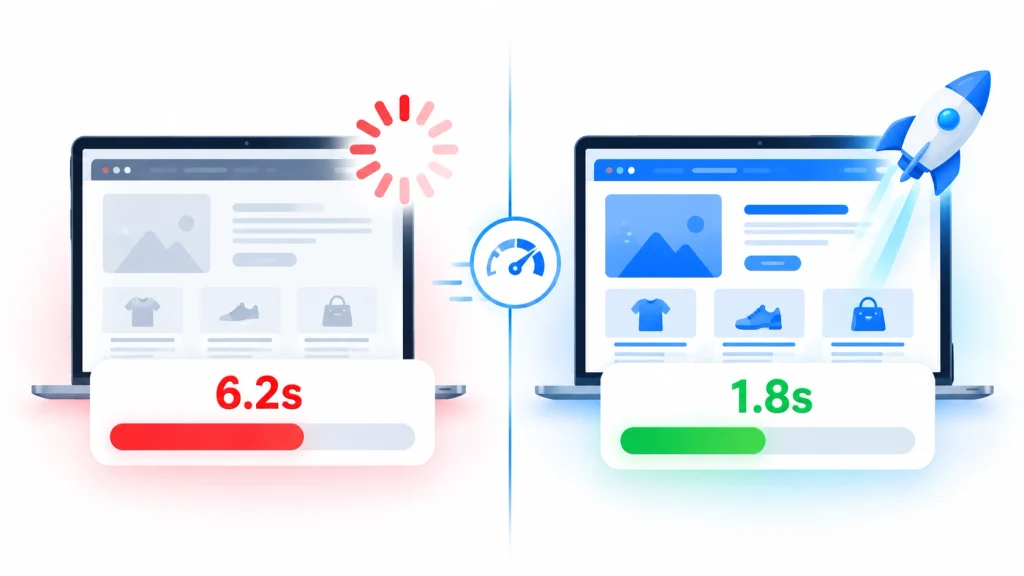
Shoppers judge a store within seconds. As a result, category pages with hundreds of products, layered navigation with many filters, and product pages with heavy option sets can slow rendering. Meanwhile, Google’s Core Web Vitals measure loading, interactivity, and visual stability. Slow listing pages on a big Magento 2 product catalog can hurt both rankings and conversions.
Common speed problems include:
- Oversized images without modern formats such as WebP.
- Large collections loaded without pagination limits.
- Uncached layered navigation queries.
- Excess third-party scripts on listing pages.
Full-page caching, a content delivery network, and optimized image pipelines solve most of these issues.
Search and Filtering Challenges as Product Counts Rise
Search quality often decides whether a large store converts. For large catalogs, search on a Magento 2 product catalog runs on OpenSearch or Elasticsearch. Without proper configuration, search can produce irrelevant results, slow autocomplete, and incomplete filters. In addition, the OpenSearch project offers guidance on cluster sizing and relevance tuning.
Worthwhile improvements:
- Dedicated search servers separate from the web application.
- Synonym lists and stop-word rules that match shopper vocabulary.
- Attribute weighting so names and SKUs rank above long descriptions.
- Filters limited to attributes that buyers actually use.
Admin Panel and Team Workflow Problems
Growth does not stop at servers. Merchandisers and content teams feel the change daily. For example, product grids can load slowly, bulk edits may time out, and large import files can fail midway. Furthermore, daily work on a Magento 2 product catalog can suffer from duplicate SKUs, inconsistent attribute naming, and missing descriptions when no governance process exists.
Practical solutions:
- Split large imports into smaller batches.
- Set naming rules for attributes and attribute sets.
- Schedule audits that flag disabled, out-of-stock, or duplicate products.
- Apply role-based permissions to reduce accidental changes.
Merchants seeking expert cleanup and scaling support can explore Magento development services.
Warning Signs That the Catalog Has Outgrown the Setup
Several symptoms show that a Magento 2 product catalog needs infrastructure or architecture attention:
- Admin saves take more than a few seconds.
- Cron jobs overlap or fail to finish before the next run.
- Category pages slow down during traffic spikes.
- Search results feel inaccurate or delayed.
- Database CPU stays high outside peak hours.
- Deployments cause noticeable downtime.
Spotting the signals early prevents lost sales and rushed fixes.
How to Scale a Magento 2 Product Catalog Step by Step
Upgrade Infrastructure
Larger catalogs need enough PHP workers, database memory, Redis for sessions and cache, and Varnish for full-page caching. Additionally, cloud hosting with autoscaling can handle seasonal peaks better than fixed servers.
Clean and Structure Magento 2 Product Catalog Data
Removing obsolete items, merging duplicate attributes, and compressing media lighten the Magento 2 product catalog and speed up queries. Moreover, clean data improves search relevance and marketplace feed quality.
Optimize Indexing and Cron
Scheduled indexers, message queues for asynchronous tasks, and monitored cron groups keep background work predictable.
Improve Category Architecture
Clear category trees, sensible pagination, and canonical tags prevent duplicate content and wasted crawl budget. Related reading: ecommerce site architecture best practices. Google also stresses helpful, well-organized pages in its guidance on helpful content, which supports organic traffic growth.
Adobe Commerce vs. Magento Open Source for Large Catalogs
Adobe Commerce is the paid edition built on the same foundation. Enterprise features include managed cloud infrastructure, B2B tools, staging, and advanced segmentation. Magento Open Source can still carry a large Magento 2 product catalog, though internal teams must manage hosting, security, and scaling. The right choice depends on budget, technical capacity, and growth targets. Official product details appear on the Adobe Commerce product page.
How Shopify, WooCommerce, and BigCommerce Handle Catalog Growth
Comparing platforms clarifies the tradeoffs of scaling.
- Shopify: A hosted platform that manages servers automatically. Scaling is simpler, while deep catalog logic depends on apps and Shopify Plus features.
- WooCommerce: Built on WordPress with flexibility and a low starting cost. Very large catalogs demand careful hosting, database tuning, and plugin selection.
- BigCommerce: A SaaS platform with strong native catalog features and multi-storefront support for mid-market and enterprise brands.
- Magento 2: The most control over data models, integrations, and custom logic, with performance responsibility resting on the development and hosting team.
No platform removes the need for disciplined catalog management. Each one only shifts where the workload sits.
Headless Commerce for Fast, Multi-Channel Growth
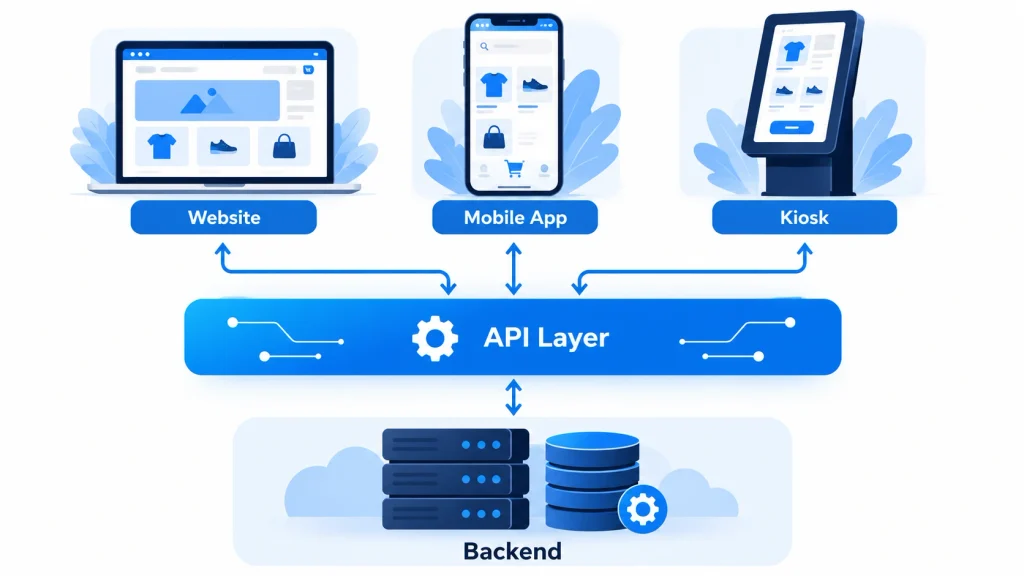
Headless commerce separates the customer-facing frontend from the commerce backend. A Magento backend can serve product data through GraphQL or REST to a frontend built with React, Vue, or Next.js, often as a PWA. Benefits include faster page loads, flexible design, and one data source for web, mobile, and kiosks. Costs include higher development effort and rebuilding search, checkout, and personalization on the frontend. Headless architecture suits stores with large catalogs, several channels, and strong engineering resources.
AEO, GEO, and AI Visibility for Large Product Catalogs
Search has changed. For this reason, Answer Engine Optimization (AEO) prepares content for direct answers in search results and voice assistants. Meanwhile, Generative Engine Optimization (GEO) prepares content for citations inside AI-generated summaries. Together, these approaches raise AI visibility and support steady organic traffic.
A well-structured Magento 2 product catalog gives AI systems clean, trustworthy data to quote. Effective tactics include:
- Structured data: Add Schema.org Product markup for price, availability, reviews, and brand.
- Direct answers: Open each section with a short, factual answer of 40 to 60 words.
- Question-led headings: Use headings that mirror real shopper queries.
- Entity clarity: Keep brand names, attributes, and specifications consistent across pages.
- Trust signals: Publish expert authorship, updated dates, and verifiable sources.
Google explains how generative results treat website content in its documentation on AI features and websites.

Building a Commerce Website Ready for Catalog Growth
Planning for scale at launch costs far less than retrofitting later. Businesses creating a new commerce website should consider:
- Data model planning: Define attributes, categories, and variant logic before importing products.
- Hosting strategy: Choose infrastructure that scales vertically and horizontally.
- Search-first design: Treat search and filtering as core features.
- Automation: Connect ERP, PIM, and inventory tools to avoid manual entry.
- Performance budgets: Set targets for page weight and load time, then test continuously.
A Product Information Management (PIM) system becomes especially valuable once a range passes several thousand SKUs. In addition, a PIM centralizes enrichment and pushes clean data to every channel.
Frequently Asked Questions About Magento 2 Product Catalog
How many products can Magento 2 handle?
Magento 2 can support hundreds of thousands of products when hosting, database tuning, caching, and search are configured correctly. Architecture quality matters more than a fixed product limit.
Why does a large catalog slow down a Magento store?
Slowdowns usually come from heavy database joins, long indexing cycles, unoptimized images, and search engines lacking resources. Fixing each layer restores speed.
Is Adobe Commerce better than Magento Open Source for big catalogs?
Adobe Commerce includes managed cloud hosting and enterprise features that reduce operational burden. Magento Open Source remains capable when a skilled team manages infrastructure.
Should a store move to headless commerce as the catalog grows?
Headless commerce helps when frontend speed, multi-channel publishing, and custom experiences are priorities. Smaller stores often achieve strong results with an optimized standard theme.
What is AEO, and how does AEO help ecommerce stores?
AEO stands for Answer Engine Optimization. AEO structures content so search engines and voice assistants can lift direct answers, which increases visibility and clicks.
What is GEO, and why does GEO matter for AI visibility?
GEO stands for Generative Engine Optimization. GEO shapes content so AI tools such as chat assistants and AI search summaries can cite a brand as a trusted source.
How can product data improve AI visibility and organic traffic?
Clean attributes, Product schema, consistent naming, and concise answer-style copy help AI systems understand and recommend products. Better understanding leads to more citations and more organic traffic.
How often should a large catalog be audited?
A quarterly audit of duplicate SKUs, unused attributes, image sizes, and URL rewrites keeps data healthy and prevents gradual performance decline.
Conclusion
A growing Magento 2 product catalog signals opportunity, yet unmanaged growth brings slower indexing, heavier databases, weaker search, and frustrated teams. Stores that invest early in infrastructure, clean data, smart indexing, and clear category structure keep performance steady while revenue climbs. Whether the plan involves staying on Magento, moving to Adobe Commerce, comparing Shopify, WooCommerce, or BigCommerce, or adopting headless commerce, the principle stays constant: build for tomorrow’s catalog size today.