

A client testimonial is one of the fastest ways an agency builds trust with a new prospect. Every agency collects feedback. Only a fraction of that feedback turns into a publish-worthy client testimonial that actually moves a reader toward a decision. This guide breaks down what separates a strong client testimonial from a forgettable one. It also covers how the format changes across Shopify, WooCommerce, Magento, BigCommerce, Adobe Commerce, and headless commerce projects.
Why a Client Testimonial Matters for Agencies
A prospect rarely trusts a sales pitch on its own. What actually closes the gap is proof. Strong customer feedback works like a stand-in for a personal referral. Placed near pricing pages, service pages, or contact forms, well-written customer feedback can influence conversions more than extra product copy.

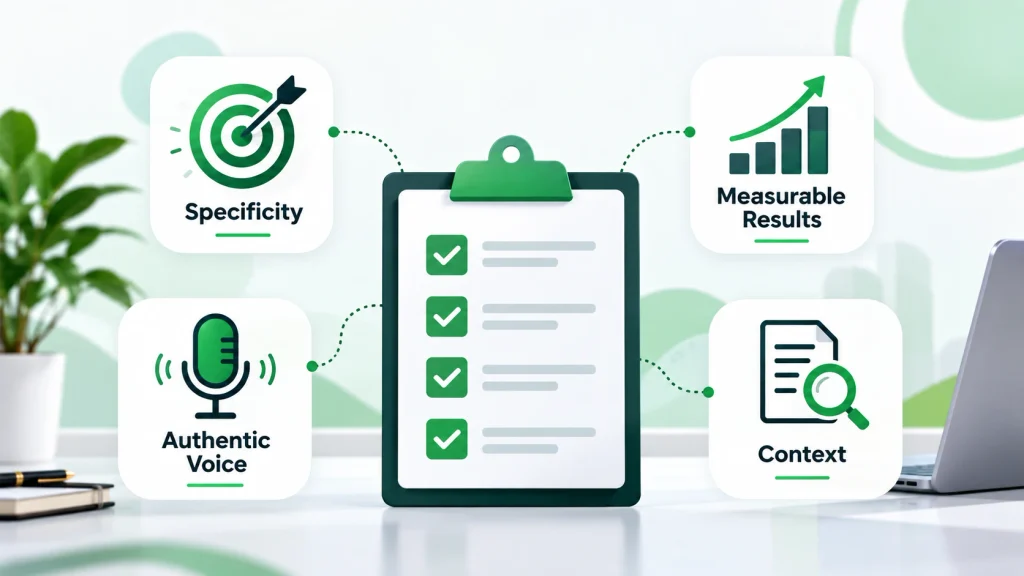
Key Elements of a Client Testimonial Worth Publishing
Specificity Over Generic Praise
“Great team, highly recommend” says nothing measurable. A publish-worthy customer review names the problem, the approach, and the result. Compare that to: “Checkout abandonment dropped 22% within two months of the redesign.” The second version is a customer review a reader can actually verify.
Measurable Results Inside the Client Testimonial
Numbers anchor a customer review in reality. Percentage growth, revenue generated, or time saved all count. A customer review with a specific figure near the opening line can be more credible than a vague one.
Authentic Voice in Every Client Testimonial
A customer review that sounds rewritten by a marketing department loses credibility fast. Natural phrasing, even with small imperfections, reads as more trustworthy than an overly polished customer review.
Context Behind the Client Testimonial
The strongest customer review opens with the original challenge, then the fix, then the outcome. That structure gives readers a story arc instead of a floating compliment.
Client Testimonial Examples Across Ecommerce Platforms
Agencies working across different ecommerce builds collect customer feedback in slightly different ways, depending on the platform.
Shopify: Shopify merchants often highlight theme customization speed and app integration ease. A strong Shopify customer review mentions the launch timeline and conversion-rate lift after the redesign, especially on stores built using Shopify’s official platform.
WooCommerce: WooCommerce clients frequently reference plugin compatibility and checkout flow improvements. A WooCommerce customer review carries more weight when it names the specific plugin conflict resolved, and site owners can reference WooCommerce’s official documentation for context.
Magento: Magento (Adobe Commerce) projects are typically larger in scope. So, a Magento client testimonial often focuses on page-speed optimization, catalog migration, or B2B feature rollouts supported by Adobe Commerce’s platform resources.
BigCommerce: BigCommerce merchants commonly praise multi-channel selling setup. A BigCommerce client testimonial that mentions marketplace integration adds concrete proof, particularly for stores using BigCommerce’s enterprise features.
Adobe Commerce: Enterprise Adobe Commerce clients value scalability and custom checkout logic. A client testimonial here should reference measurable uptime or performance gains, drawing on Adobe Commerce’s enterprise solutions.
Headless Commerce: Headless commerce projects, often built on frameworks like Next.js with Shopify or BigCommerce as the backend, Generate a customer review centered on site speed and flexibility. Agencies exploring this approach often reference Shopify’s headless commerce documentation for architecture guidance.

Where to Collect Strong Customer Feedback
The best customer feedback rarely comes from a generic “leave a review” request. Stronger material tends to surface through:
- Post-project debrief calls, where a client naturally reflects on results
- Short surveys sent right after a milestone, following practices outlined in HubSpot’s guide to customer testimonials
- Account manager check-ins where a client mentions wins in passing
- Case study interviews with follow-up questions that dig into specifics
How to Ask for a Client Testimonial Without Sounding Pushy
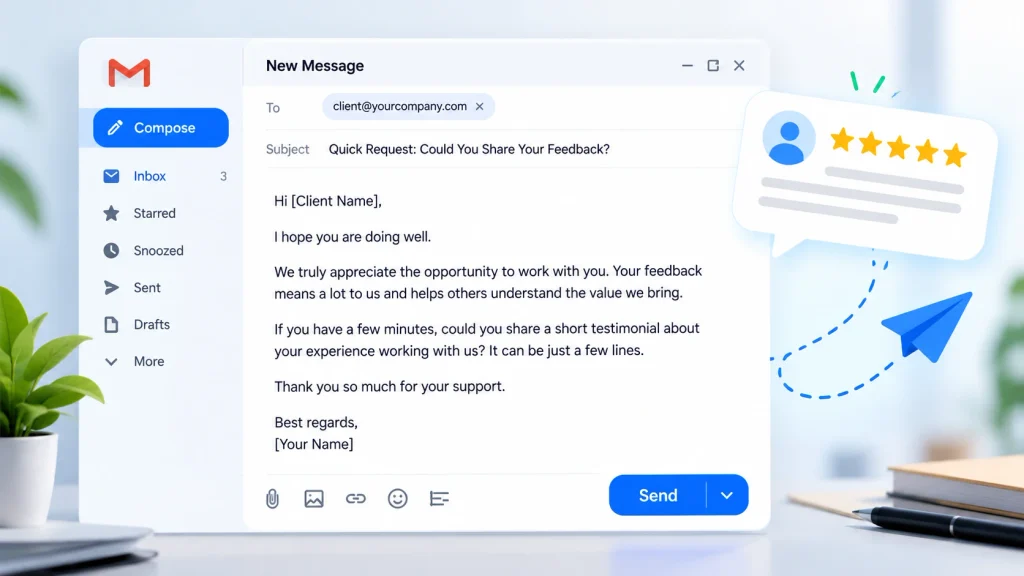
Timing matters. A customer review request feels natural right after a launch, a renewal, or a visible win not weeks later when the excitement has faded. Keep the ask short. A simple two-line email works better than a long form full of questions.
A few things help the request feel easy to say yes to:
- Ask a specific question instead of “any feedback?” for example, “What result stood out most since the launch?”
- Offer to write a first draft from a call transcript, then send it back for approval
- Keep the process short. Three minutes of a client’s time is easy to give; twenty minutes is not
- Always explain where the customer review will appear, so there are no surprises later.
A customer review collected this way tends to be more detailed and more honest, simply because the request felt low-effort and personal rather than transactional.
Common Mistakes That Weaken a Client Testimonial
- Overediting a customer review until it sounds like internal marketing copy.
- Publishing a customer review with no name, role, or company attached, which reduces credibility, as noted in Nielsen Norman Group’s research on trust signals
- Leaving out numbers or outcomes when they were originally shared
- Using a customer review that is too long, forcing a reader to skim past the strongest line.
- Skipping written permission before publishing a name, photo, or logo, in line with general FTC endorsement guidelines

How to Format a Client Testimonial for Maximum Impact
- Lead with the strongest line of the customer review, not the polite opener.
- Attach full name, title, and company wherever permission allows
- Pair the customer review with a photo or logo for authenticity, a practice supported by CXL’s conversion research on social proof
- Keep the customer review short two to four sentences.
- Link the customer review to a fuller case study for readers wanting more detail.
Video vs. Written Customer Review
A written customer review is faster to collect and publish. A video customer review can carry more persuasive weight, since tone and expression can add authenticity, as noted in Wyzowl’s video marketing statistics report. A mixed approach written client testimonial as default, video for flagship accounts works best for most agencies.
AEO, GEO, and AI Visibility for a Client Testimonial
Search behavior is shifting toward AI-generated answers through tools like ChatGPT, Perplexity, and Google’s AI Overviews. Answer Engine Optimization (AEO) and Generative Engine Optimization (GEO) determine whether customer feedback gets surfaced inside an AI-generated response, rather than only a traditional search listing.
A few things improve AI visibility for customer feedback:
- Structure the customer feedback in clear, quotable sentences that AI systems can extract cleanly.
- Attach schema markup (Review or Testimonial schema) so structured data clarifies who said what, following Google’s structured data guidelines
- Use direct question-and-answer formatting, since AI answer engines favor content already shaped like a response
- Keep each customer story fact-checkable with a name, a number, and a specific outcome.
- Publish the customer story on a fast-loading, crawlable page, since AI crawlers may deprioritize slow pages.

Customer Feedback Content That Increases Organic Traffic
A well-optimized customer feedback page supports organic traffic in three ways. It targets long-tail, trust-based search queries. It earns natural backlinks when case studies are cited elsewhere. And it increases average time-on-page, a ranking factor discussed in Google Search Central’s guidance on helpful content. Pairing customer feedback with schema markup, fast page speed, and a clear H2/H3 structure gives it the best chance of ranking in both traditional search and AI-driven answer engines.
FAQ
What makes a client testimonial worth publishing?
A client testimonial is worth publishing when it includes a specific result, names the original problem, sounds authentic rather than overedited, and includes a real name and company wherever permission allows.
How long should a client testimonial be?
Two to four sentences is generally enough. A longer client testimonial can be trimmed to its strongest section and linked out to a full case study.
Is permission required before publishing a client testimonial?
Yes. Written consent is strongly recommended before publishing any client testimonial that includes a name, job title, company name, or photo.
How does a client testimonial help with AI visibility (AEO/GEO)?
A client testimonial formatted in clear, factual, quotable sentences, and supported by schema markup, is easier for AI answer engines like ChatGPT and Google AI Overviews to extract and cite.
Do testimonials differ across Shopify, WooCommerce, and Magento projects?
Yes. A Shopify client testimonial often focuses on launch speed, a WooCommerce client testimonial on plugin fixes, and a Magento or Adobe Commerce client testimonial on performance and scalability for larger catalogs.
Should a client testimonial include exact numbers?
Whenever available, yes. Percentages, dollar figures, and timeframes make a client testimonial significantly more credible than vague praise.
Conclusion
A testimonial earns its place on a homepage or case study page only when it is specific, measurable, authentic, and properly formatted. Across Shopify, WooCommerce, Magento, BigCommerce, Adobe Commerce, and headless commerce projects, the strongest client testimonial always follows the same pattern: name the problem, show the number, and let the client’s real voice carry the rest. Agencies that treat every client testimonial as a mini case study, rather than a decorative quote, tend to see stronger conversion results and better visibility across both traditional search and AI answer engines.