

Retail websites lose real revenue every day because automated scripts visit stores without any intention to purchase. Bot traffic and checkout abuse are major threats to online retail. They drain server resources, affect analytics accuracy, and prevent real shoppers from buying high-demand products. A store might see a spike in sessions and assume demand is rising, only to discover that most of the traffic came from scripts scraping prices, testing stolen card numbers, or hoarding limited-stock items in abandoned carts. Understanding how automated abuse infiltrates a storefront, and how to stop it, is essential for any brand that depends on a healthy conversion funnel.
What Counts as Bot Traffic
Not every automated visitor is malicious. Search engine crawlers, uptime monitors, and price-comparison tools all send bots to a storefront, and most of that traffic is harmless or even useful. The trouble starts with malicious bots built specifically to exploit checkout systems: credential-stuffing scripts, inventory-hoarding bots, scalper bots, and scraper bots that copy pricing and product data for competitors.
The OWASP Automated Threats to Web Applications catalog outlines the most common categories of automated abuse, including scalping, denial of inventory, and account takeover attempts.
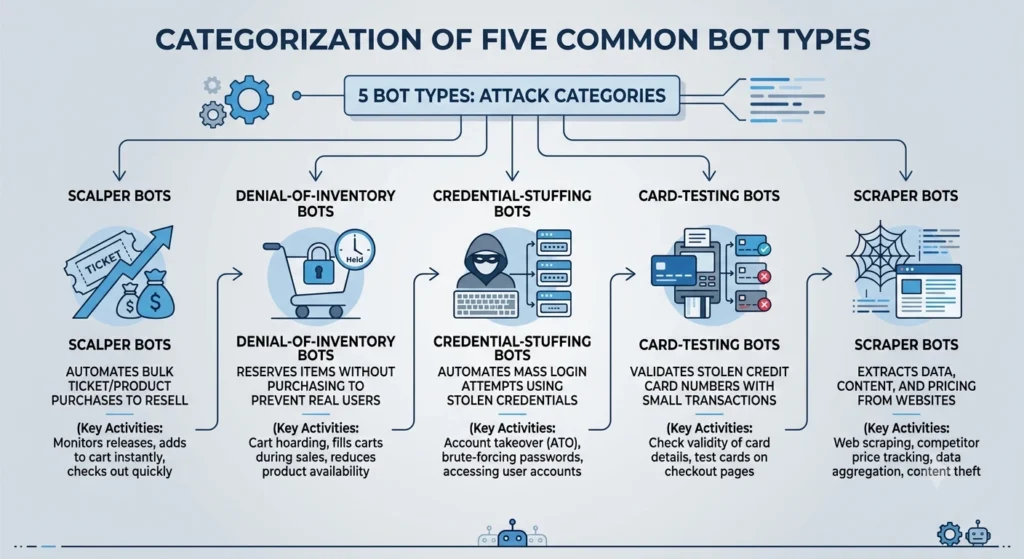
Common Bot Categories for Bot Traffic and Checkout Abuse
- Scalper bots purchase limited-edition or high-demand items within seconds of release, leaving nothing for genuine customers.
- Denial-of-inventory bots add products to cart without completing checkout, artificially showing items as out of stock.
- Credential-stuffing bots test stolen username-password combinations against login pages at scale.
- Card-testing bots run small, rapid transactions using stolen card numbers to validate which cards are still active.
- Scraper bots extract pricing, descriptions, and inventory data for competitor analysis or resale.
Impact on the Conversion Funnel
Checkout abuse rarely shows up as an obvious attack. It shows up as strange patterns: abandoned cart rates that climb without explanation, chargeback volume that creeps upward month over month, or customer support tickets from shoppers who could not complete a purchase because inventory “sold out” in seconds. Bot traffic and checkout abuse distort every stage of the funnel, from landing page views to final order confirmation, making it difficult to trust standard analytics.
Product teams misinterpret demand signals for products that were never actually purchased by a human, and marketing expenditures are directed towards channels that never generated a genuine customer as a result of a conversion rate optimization checklist based on inflated or bot-polluted data. The damage compounds because most attribution and analytics platforms count bot sessions the same as genuine ones unless filtering is specifically configured.
Financial and Reputational Costs of Bot Traffic and Checkout Abuse
- Chargeback fees from card-testing activity, which can also trigger higher processing rates from payment providers.
- Lost sales when scalper bots buy out inventory that real customers wanted.
- Server strain from high-volume automated requests, sometimes leading to slow load times or outages during peak sales events.
- Brand damage when frustrated customers publicly complain about a product that “sold out” in seconds, only to see it resold at inflated prices elsewhere.
Detection Signals Worth Monitoring
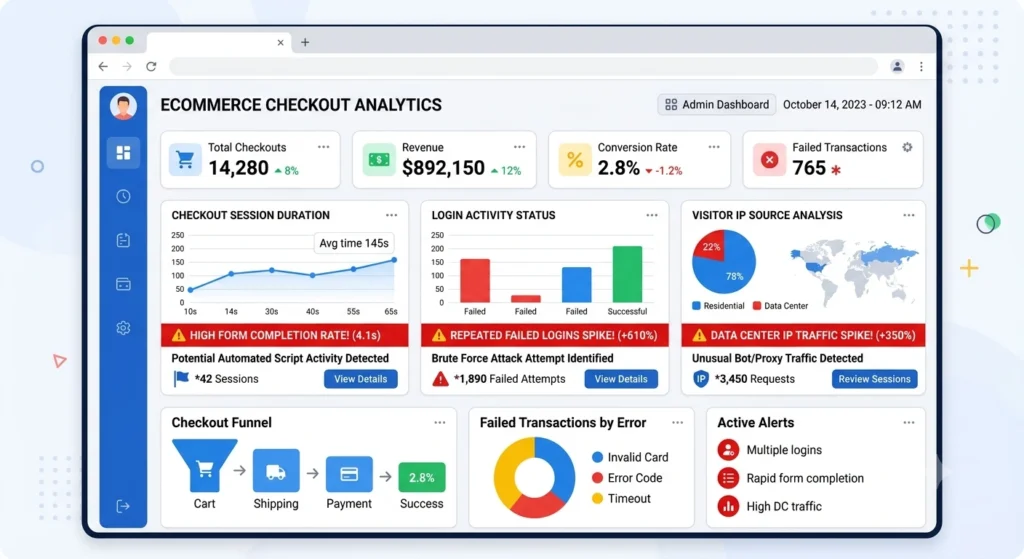
Spotting bot traffic and checkout abuse early depends on watching for patterns that differ from normal human browsing behavior. A few reliable signals include:
- Exceptionally quick form completion times (checkout completed in less than two seconds).
- Repeated failed login attempts from a small set of IP addresses or IP ranges.
- Cart abandonment spikes concentrated in a narrow time window right after a product launch.
- Identical browsing paths across sessions with no mouse movement or scroll behavior.
- A surge in traffic from data center IP ranges rather than residential ISPs.
Google’s guidance on verifying automated crawlers explains how legitimate bots identify themselves, which is a useful baseline for distinguishing verified crawlers from disguised abuse traffic.
Traffic analysis alone is rarely sufficient behavioral analysis combined with device fingerprinting tends to catch abuse that simple rate-limiting misses.
Platform-Specific Prevention Strategies for Bot Traffic and Checkout Abuse
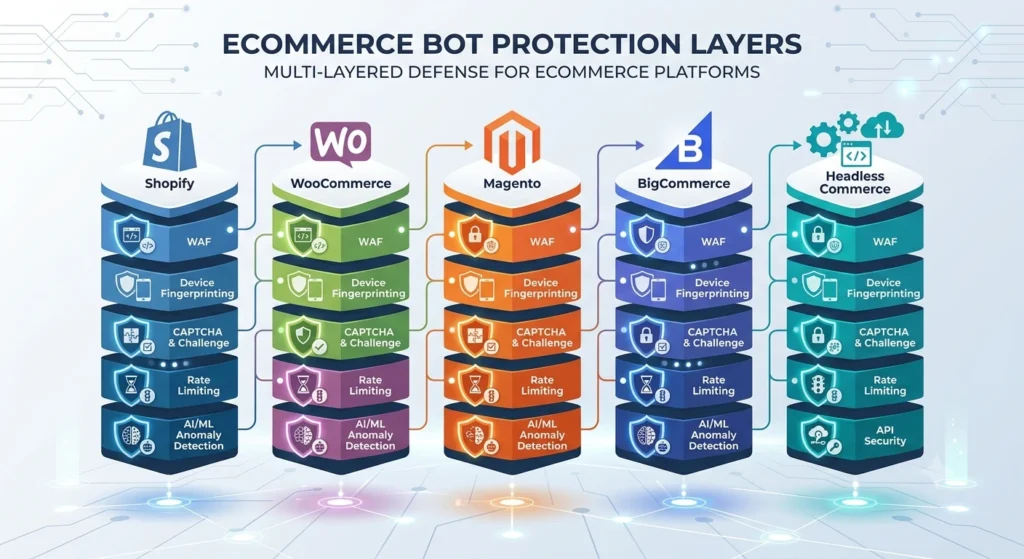
Every commerce platform handles bot mitigation differently, and the right defense depends heavily on the underlying architecture.
Shopify
Shopify stores benefit from built-in fraud analysis flags on each order, combined with third-party bot-mitigation apps from the Shopify App Store. Enabling CAPTCHA on high-traffic product pages during launches, along with checkout rate limiting, reduces scalper bot success rates significantly.
WooCommerce
Since WooCommerce runs on WordPress, security plugins that specialize in web application firewalls (WAF) and login attempt limiting serve as the first line of defense. Pairing a WAF with reCAPTCHA on checkout and account creation forms closes off two of the most common abuse entry points.
Magento (Adobe Commerce)
Magento and Adobe Commerce storefronts often face large-scale scraper and credential-stuffing attacks due to their popularity among enterprise retailers. Configuring admin-level rate limiting, enabling two-factor authentication for admin accounts, and deploying a dedicated bot-management layer at the CDN level, before requests even reach the application server, provides stronger protection than application-only fixes.
BigCommerce
BigCommerce‘s API-first architecture allows bot-detection services to be layered in at the edge, filtering malicious requests before they consume checkout resources. Store owners should also review API rate limits regularly, since headless integrations can inadvertently expose additional attack surfaces.
Headless Commerce
Headless setups separate the front end from the commerce engine, which means bot protection needs to be applied at multiple layers: the CDN/edge layer, the API gateway, and the commerce backend itself. Because headless architectures often expose APIs directly, unprotected endpoints become an easy target for automated abuse if authentication and rate limiting are not enforced consistently across every layer.
Tools and Technologies for Bot Mitigation
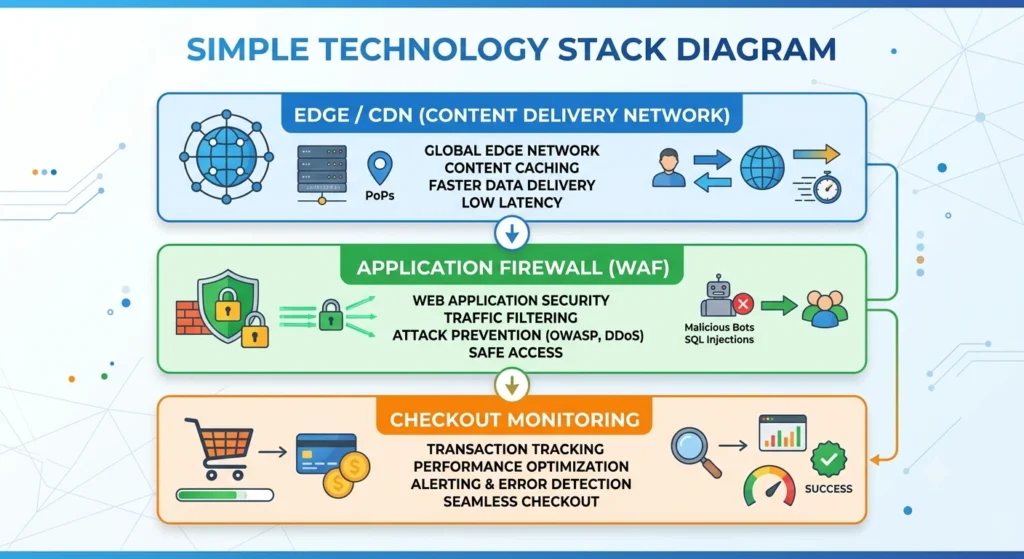
A layered technology stack tends to outperform any single tool when it comes to stopping bot traffic and checkout abuse. Several categories of tools work together to close different gaps in a store’s defenses.
Web Application Firewalls (WAF) to Prevent Bot Traffic and Checkout Abuse
A WAF sits between incoming traffic and the storefront, filtering requests based on known attack signatures, IP reputation, and traffic rules. Most WAFs can be configured to automatically challenge or block traffic from data center IP ranges, which is where a large share of automated abuse originates.
CAPTCHA and Bot-Detection Services
Modern CAPTCHA services move beyond simple image puzzles, instead scoring sessions based on mouse movement, typing cadence, and browser fingerprint data. Dedicated bot-detection vendors specialize in identifying automation frameworks like headless browsers, which are commonly used to script large-scale checkout abuse.
Rate Limiting and Queueing Systems to Prevent Bot Traffic and Checkout Abuse
Rate restriction restricts how many queries a single IP address or session can submit in a given amount of time. For high-demand product launches, virtual queueing systems add an extra layer of control, spacing out checkout attempts so a burst of bot traffic cannot overwhelm inventory in seconds.
Fraud Scoring and Payment Verification
Payment gateways increasingly offer built-in fraud scoring that flags suspicious transaction patterns, such as rapid small-value charges typical of card-testing bots. Combining fraud scoring with address verification and card verification value (CVV) checks reduces the success rate of automated payment fraud.
Common Mistakes Store Owners Make When Fighting Bot Traffic and Checkout Abuse
Even well-intentioned bot-mitigation efforts can fall short when a few common mistakes creep into the strategy.
- Relying on CAPTCHA alone. CAPTCHA reduces abuse but does not stop it entirely, since CAPTCHA-solving services are widely available to bot operators.
- Blocking traffic reactively instead of proactively. Waiting until a launch event is already underway to respond to bot activity almost always results in lost inventory before mitigation kicks in.
- Ignoring mobile app traffic. Bot mitigation strategies often focus heavily on the website while leaving a companion mobile app’s API endpoints unprotected.
- Over-blocking and frustrating real customers. Aggressive rate limiting or CAPTCHA placement on every page can create enough friction to drive away genuine shoppers, so tuning is necessary to balance security with usability.
- Failing to review chargeback and fraud reports regularly. Abuse patterns shift over time, and a defense strategy that worked six months ago may no longer catch newer bot techniques.
Building a Layered Defense
No single tool eliminates bot traffic and checkout abuse completely. The strongest storefronts combine several layers:
- Edge-level filtering blocking known malicious IP ranges and data center traffic before it reaches the server.
- Behavioral analysis flagging sessions with non-human interaction patterns.
- Rate limiting capping the number of requests allowed from a single source within a set time window.
- CAPTCHA and multi-factor authentication adding friction at high-risk points like login, checkout, and account creation.
- Ongoing monitoring reviewing traffic and chargeback reports regularly rather than reacting only after a major incident.
Combining automated tools with manual review of unusual order patterns tends to produce the best balance between blocking abuse and avoiding unnecessary friction for genuine shoppers.
Frequently Asked Questions About Bot Traffic and Checkout Abuse
What is the difference between bot traffic and checkout abuse?
Bot traffic refers to any automated, non-human visits to a website, while checkout abuse specifically describes automated or fraudulent activity that targets the purchase process, such as scalping, card testing, or inventory hoarding.
Can small ecommerce stores be affected by bot traffic and checkout abuse?
Yes. Store size does not determine risk. Smaller stores often have fewer security resources in place, which can make them easier targets for scalper bots and credential-stuffing attacks during high-demand product launches.
Does CAPTCHA fully stop checkout abuse?
CAPTCHA reduces automated abuse but does not eliminate it entirely, since sophisticated bots increasingly use CAPTCHA-solving services. Layering CAPTCHA with rate limiting and behavioral analysis produces stronger results than relying on CAPTCHA alone.
How can a store tell if traffic spikes come from bots rather than real customers?
Signals such as unnaturally fast checkout completion times, traffic concentrated from data center IP ranges, and identical browsing patterns across sessions usually indicate automated rather than human activity.
Is bot traffic always harmful to a conversion funnel?
Not always. Legitimate bots, such as search engine crawlers, serve a useful purpose and do not target checkout systems. The harmful category is limited to bots designed to exploit inventory, pricing, or payment systems.
Conclusion
Bot traffic and checkout abuse are not isolated technical issues confined to the IT department; the effects reach marketing budgets, inventory planning, customer trust, and revenue reporting. A storefront running on Shopify, WooCommerce, Magento, BigCommerce, Adobe Commerce, or a headless architecture each faces a slightly different set of risks, but the underlying principle stays consistent across every platform: layered, proactive defense outperforms reactive fixes applied after damage is already done. Store owners who monitor detection signals consistently, tune their tools to reduce false positives, and revisit their defenses as bot techniques evolve are best positioned to protect both revenue and customer trust over the long term.