

AI-powered ecommerce search has become one of the most valuable upgrades available to online retailers. Shoppers arrive with specific intent, and a search bar that misreads that intent sends buyers straight to competitors. Modern machine learning models interpret meaning, context and behavior, which turns a basic text-matching box into a revenue-generating discovery engine. For merchants on Magento, Shopify, WooCommerce and BigCommerce, the opportunity is significant. The right implementation can lift conversions, average order value and customer loyalty at the same time.
Quick Answer: AI-powered ecommerce search uses machine learning and natural language processing to understand shopper intent and rank products by relevance, behavior and business goals. Compared with basic text matching, the approach reduces zero-result pages, improves product discovery and increases search-driven revenue on Magento, Adobe Commerce, Shopify, WooCommerce and BigCommerce.
Key Takeaways
- Intelligent search understands meaning, not just matching characters.
- Every major platform offers a path to adoption, from apps to custom integrations.
- Magento enterprise development and Adobe Commerce suit large, complex catalogs.
- Headless ecommerce development allows one search layer to serve many channels.
- A clean ecommerce backend and strong ecommerce performance optimization decide how well search performs.
- Structured data, clear answers and trusted citations improve visibility in AI assistants and answer engines.
What Is AI-Powered eCommerce Search?
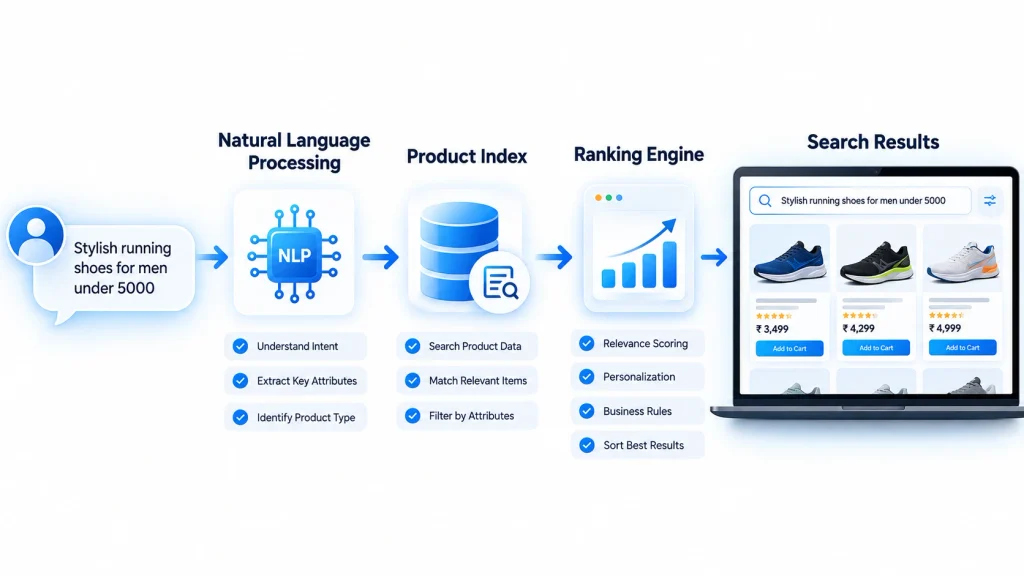
AI-powered ecommerce search is a retrieval system that uses natural language processing, machine learning and behavioral data to return the most relevant products for each query. Traditional engines match typed characters against product titles and descriptions. Intelligent engines go further. Intent, synonyms, spelling variations, past clicks and purchase signals all shape the ranking.
A query such as “light jacket for rainy commute” illustrates the difference. Exact-match logic might return nothing because no product contains the full phrase. A semantic engine understands that the request points to lightweight, water-resistant outerwear and surfaces suitable items immediately.
Key building blocks include:
- Natural language understanding for conversational and long queries
- Vector and semantic retrieval for meaning-based matching, explained in detail by Elastic’s guide to vector search
- Machine learning ranking informed by clicks, carts and purchases
- Personalization based on browsing history and segments
- Merchandising controls for business rules and promotions
Why Traditional Store Search Falls Short
Default search modules shipped with most platforms rely on database queries or basic indexing. Spelling mistakes, plural forms, brand abbreviations and regional vocabulary frequently produce empty result pages. Every empty page represents a lost sale and a frustrated visitor.
Static ranking creates a second problem. Bestsellers, margins and stock levels change daily, yet rule-based sorting rarely adapts. Merchandisers end up spending hours adjusting boosts manually. Intelligent search automates much of that work and keeps results aligned with real demand.
Usability research backs up the concern. The Baymard Institute’s ecommerce search research documents how many major stores still fail basic search expectations, such as handling abbreviations, symptom-based queries and product-type searches.
Core Capabilities of AI-Powered eCommerce Search
Semantic Understanding and Intent Detection
Semantic models map queries and products into a shared meaning space. Searches for “sneakers,” “trainers” and “running shoes” resolve to the same intent without manually maintained synonym lists. Intent detection also separates browsing queries from purchase-ready queries, allowing result layouts to adapt.
Personalized Ranking and Recommendations
Two shoppers typing the same word can receive different result orders. Past category affinity, size preferences, price sensitivity and device type all influence ranking. Personalization of that kind regularly improves click-through rates on the first page of results.
Visual, Voice and Conversational Search
Image-based discovery lets shoppers upload a photo and receive visually similar products. Voice queries are longer and more natural, which makes semantic engines especially useful. Conversational assistants can also refine results through follow-up questions such as budget or color preference.
Typo Tolerance, Autocomplete and Zero-Result Recovery
Fuzzy matching corrects errors in real time. Predictive autocomplete guides shoppers toward high-converting queries, and fallback logic replaces empty pages with related alternatives.
AI-Powered eCommerce Search Opportunities by Platform
Each platform offers a different balance of flexibility, speed of deployment and control. Understanding the differences helps merchants select an approach that fits technical resources and growth targets.
Magento Enterprise Development and AI-Powered eCommerce Search
Magento offers deep customization, which makes the platform a strong candidate for advanced search. Native catalog search relies on OpenSearch or Elasticsearch, and the architecture supports plugging in external relevance engines through modules and APIs. Large catalogs with complex attributes, multiple store views and B2B pricing benefit heavily from semantic ranking.
Enterprises evaluating magento enterprise development frequently prioritize search because catalog scale amplifies relevance problems. Thousands of SKUs, customer-specific price lists and layered navigation all depend on accurate retrieval. Official guidance is available in the Adobe Commerce developer documentation.
Adobe Commerce Development Services and Live Search
Teams working with adobe commerce development services can combine Live Search capabilities from Adobe with custom ranking layers. Typical projects include synonym governance, attribute weighting, merchandising rules and connectors to external recommendation engines. Specialist support shortens the path from pilot to production.
Magento 2 Commerce Cloud for Search Workloads
Merchants running Magento 2 Commerce Cloud gain managed infrastructure that supports heavy indexing and real-time personalization workloads. Built-in scaling, staging environments and deployment pipelines make it easier to test new ranking models without risking live revenue.
Magento 2 Performance Optimization for Fast Search
Performance remains central. Proper Magento 2 performance optimization ensures that intelligent search does not add latency. Index tuning, full-page caching, Redis configuration and asynchronous updates keep response times under a few hundred milliseconds.
Magento Ecommerce Development for Custom Search Connectors
Businesses seeking dedicated Magento ecommerce development expertise can build custom connectors, merchandising dashboards and analytics pipelines around the chosen search provider. Custom modules also allow business logic, such as margin-aware ranking or stock-priority boosts, to influence results.
Shopify
Shopify prioritizes speed of launch. The Search & Discovery app provides synonyms, filters and product boosts, while third-party apps add semantic ranking, personalization and visual search with minimal coding. Shopify Plus merchants gain additional flexibility through Hydrogen and the Shopify Storefront API, allowing fully customized search experiences.
The main opportunity lies in rapid experimentation. App-based deployment allows A/B testing of ranking strategies within days. The main limitation involves deep backend logic, where custom data models are more constrained than on open-source platforms.
WooCommerce
WooCommerce runs on WordPress and MySQL, and default search is notoriously basic. Plugins and external search services deliver the largest relative improvement among all four platforms. Because the platform is open and extensible, hooks and REST endpoints make integration straightforward, as outlined in the WooCommerce developer documentation.
Smaller stores can adopt hosted search plugins with prebuilt AI relevance. Larger WooCommerce stores often need a dedicated search index to offload queries from the database, which also improves page speed and server stability.
BigCommerce
BigCommerce combines SaaS reliability with an open API approach. Native search includes faceted filtering and basic relevance tuning, and the app marketplace offers AI-driven alternatives. Headless storefronts built with Next.js and the Catalyst framework make integration of external search widgets and personalized ranking services simple. Technical details sit in the BigCommerce developer documentation.
Multi-storefront capabilities create another opportunity: separate search configurations for regions, languages and customer groups under a single backend.
Platform Comparison at a Glance
- Magento and Adobe Commerce: best for large and complex catalogs; strongest customization and semantic ranking; requires skilled development and tuning.
- Shopify: best for fast launch and testing; app-based AI search live in days; limited backend flexibility.
- WooCommerce: best for small and mid-size stores; largest uplift over default search; needs an external index at scale.
- BigCommerce: best for SaaS stability with API flexibility; strong headless and multi-storefront search; relies on app or API integrations.

Headless Ecommerce Development and AI-Powered eCommerce Search
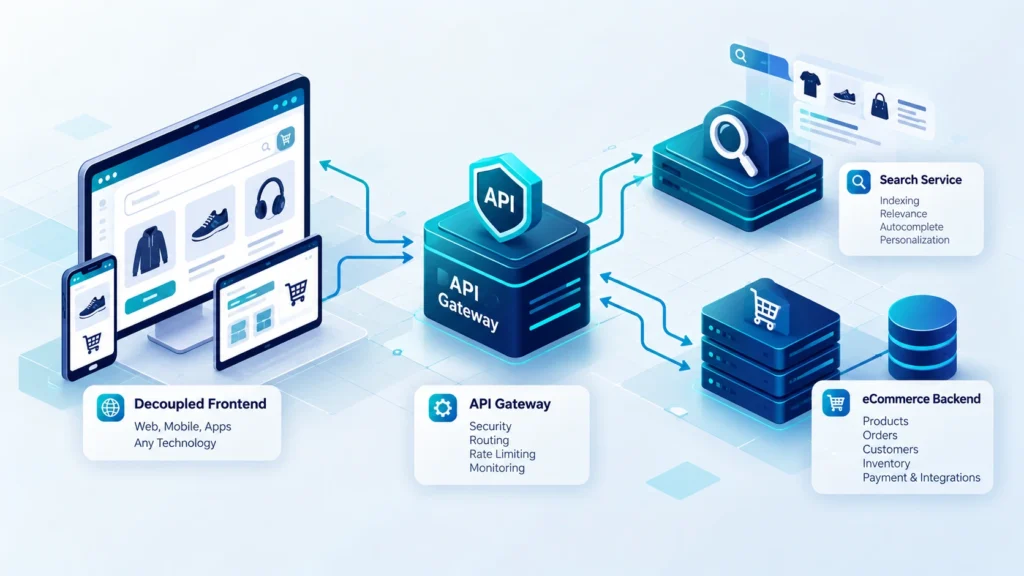
Decoupled architecture separates the presentation layer from the commerce engine. Search benefits greatly from that separation. A dedicated search service can sit between storefront and backend, receiving catalog updates through APIs and returning ranked results in milliseconds.
Headless ecommerce development opens several advantages:
- Frontend freedom to design instant search overlays, visual filters and conversational interfaces
- Independent scaling of search infrastructure during traffic spikes
- Platform flexibility: Magento, Shopify, WooCommerce, and BigCommerce can all be served by the same search layer.
- Omnichannel reuse across mobile apps, kiosks and marketplaces
Ecommerce API Integration Services for Search Data Sync
Reliable ecommerce api integration services are essential in the model. Product, price, inventory and customer data must synchronize continuously so that ranked results reflect real availability. Webhooks, event queues and incremental feeds keep the search index fresh without overloading the commerce platform.
Ecommerce Backend and Ecommerce Performance Optimization
Search quality depends on data quality. A well-structured ecommerce backend supplies clean attributes, consistent taxonomy, accurate stock and rich descriptions. Missing or inconsistent data weakens even the most advanced model.
Speed matters equally. Google’s Core Web Vitals guidance explains how loading speed, interactivity and visual stability shape user experience. Thoughtful ecommerce performance optimization for search includes:
- Edge caching of popular queries
- Incremental indexing instead of full reindexing
- Lightweight response payloads
- Lazy loading of result images
- Monitoring of query latency percentiles
Balancing relevance and response time ensures that intelligence enhances the experience rather than slowing the store down.
Integration Roadmap for AI-Powered eCommerce Search
A structured rollout reduces risk and produces measurable wins early.
- Audit current search: Review top queries, zero-result rates and exit rates after searches.
- Clean the catalog: Standardize attributes, titles, categories and descriptions in the ecommerce backend.
- Choose a supplier: Compare the needs for customization, budget, and catalog size with native tools, apps, and external engines.
- Pilot on a segment: Test on one category or region before full deployment.
- Tune and expand: Adjust synonyms, boosts and personalization based on data.
- Automate monitoring: Track relevance, speed and revenue influence continuously.
Measuring the Impact of AI-Powered eCommerce Search
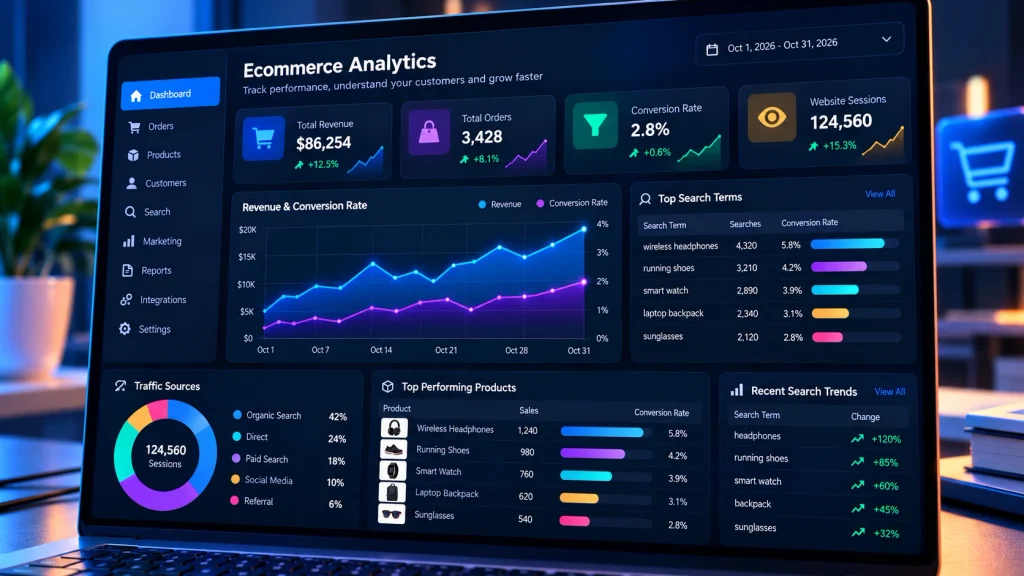
Clear metrics prove value and guide optimization. Important indicators include:
- Search conversion rate compared with non-search sessions
- Zero-result rate and recovery rate
- Click-through rate on the first result row
- Revenue per search session
- Average order value from search-driven visits
- Refinement rate, where fewer refinements signal better relevance
Event tracking through Google Analytics 4 ecommerce measurement captures search terms, product impressions and purchases in one reporting view. Pairing the data with usability findings from the Baymard Institute shows where relevance gaps still exist.
Answer Engine Optimization (AEO) for AI-Powered eCommerce Search
Answer engine optimization prepares content so that search engines, voice assistants and AI chat tools can extract a direct, trustworthy answer. Shoppers now ask full questions, and the first response often appears before any link is clicked. Stores and publishers that structure content for fast extraction earn more featured snippets, voice answers and AI citations.
Structured Data and Schema Markup
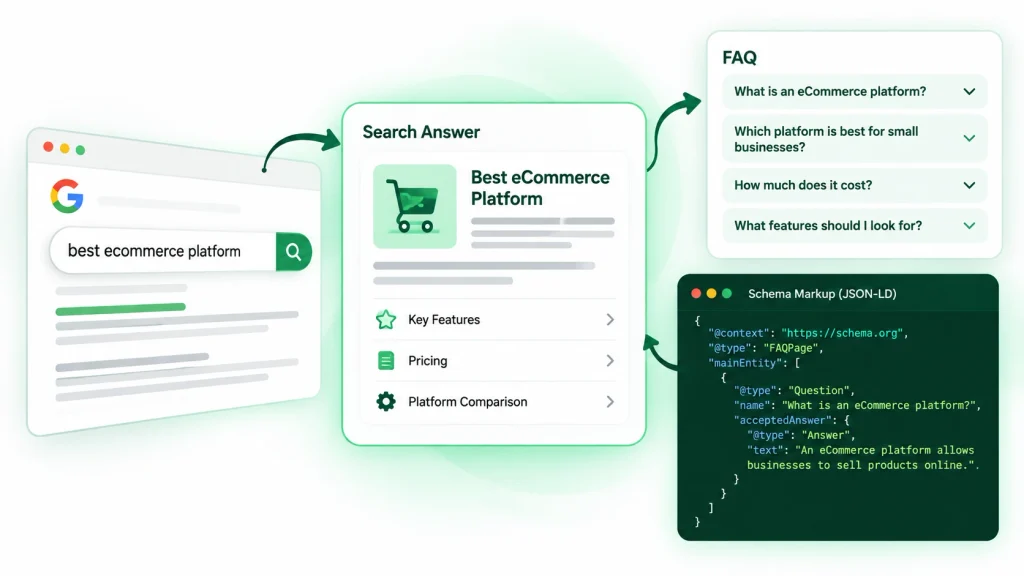
Schema markup tells machines exactly what a page contains. Product structured data communicates price, availability, ratings and variants, while FAQ structured data labels questions and answers. The shared vocabulary lives at Schema.org. Clean markup on category, product and guide pages improves the accuracy of AI-generated summaries and shopping results.
Question-Based Content and Direct Answers
Answer engines favor pages that respond to a question within the first one or two sentences, followed by supporting detail. Effective formatting follows a simple pattern:
- “What is AI-powered ecommerce search?” is an example of a question-style heading.
- A 40 to 60 word direct answer placed immediately below the heading
- Short paragraphs and lists for easy extraction
- A dedicated FAQ section covering follow-up questions
Search Experience Signals
Site search itself feeds AEO. Top internal queries reveal the exact language shoppers use, which can shape FAQ topics, buying guides and product descriptions. Zero-result queries expose content gaps worth filling.
Generative Engine Optimization (GEO) and AI Visibility for Online Stores
Generative engine optimization focuses on earning mentions and citations inside AI-generated responses from AI assistants, chat-based search and AI overviews. Visibility in those environments depends less on a single ranking position and more on clarity, authority and consistency across the web. Google’s documentation on AI features and website content confirms that standard search fundamentals still apply.
Entity Clarity and Brand Consistency
AI systems develop comprehension of entities like brands, products, and categories. Models are able to link the appropriate facts to the appropriate brand when business names, product names, descriptions, and organizational schema are consistent across websites, marketplaces, and social media accounts.
Authority, Citations and Original Insight
Generative tools prefer sources that demonstrate experience, expertise and trust. Google’s guidance on helpful, people-first content outlines the qualities that matter. Practical steps include:
- Original data such as benchmark results, case studies and survey findings
- Named authors with visible credentials
- Outbound citations to respected research and official documentation
- Fresh updates with visible revision dates
- Third-party mentions from review sites, industry publications and partner pages
Technical Access for AI Crawlers
Before being mentioned, content must be accessible. Key text is visible to crawlers through server-side rendering or static creation, which is important on headless shops that rely heavily on JavaScript. Discovery is supported by a clear XML sitemap, a well-configured robots.txt file, and quick page delivery. An optional, machine-readable summary of key site resources is provided by the developing llms.txt proposal.
Tracking AI Visibility
Measurement closes the loop. Useful tactics include:
- Monitoring brand references and routinely testing important questions in large AI assistants
- Analyzing referral traffic from AI platforms
- Monitoring branded search growth
- Comparing cited competitors and the content formats earning citations

Challenges and Best Practices
Intelligent search delivers strong returns, but careful planning avoids common pitfalls.
- Data privacy: Personalization must comply with regulations such as GDPR and the California Consumer Privacy Act.
- Cold start: New catalogs lack behavioral data, so hybrid ranking with rules is recommended initially.
- Over-personalization: Excessive tailoring can hide relevant variety.
- Accessibility: Search overlays and autocomplete should follow the WCAG accessibility standards.
- Governance: Merchandisers should retain override controls for campaigns and inventory priorities.
- Continuous testing: Regular experiments prevent relevance from drifting as the catalog evolves.
Frequently Asked Questions (FAQ)
What is AI-powered ecommerce search?
AI-powered ecommerce search uses machine learning and natural language processing to understand shopper intent and return highly relevant products, even for misspelled, vague or conversational queries.
Which platform benefits most from AI-powered ecommerce search?
All four platforms benefit. Magento and Adobe Commerce gain the most from handling complex, large catalogs, while WooCommerce sees the largest improvement over weak default search.
Why is Magento popular for advanced ecommerce search projects?
Magento supports custom modules, flexible APIs and OpenSearch-based indexing. Combined with magento ecommerce development and Magento 2 performance optimization, the platform handles large catalogs, B2B pricing and multiple store views with precise relevance control.
Does AI search slow down an online store?
A well-configured solution speeds up discovery. Caching, incremental indexing, ecommerce performance optimization and a dedicated search service keep response times fast.
Is headless architecture required for AI-powered search?
Headless architecture is optional. Traditional storefronts can integrate intelligent search through modules, apps and APIs, although headless ecommerce development offers greater design and scaling freedom.
How long does implementation take?
App-based setups on Shopify or WooCommerce can go live within days. Custom integrations on Magento or enterprise headless builds typically require several weeks, depending on catalog complexity and ecommerce api integration services scope.
How can the success of AI-powered ecommerce search be measured?
Search conversion rate, zero-result rate, revenue per search session, click-through rate and average order value provide a clear picture of performance.
What is the difference between AEO and GEO?
AEO structures content so search engines and voice assistants can extract direct answers. GEO builds authority, entity clarity and citations so generative AI tools mention a brand inside synthesized responses. Both rely on structured data, original insight and trustworthy sources.
Conclusion
AI-powered ecommerce search represents a practical, high-impact opportunity for every major platform. Magento and Adobe Commerce provide unmatched depth for complex catalogs, supported by magento enterprise development, Commerce Cloud infrastructure and performance tuning. Shopify enables fast app-based adoption, WooCommerce gains the largest uplift over default capabilities, and BigCommerce pairs SaaS stability with API flexibility. Headless ecommerce development further expands possibilities by allowing one intelligent search layer to power multiple channels.
Visibility beyond the store matters as well. Structured data, direct answers and trusted citations help AEO and GEO efforts place a brand inside the answers shoppers read first. Merchants that treat search as a core revenue system rather than a utility feature position stores for higher conversion, stronger loyalty and long-term growth. Starting with ecommerce backend cleanup, selecting a platform-appropriate engine and measuring outcomes consistently builds a reliable path forward.