

Online retailers already rely on machine learning every day. Algorithms rank search results, suggest products, flag risky orders, and forecast stock. AI in eCommerce has clearly moved past the experimental stage.
Magento and Adobe Commerce are well placed for the shift. The platforms offer a modular codebase, mature APIs, and a large extension ecosystem. The sections below connect each use case to a real store problem.
Quick answer: Start with intelligent site search, product recommendations, and catalog enrichment. Forecasting, dynamic pricing, and conversational support work better later, once data quality is dependable. Above all, AI in eCommerce succeeds when one pilot is measured against a holdout group before expansion.
What AI in eCommerce Actually Covers
Artificial intelligence in online retail is a family of techniques. It is not a single tool.
Four Core Technology Types
- Predictive models estimate demand, churn, conversion probability, or order risk from historical data.
- Ranking and recommendation models decide which products, offers, or search results appear first.
- Language models generate or classify text for product copy, support assistants, and query understanding.
- Computer vision reads images to tag attributes, detect duplicates, or match photos to catalog items.
Three Ways to Add Intelligence to Magento
Each route trades speed against control.
- Native Adobe services: The fastest launch on Adobe Commerce, though custom model logic has less room.
- Marketplace extensions: A budget-friendly choice for single-purpose features. Quality varies, so code review matters.
- Custom integration: The right fit for proprietary data or models. Build and maintenance effort rises accordingly.
Adobe documents built-in features in the Commerce Merchant Services guides. Examples include Product Recommendations and Live Search.
Practical AI in eCommerce Use Cases for Magento and Adobe Commerce
Search That Understands Intent
Shoppers who use site search usually show strong buying intent. Plain text matching often fails, however. Misspellings, regional vocabulary, and descriptive queries such as “quiet fan for small bedroom” all cause misses.
Machine-learned relevance fixes many of those gaps through synonym expansion, typo tolerance, and semantic matching. Adobe Commerce Live Search adds faceting and merchandising rules. Magento 2.4 stores run on OpenSearch or Elasticsearch, and many add a relevance layer from a specialist vendor.
Zero-result queries make the best diagnostic. Each one points to a vocabulary gap, a missing product, or a weak attribute.
Product Recommendations That Lift Basket Size
Recommendations work best when matched to page context. A product page suits “similar items” while a shopper compares options. A cart page performs better with “frequently bought together” accessories.
Adobe Commerce includes a Sensei-powered service with preconfigured unit types, such as most viewed and more like this. Magento Open-Source stores can reach similar outcomes with third-party engines.
Cold-start behavior deserves attention. New products and new visitors generate little data. Fallback rules, such as category bestsellers, keep recommendation slots filled.
Catalog Enrichment and Attribute Extraction
Weak product data undermines every other smart feature. Language models and computer vision can read supplier spreadsheets and images, then propose values such as material, fit, voltage, or compatibility. Generative drafting adds first-pass descriptions and meta tags.
A safe workflow sends generated output to a review queue before publication. Factual attributes need the closest checks, since a wrong dimension or compatibility claim causes returns. Retailers with tens of thousands of SKUs often save the most time here.
Conversational Support and Guided Selling
Assistants linked to catalog and order APIs handle routine questions. Order status, return policies, and product narrowing all fit well.
Grounded design is essential. Answers should rely on store data and policy documents, and low-confidence cases should pass to a human agent. Otherwise, an assistant may invent policies or prices, which creates legal and trust problems.
Dynamic Pricing and Promotion Tuning
Pricing models weigh competitor movement, inventory depth, margin targets, and elasticity. Full automation is rarely the first step. Many merchants begin by ranking promotion candidates or suggesting discount depth for clearance items.
Margin floors, brand pricing agreements, and change-frequency limits protect the business. Approved updates then flow into Adobe Commerce through catalog price rules, tier prices, or special prices set by API.
Demand Forecasting and Inventory Planning
Forecasts improve when several signals combine: sales history, promotion calendars, seasonality, supplier lead times, and regional patterns. Adobe Commerce Inventory Management (MSI) exposes multi-source stock data for planning tools. Teams can then move stock between warehouses or delay a reorder.
Accuracy usually improves after several seasonal cycles. Early outputs should therefore support decisions rather than replace them.
Fraud Screening and Payment Risk
Risk engines score each order using device data, address mismatches, order velocity, and chargeback history. The goal is balance. Genuine fraud must be blocked, yet false declines cost real sales.
Review queues handle mid-risk orders, and feedback loops record confirmed outcomes. Consequently, models stay accurate as attack patterns change.
B2B Reordering and Account Intelligence
Business buyers repeat purchases on predictable cycles. Models can forecast reorder timing, suggest requisition list updates, and flag accounts at risk of churn.
Adobe Commerce B2B features supply structured data through shared catalogs, company accounts, and quote negotiation. Predictions therefore become more reliable than those built on anonymous consumer traffic.

Technical Foundation: Data, Architecture, and Delivery
Smart features fail more often from weak engineering than from weak models.
Clean Data and Event Tracking
Models need consistent product attributes and accurate stock. Reliable behavioral events matter just as much: views, searches, add-to-cart actions, and purchases.
A documented tracking plan prevents silent data gaps. Consent signals must also travel through the same pipeline so personalization respects regional privacy rules.
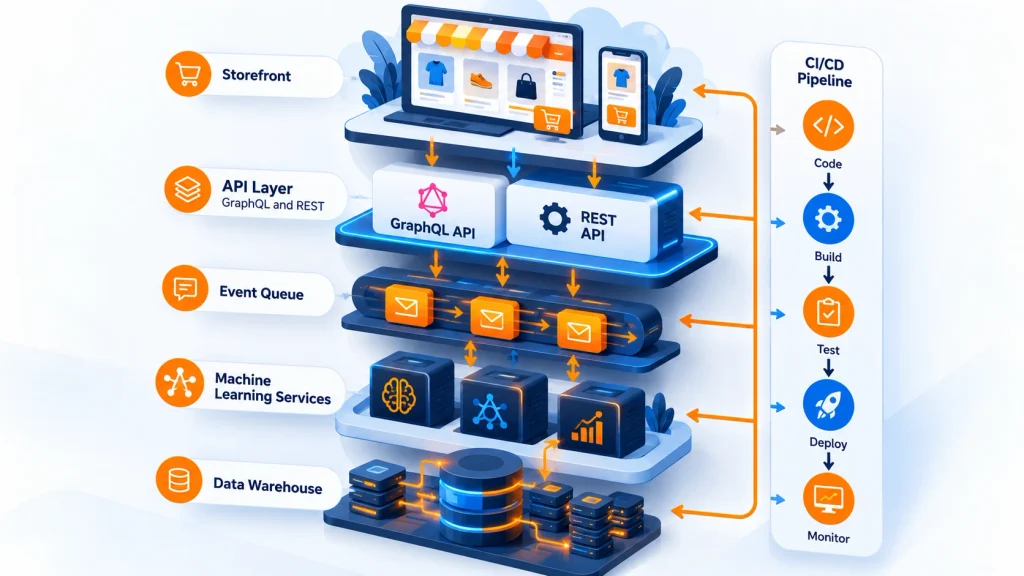
Integration Patterns on Magento
An experienced Magento ecommerce developer usually chooses among three patterns:
- Synchronous API calls for real-time features such as search.
- Asynchronous queues for heavy jobs such as enrichment.
- Event-driven flows for stock and order updates.
Adobe App Builder and eventing tools support out-of-process extensions. Custom logic stays away from core code, so upgrades become easier. Skilled Magento ecommerce development also adds automated tests at every integration point. As a result, a vendor outage never blocks checkout.
Cloud Hosting and Magento DevOps for AI in eCommerce
Magento 2 Commerce Cloud is the managed hosting option for Adobe Commerce. It bundles environments, a CDN, and monitoring, which suits workloads with many integrations.
Mature Magento DevOps adds CI/CD pipelines, staging that mirrors production, feature flags, and fast rollback. A recommendation widget or chat script can be switched off in seconds when conversion dips.
Speed and Ecommerce Performance Optimization
Every added script competes for load time. Therefore, ecommerce performance optimization should be rechecked after each rollout. Google’s Core Web Vitals set the benchmark:
- Largest Contentful Paint within 2.5 seconds
- Interaction to Next Paint under 200 milliseconds
- Cumulative Layout Shift below 0.1
Full-page caching with Varnish or Fastly, deferred loading of below-the-fold widgets, server-side rendering of recommendation blocks, and image compression all help.
Enterprise-Scale Requirements for AI in eCommerce
Large merchants face multi-brand catalogs, regional pricing, and ERP or PIM links. Magento enterprise development answers with queue-based processing, indexer tuning, and data governance. Adobe Magento development services often cover the full lifecycle, from architecture planning to post-launch support.
How Other Platforms Handle AI in eCommerce
Platform choice shapes how much intelligence arrives built in and how much must be assembled.
- Adobe Commerce and Magento: Native Sensei services, open APIs, and extensions. Best for complex catalogs, B2B, and deep customization.
- Shopify: Built-in assistants, content tools, and a large app store. Best for fast-moving direct-to-consumer brands.
- WooCommerce: Plugins and WordPress integrations. Best for content-led stores with moderate catalogs.
- BigCommerce: Integrations with search and personalization vendors. Best for mid-market merchants wanting open SaaS.
- Headless setups: Any intelligent service on any channel. Best for multi-channel brands with strong engineering.
Shopify and WooCommerce
Shopify bundles assistant and copy-generation tools into the admin. Setup is quick, but customization is narrower. WooCommerce relies on plugins for recommendations, chat, and content, so plugin quality and database speed need scrutiny as catalogs grow.
Teams weighing both options can compare Shopify development and WooCommerce development against catalog size and customization needs.
BigCommerce
BigCommerce keeps the core lean. Merchants connect specialist search and personalization tools through APIs. The Next.js-based Catalyst storefront framework appeals to teams wanting a modern frontend. Experienced BigCommerce development partners usually focus on integration quality and data mapping.
Headless Commerce and Composable Storefronts
Decoupling the presentation layer from the commerce engine brings flexibility. Smart features can run on web, mobile apps, kiosks, and voice interfaces from one backend. Adobe Commerce exposes GraphQL APIs built for such storefronts. Frontend options include PWA Studio, Hyvä-based themes, and Adobe Edge Delivery Services.
Headless commerce development raises the engineering bar, since caching, SEO rendering, and preview workflows must be rebuilt deliberately. Headless ecommerce development pays off most when several channels share the same search and personalization services. Planning details appear in headless commerce development guides.

Making Product Content Ready for AI Search and Answer Surfaces
Why Product Pages Need Parsable Facts
Shoppers increasingly start research inside assistants and search summaries. Product and category pages earn citations when facts are explicit and easy to parse. Consequently, AI in eCommerce strategy extends beyond the storefront into how catalog content is published.
Practical Content Steps
- Publish specifications as plain HTML text, not only inside images or scripts.
- Add Product structured data that matches visible price, availability, brand, and review details.
- Write short, direct answers to common pre-purchase questions.
- Keep brand names, product names, and policy details consistent across the store, marketplaces, and social profiles.
- Update stale pages on a schedule, since outdated specifications reduce trust.
Authority and Citation Potential
Google’s guidance on AI features and search states that no special markup is required for inclusion. Content quality and technical accessibility are the real levers.
In addition, buying guides, comparison pages, and integration walkthroughs build topical depth. Such pages attract references from industry publications, which strengthens site authority over time.
Implementation Roadmap for AI in eCommerce on Adobe Commerce
A phased plan limits risk and produces early wins.
- Weeks 1 to 2: Audit. Review attribute completeness, category structure, event tracking, and search exit rate.
- Weeks 3 to 6: Pilot one surface. Launch recommendations or improved search on a single store view, with a holdout group.
- Weeks 7 to 10: Measure and refine. Compare conversion rate, revenue per visitor, and page speed against the holdout.
- Weeks 11 to 14: Expand. Add catalog enrichment or support automation, using lessons from the pilot.
- Ongoing: Govern. Schedule model reviews, content audits, and privacy checks.
Merchants moving from older versions or other systems should check data and extension compatibility first. That work is the focus of Adobe Commerce migration projects.
Metrics That Show Whether Intelligent Features Deliver
Each use case needs one primary metric and one supporting metric:
- Search: Search conversion rate, backed by zero-result rate and exit-after-search rate.
- Recommendations: Average order value, backed by recommendation click-through rate.
- Catalog enrichment: Time to publish, backed by return rate by reason.
- Support assistant: Resolution without an agent, backed by customer satisfaction score.
- Forecasting: Stockout rate, backed by inventory turnover.
- Fraud screening: Chargeback rate, backed by false decline rate.
Controlled experiments beat before-and-after comparisons. Seasonality and campaigns easily distort raw trends.
Risks, Compliance, and Governance for AI in eCommerce
Every rollout carries risk. Clear rules reduce it.
- Privacy: GDPR and CCPA require a lawful basis, consent handling, and data retention limits for behavioral profiling.
- Accuracy: Generated product claims need human review, especially for health, safety, and compatibility statements.
- Bias and fairness: Pricing and personalization models should be audited for unintended discrimination.
- Vendor dependency: Contracts should cover data ownership, export options, and uptime commitments.
- Performance regression: Third-party scripts need budgets and monitoring.
Building a New Commerce Website with AI in eCommerce in Mind
Greenfield projects can build intelligence into the foundation. Product taxonomy, attribute models, and event schemas are far cheaper to settle before design starts. Retrofits cost much more.
A capable eCommerce website development team can align platform selection, hosting, search, and analytics with the launch roadmap. Enterprise builds benefit from Adobe Magento development services for integration design and long-term support. Smaller catalogs, meanwhile, may start leaner and scale later.

Where AI in eCommerce Is Heading
Agent-style shopping assistants have started comparing products and completing purchases for consumers. Machine-readable catalogs, accurate inventory feeds, and clear policies will matter more as a result.
Multimodal search will blend photos, text, and voice. Generative tools will assemble landing pages and campaign variants for approval, so teams no longer start from a blank page. Merchants with clean data and API-first architecture can adopt each development without a rebuild.
Frequently Asked Questions About AI in eCommerce
What is AI in eCommerce?
The term covers machine learning, language models, and computer vision applied to online retail. Typical tasks include search ranking, product recommendations, content creation, support, pricing, forecasting, and fraud detection.
Which intelligent features does Adobe Commerce include natively?
Adobe Commerce offers Sensei-powered Product Recommendations and Live Search through Commerce Merchant Services. Extensions and App Builder integrations add further capabilities.
Can Magento Open Source use machine learning features?
Yes. Marketplace extensions and custom API integrations provide search, recommendation, chatbot, and content tools. Native Adobe services, however, are tied to Adobe Commerce.
What is the best first use case for an online store?
Intelligent search or product recommendations usually deliver the fastest measurable return. Both affect high-intent behavior, and both rely on data most stores already collect.
Does automation slow down an online store?
It can when scripts are heavy or poorly loaded. Caching, deferred loading, server-side rendering, and regular Core Web Vitals checks keep performance healthy.
Is Magento 2 Commerce Cloud suitable for intelligence-heavy stores?
Managed environments, CDN delivery, and scalable infrastructure suit workloads with many integrations. Architecture and code quality still decide the results.
How does headless commerce relate to machine learning?
A decoupled frontend lets the same search, personalization, and assistant services power web, app, and other channels from one commerce backend.
How should product pages be prepared for AI-generated answers?
Specifications should appear as readable text. Structured data should match visible content. Common buyer questions deserve brief, accurate answers.
How long before results appear?
Search and recommendation changes often show movement within weeks. Forecasting and pricing models generally need several months of data.
Conclusion
Success with AI in eCommerce depends less on buying the newest model. Disciplined fundamentals matter more: trustworthy data, fast pages, careful rollout, and honest measurement.
Magento and Adobe Commerce offer the flexibility to start small and prove value. Pricing, forecasting, and support can follow. Strong engineering combined with genuinely useful product content serves shoppers well across classic search, AI summaries, and every channel in between.