
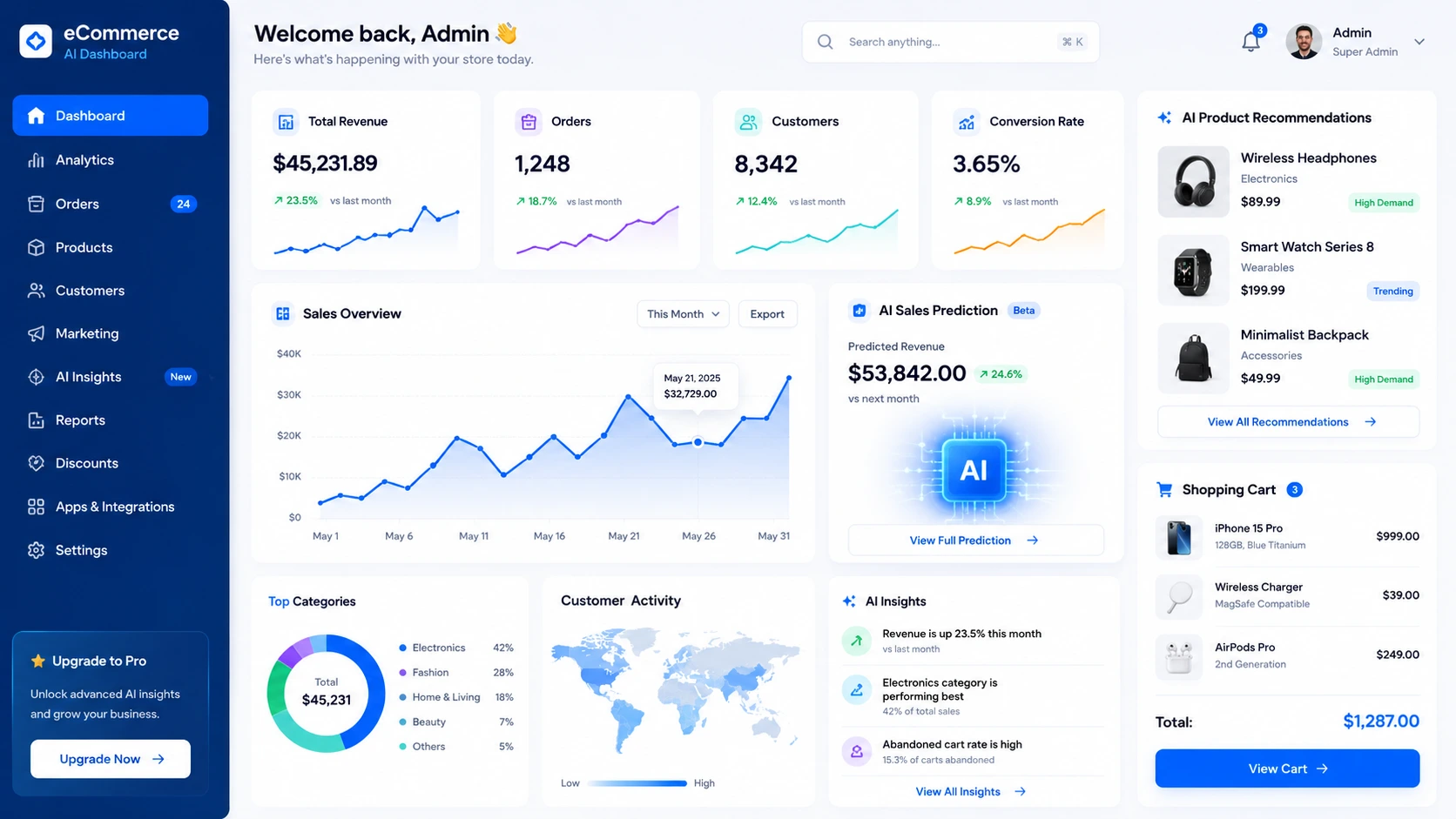
AI in eCommerce 2026 has moved past the experimentation phase. Online retail businesses of every size from small WooCommerce shops to enterprise Adobe Commerce deployments are now running AI tools in production, not just testing them in sandbox environments. The shift is no longer about whether artificial intelligence belongs in an online store; the shift is about which applications deliver measurable returns, and which remain overhyped.
This piece breaks down what is genuinely working right now, platform by platform, feature by feature, without the marketing fluff that usually surrounds this topic.
Beyond the Hype: The State of AI in eCommerce in 2026
A few years ago, most AI adoption in online retail centered on chatbots that answered basic FAQs and recommendation widgets that showed “customers also bought” suggestions. Those tools still exist, but the landscape has matured considerably.
By 2026, three categories dominate real-world usage, backed by retail AI adoption research
- Personalization engines that adjust product displays, pricing, and content per shopper in real time
- Operational AI covering inventory forecasting, fraud prevention, and logistics optimization
- Generative AI for content and support, including product descriptions, customer service, and visual search
The common thread among successful deployments: narrow, well-defined use cases outperform broad, all-in-one “AI platforms” that promise to automate everything at once.
AI Product Recommendations and Personalization Engines
Personalization remains the single most reliable AI application in online retail. Modern recommendation engines no longer rely purely on purchase history. Behavioral signals scroll depth, time spent on a product page, cart abandonment patterns, even weather and location data now feed into recommendation models.
Merchants running mature personalization stacks report:
- Higher average order value through cross-sell and bundle suggestions
- Reduced bounce rates on category pages
- Improved email click-through rates when product blocks are dynamically generated per recipient
The key differentiator between stores that benefit and stores that waste budget on personalization tools comes down to data quality. A recommendation engine fed with clean, well-structured product data consistently outperforms a more “advanced” model working with messy catalog information.

Conversational AI and Shopping Assistants
Chat-based shopping assistants have shifted from novelty to genuine support-cost reducers. Instead of scripted decision trees, current-generation assistants use large language models trained or fine-tuned on a store’s own catalog, policies, and past support tickets.
Practical wins observed across mid-size and enterprise stores:
- Order status and return questions resolved without human intervention
- Product-finder conversations that replace clunky filter menus, especially useful for stores with large, complex catalogs (furniture, electronics, apparel)
- Multilingual support without hiring additional agents
The pitfall worth noting assistants that are not properly scoped can hallucinate policies or pricing, creating customer trust issues. Guardrails and human escalation paths remain essential, not optional.
AI in eCommerce 2026: AI-Powered Search and Visual Discovery
Search has quietly become one of the highest-ROI applications of AI in eCommerce 2026. Traditional keyword-based site search frustrates shoppers who describe products in natural language (“a warm jacket for hiking in cold weather” instead of exact product names).
Semantic search models now interpret intent rather than matching exact strings, and visual search uploading a photo to find similar products has moved from a luxury fashion feature to a mainstream expectation across home goods, apparel, and beauty categories.
Stores that upgraded search infrastructure, alongside broader conversion rate optimization efforts, report measurable lifts in search-to-purchase conversion, often outperforming gains from marketing spend increases alone.
Supply Chain AI, Demand Forecasting, and Inventory
Behind the storefront, forecasting tools have become far more dependable. Machine learning models now factor in seasonality, regional demand shifts, marketing calendars, and even social media trend signals to predict stock needs.
AI in eCommerce 2026: Areas Showing Consistent Results :
- Reduced stockouts on high-demand items during promotional periods
- Lower excess inventory carrying costs
- Better-informed reorder timing with suppliers
Mid-market and enterprise merchants using Adobe Commerce and BigCommerce, in particular, have integrated these forecasting tools directly into order management workflows rather than treating them as separate spreadsheets.
Dynamic Pricing and Fraud Detection
Dynamic pricing models adjust prices based on demand, competitor pricing, and inventory levels. When implemented transparently and within reasonable bounds, this approach protects margin during high-demand periods without alienating shoppers through erratic price swings.
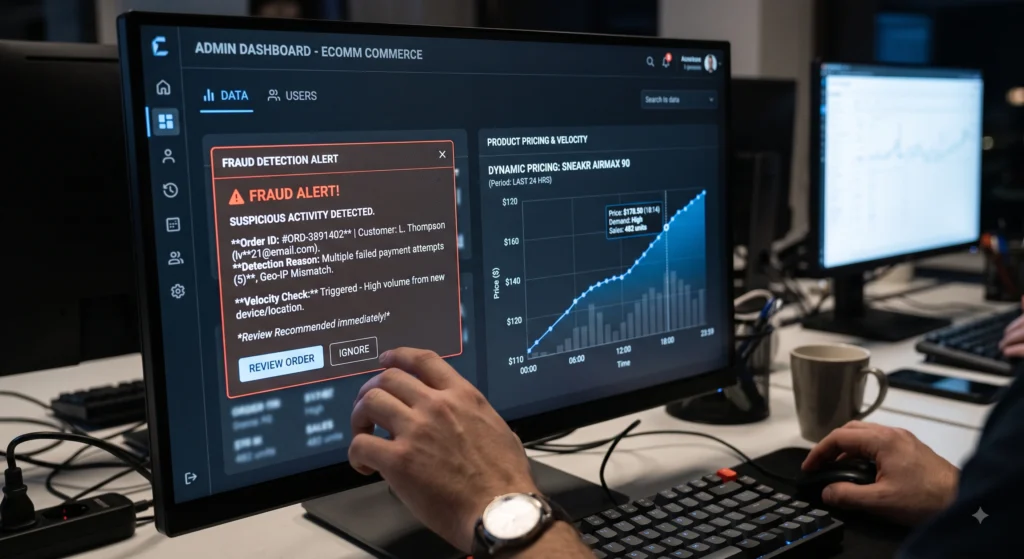
Fraud detection, meanwhile, has become one of the quieter but most valuable AI applications, tying directly into broader eCommerce fraud prevention strategy. Machine learning models trained on transaction patterns now catch fraudulent orders with far greater accuracy than static rule-based systems, reducing chargebacks without adding excessive friction to legitimate checkouts.
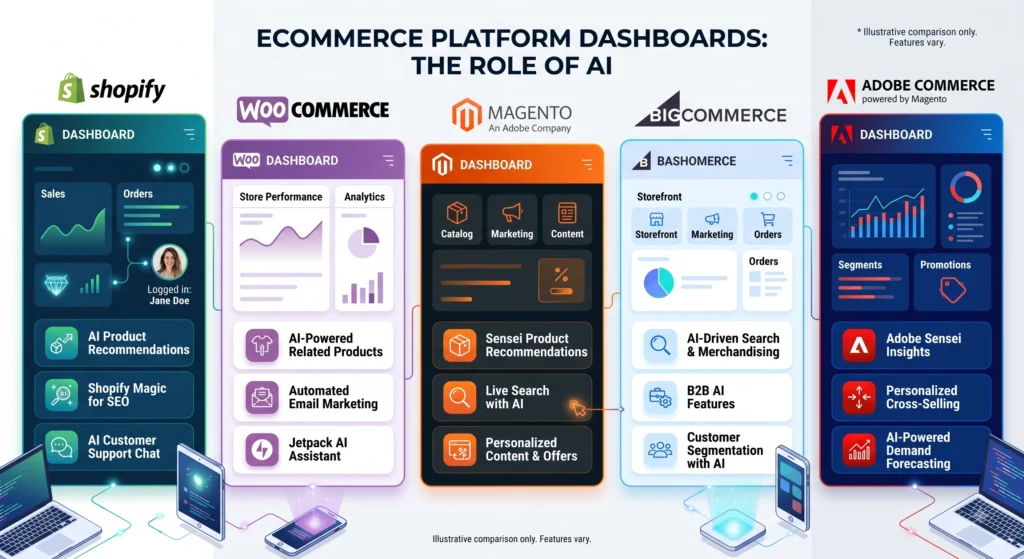
Platform-by-Platform: How Major eCommerce Platforms Handle AI
Each major eCommerce platform has taken a distinct approach to embedding AI into its ecosystem. A breakdown of what stands out on each:
Shopify
Shopify’s AI tools, built around its Shopify Magic and Sidekick features, focus heavily on content generation (product descriptions, email copy) and merchant-facing assistance (store setup guidance, analytics summaries). Native AI-driven product recommendation apps integrate easily through the App Store, making Shopify‘s AI tools a strong choice for small-to-mid-size stores wanting AI capability without heavy development work.
WooCommerce
Because WooCommerce runs on WordPress, AI adoption depends heavily on plugin selection. Merchants pair WooCommerce with third-party AI plugins for personalization, chat support, and content generation. Flexibility is the advantage; the tradeoff is that quality and support vary widely across the plugin ecosystem, so vetting tools carefully matters more here than on more tightly controlled platforms.
Magento (Adobe Commerce)
Magento’s open-source core allows deep customization of AI integrations, appealing to merchants with in-house development resources. Custom-built recommendation engines, search integrations, and fraud detection systems are common on Magento stores that need highly specific business logic.
BigCommerce
BigCommerce has leaned into native AI features for product descriptions, image alt-text generation, and merchandising suggestions, alongside a strong ecosystem of AI-focused apps for personalization and search. Its API-first design also makes it a popular choice for headless implementations that pair BigCommerce’s backend with AI-enhanced custom frontends.
Adobe Commerce
Adobe Commerce (the enterprise version of Magento) integrates with Adobe Sensei, Adobe’s AI and machine learning framework, powering product recommendations, search relevance, and content optimization at enterprise scale. This tier suits larger retailers with complex catalogs and higher development budgets.
Headless Commerce Architectures
Headless setups separating the frontend presentation layer from the backend commerce engine have become a natural fit for AI experimentation. Because headless commerce architecture relies on APIs, merchants can plug in specialized AI services (search, personalization, chat) without waiting on platform-specific feature releases. This approach requires more development investment upfront but offers the most flexibility for merchants wanting to combine best-in-class AI tools from multiple vendors.
Content Creation and Marketing Automation
Generative AI tools now assist with product descriptions, blog content, ad copy, and email campaigns across nearly every platform listed above. The realistic picture: these tools speed up first drafts significantly, but content still requires human review for brand voice, accuracy, and originality. Stores publishing AI-assisted content without editing often see inconsistent tone and, in some cases, factual errors in product specifications.
Common Pitfalls When Adopting AI in eCommerce
- Treating AI as a one-time setup rather than an ongoing process requiring monitoring and retraining
- Poor data hygiene, which undermines even the most sophisticated models
- Over-automating customer-facing communication without human escalation paths
- Chasing every new AI tool instead of focusing on two or three high-impact applications
Building an AI Roadmap for 2026
A practical approach for merchants evaluating where to start:
- Audit existing product and customer data quality before adding new AI tools
- Prioritize one operational area (forecasting, search, or personalization) rather than attempting all at once
- Pilot with a defined success metric conversion rate, average order value, or support ticket reduction
- Scale only after the pilot shows measurable impact
- Reassess quarterly, since AI tooling in this space evolves quickly
AI in eCommerce 2026 FAQs
What does AI in eCommerce 2026 actually mean for small businesses?
It means access to personalization, search, and support tools that were previously limited to large enterprises, now available through affordable apps and plugins on platforms like Shopify, WooCommerce, and BigCommerce.
Which eCommerce platform has the strongest native AI features?
Shopify and BigCommerce currently offer the most accessible native AI tools for merchants without development teams, while Adobe Commerce and Magento suit businesses needing deep customization.
Is headless commerce necessary to use AI effectively?
No. Headless commerce offers more flexibility for combining specialized AI tools, but many merchants achieve strong results using native or app-based AI features on traditional platforms.
What is the most reliable AI investment for online retailers right now?
Personalization and search improvements consistently show the clearest return, provided the underlying product data is clean and well-organized.
Does adopting AI in eCommerce 2026 replace the need for human staff?
Not entirely. AI reduces repetitive workload (support tickets, forecasting spreadsheets, first-draft content) but human oversight remains essential for accuracy, brand voice, and handling complex customer situations.
Conclusion
AI in eCommerce 2026 has settled into a practical, results-driven phase. The merchants seeing real returns are not the ones adopting every new tool on the market they are the ones focusing on clean data, clear use cases, and platform-appropriate integrations, whether that means Shopify’s built-in AI features, a custom Magento build, or a fully headless architecture powering a specialized frontend experience.