

AI-powered search is changing the way online shoppers find products across Magento, Shopify, WooCommerce, BigCommerce, and headless storefronts. Traditional search boxes depend on exact text matches, which often return empty pages or irrelevant results. Modern engines driven by machine learning interpret intent, understand context, and rank products by relevance and likelihood of purchase. The outcome is faster product discovery, higher conversion rates, and a smoother shopping experience.
Why Traditional Site Search Fails Shoppers
Basic search tools match typed text against product titles and descriptions. A shopper typing “lightweight jacket for rainy hiking” may see zero results if the catalog uses the phrase “waterproof trail shell.” Misspellings, synonyms, and long conversational queries create similar failures.
Research from the Baymard Institute shows that site search remains one of the weakest areas of ecommerce usability. Usability studies from the Nielsen Norman Group also confirm that a visible, forgiving search experience is essential for task completion. Poor results push shoppers toward competitors, and every failed query represents lost revenue.

How AI-Powered Search Works
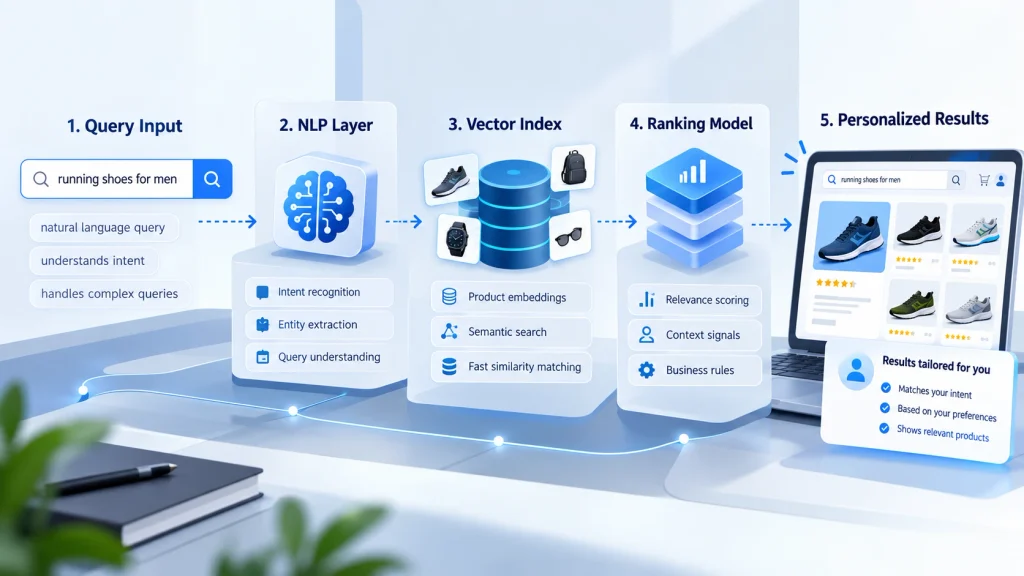
AI-powered search combines several technologies that work together to interpret what a shopper actually wants.
Natural Language Processing and Intent Detection
Natural language processing breaks a query into entities, attributes, and intent. A phrase such as “red running shoes under 80 dollars” is parsed into color, category, and price range, then matched against structured catalog data. Typo tolerance, stemming, and synonym handling operate automatically.
Semantic and AI-Powered Search Retrieval
Semantic search converts both queries and product data into numerical vectors. Products with similar meaning sit close together in vector space, so a query for “sofa” can surface couches and sectionals without manual synonym lists. Engines built on Elasticsearch and OpenSearch now support vector retrieval alongside classic text matching, while hosted platforms such as Algolia deliver the same capabilities as a managed service.
Machine Learning Ranking and Personalization
Ranking models learn from clicks, add-to-cart events, and purchases. Results shift according to device, location, browsing history, and seasonal demand. Two visitors searching for the same term can receive different result orders based on past behavior.
Key Benefits of AI-Powered Search for Product Discovery
- Higher relevance: Intent-aware matching reduces zero-result pages.
- Better conversion: Shoppers reach the right product in fewer steps.
- Larger order values: Smart recommendations surface complementary items.
- Reduced bounce rate: Relevant results keep visitors engaged.
- Actionable insights: Query analytics reveal unmet demand and catalog gaps.
- Scalability: Large catalogs with thousands of SKUs remain searchable without manual tuning.
Advanced Features That Strengthen Product Discovery
Relevance is only the starting point. Modern engines include interface and data features that guide shoppers from the first keystroke to the product page.
Autocomplete and Query Suggestions
Autocomplete predicts a query while typing and displays matching categories, brands, and products in a dropdown. Well-designed suggestions shorten the path to purchase and steer shoppers away from phrases that return weak results. Guidance from the Baymard autocomplete research highlights the value of clear, scannable suggestions that mix query terms with category shortcuts. Product thumbnails and live pricing inside the dropdown add further context.
Visual Search and Voice Search
Visual search allows a shopper to upload a photo and receive visually similar items, which suits fashion, furniture, and home decor catalogs. Voice search relies on speech recognition, and browser support through the Web Speech API makes spoken queries practical on mobile storefronts. Spoken queries tend to be longer and more conversational, so natural language models handle them far better than keyword matching.
Smart Filters and Dynamic Facets
Dynamic facets change according to the query. A search for “laptop” can surface memory, screen size, and processor filters, while a search for “dress” can highlight size, fabric, and occasion. Accurate attributes make such filters possible, and Google Search Central product structured data guidelines offer a useful standard for organizing product information consistently.

AI-Powered Search on Major eCommerce Platforms
Each platform offers a different path for adding intelligent search. The right approach depends on catalog size, traffic, and technical resources.
Magento and Adobe Commerce
Large catalogs benefit most from advanced search. Adobe Commerce includes Live Search powered by Adobe Sensei, documented in the Adobe Commerce Live Search guide, while Magento Open Source relies on OpenSearch with extensions for semantic features. Businesses investing in Magento ecommerce development often connect external engines for faster indexing and finer ranking control.
An experienced Magento ecommerce developer can tune attribute weighting, configure synonyms, and customize facets. For Magento enterprise development projects with multiple store views and complex pricing, a dedicated search layer keeps response times low. Teams offering Adobe Magento development services typically audit indexing, caching, and query performance before connecting any AI engine. Adobe Commerce development also covers GraphQL-based search queries, which pair well with modern storefronts. Detailed technical references are available in the Adobe Commerce developer documentation.
Stores hosted on Magento 2 Commerce Cloud gain managed infrastructure, which simplifies scaling search during peak seasons. The Adobe Commerce Cloud documentation explains environment setup and deployment workflows. Strong Magento DevOps practices, including CI/CD pipelines, automated index monitoring, and staged rollouts, ensure that ranking changes reach production safely.
Shopify
Shopify provides the Search & Discovery app, while many merchants also use engines such as Algolia or Searchanise. Through Shopify development, teams can customize search using theme code, the Storefront API, and metafields that enrich product data. Clean product tags and structured metafields significantly improve AI relevance. The Shopify developer documentation outlines available search APIs.
WooCommerce
Default WordPress search handles product queries poorly. WooCommerce development projects commonly integrate Elasticsearch-based plugins or hosted services to enable typo tolerance, filters, and instant results. The WooCommerce developer resources cover hooks and APIs for custom search behavior. Lightweight hosting setups should rely on external search services to avoid database strain.
BigCommerce
BigCommerce development benefits from open APIs and native integrations with leading search vendors. Product attributes, custom fields, and category structures feed the AI model directly, and the BigCommerce developer center provides guidance on connecting external engines.
Headless Commerce
Decoupled storefronts need a search layer independent of the backend. Headless commerce development usually pairs a frontend framework with an API-first search service delivering results in milliseconds. Headless ecommerce development also allows search widgets, autocomplete, and visual merchandising to be built exactly to brand requirements, without theme limitations.

Ecommerce Performance Optimization for Search
Intelligent search adds value only when pages remain fast. Ecommerce performance optimization should run in parallel with any search upgrade.
- Serve autocomplete from an edge cache or dedicated search cluster.
- Keep index updates incremental rather than full rebuilds.
- Compress and lazy-load product thumbnails in result grids.
- Limit heavy scripts on search result pages.
- Monitor Core Web Vitals after every deployment.
- Test result pages regularly with PageSpeed Insights.
Slow results erase the benefits of relevance. A response time under 200 milliseconds for suggestions keeps the experience feeling instant.
Steps to Implement AI-Powered Search
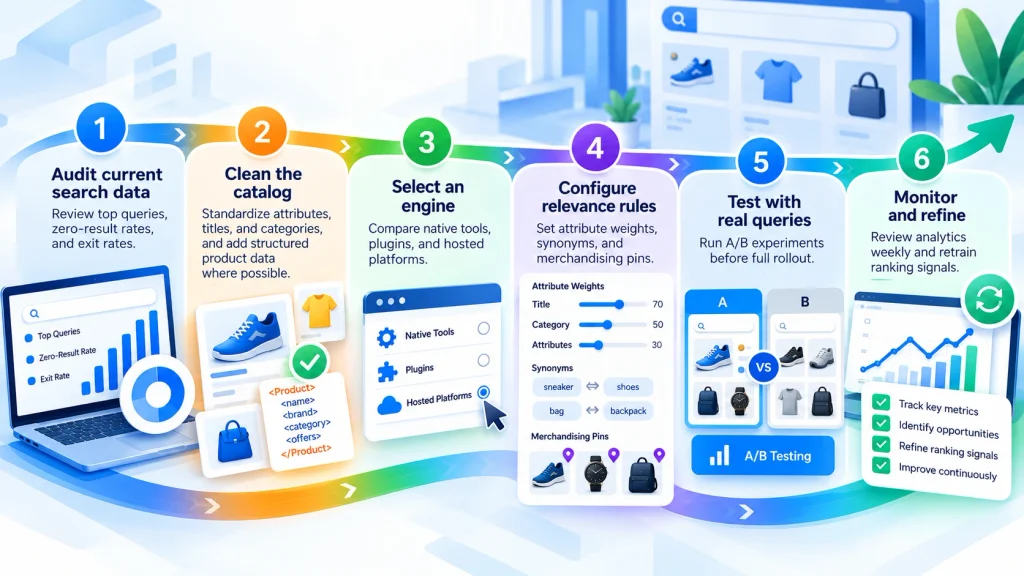
- Audit current search data: Review top queries, zero-result rates, and exit rates.
- Clean the catalog: Standardize attributes, titles, and categories, and add structured product data where possible.
- Select an engine: Compare native tools, plugins, and hosted platforms.
- Configure relevance rules: Set attribute weights, synonyms, and merchandising pins.
- Test with real queries: Run A/B experiments before full rollout.
- Monitor and refine: Review analytics weekly and retrain ranking signals.
Metrics That Show AI-Powered Search Success
- Search conversion rate compared with overall conversion rate
- Zero-result query percentage
- Click-through rate on top results
- Average revenue per search session
- Search exit rate
- Time taken to reach a product page
Tracking such indicators over time reveals whether ranking adjustments produce measurable gains.
Future Trends in AI-Powered Search
Search technology continues to evolve quickly, and stores that prepare early gain a lasting advantage in product discovery.
Conversational and Generative Search
Shoppers increasingly type full questions instead of short terms, such as “what to pack for a monsoon trip to Goa.” Generative models can interpret the request, return curated product bundles, and explain why each item fits. Chat-style search panels are becoming a standard part of modern storefronts, particularly for categories where buying decisions require guidance.
Hyper-Personalization with First-Party Data
As third-party cookies decline, first-party data from searches, wishlists, and purchase history becomes the most valuable personalization signal. Analysis from McKinsey on personalization shows that businesses getting personalization right see stronger revenue growth than competitors that treat every visitor identically. Consent management and transparent data practices remain essential for maintaining shopper trust.
Multimodal and Agent-Driven Shopping
Multimodal models accept text, images, and voice in a single query, such as a photo of a living room paired with the request “find a matching side table under 100 dollars.” Automated shopping agents are also emerging, which means product data must be clean, structured, and machine-readable so that catalogs remain discoverable by both humans and software. Insights published by Think with Google track how consumer search behavior keeps shifting toward richer, more conversational formats.

Common AI-Powered Search Mistakes to Avoid
Poor catalog data is the biggest obstacle, since even the smartest model cannot fix missing attributes. Over-personalization can hide new arrivals, and ignoring mobile layouts frustrates the majority of shoppers. Skipping analytics review leaves persistent problems unnoticed.
Frequently Asked Questions About AI-Powered Search
What is AI-powered search in eCommerce?
AI-powered search uses machine learning, natural language processing, and semantic matching to understand shopper intent and return highly relevant products instead of relying on exact text matches.
How does AI-powered search improve product discovery?
Typos, synonyms, and long conversational queries are interpreted correctly, and results are ranked by relevance and behavior signals. Shoppers reach suitable products faster, which lifts conversions.
Does AI-powered search work with Magento and Adobe Commerce?
Yes. Adobe Commerce offers Live Search, and Magento stores can integrate OpenSearch or third-party engines through extensions and API connections.
Is AI-powered search suitable for small WooCommerce or Shopify stores?
Yes. Hosted search services and apps scale to small catalogs and grow with the business, so advanced relevance is available without heavy infrastructure.
Can AI-powered search be used in a headless commerce setup?
Absolutely. API-first search services fit decoupled architectures well and deliver fast, customizable results across web, mobile, and other channels.
Does AI-powered search affect site speed?
A well-configured engine improves perceived speed through caching and instant suggestions. Regular ecommerce performance optimization keeps response times low.
What are the latest trends in AI-powered search?
Conversational search, multimodal queries, and first-party data personalization lead current developments. Clean, structured product data prepares a catalog for each of those shifts.
Can AI-powered search include visual and voice features?
Yes. Visual search matches uploaded photos to similar products, and voice search converts spoken requests into queries that language models interpret accurately.
Conclusion
AI-powered search turns a basic search box into a powerful product discovery engine. Intent recognition, semantic matching, and behavioral ranking help shoppers find the right item quickly, while merchants gain stronger conversion and richer insights. Whether the store runs on Adobe Commerce, Shopify, WooCommerce, BigCommerce, or a headless architecture, investing in intelligent search delivers lasting returns. Pairing a clean catalog with solid performance engineering ensures the best possible shopping experience.