
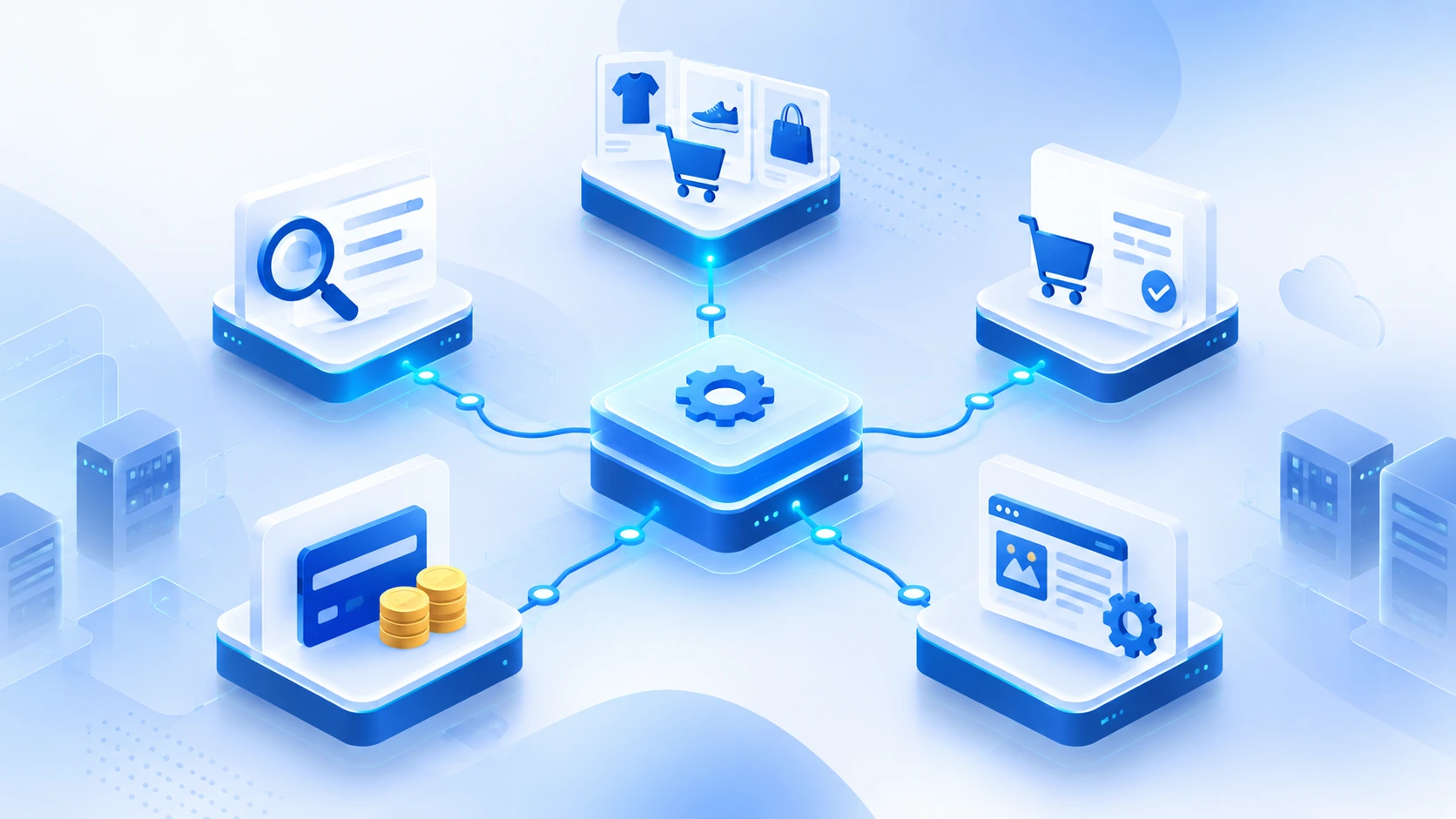
Digital retail is moving beyond single platforms that handle every part of an online store. Composable commerce has emerged as an option for brands that want speed, customization, and long-term growth without vendor lock-in. This approach breaks a storefront into independent components such as catalog, checkout, search, payments, and content. These components connect through APIs instead of running inside one codebase.
Retail leaders, IT teams, and marketing departments now compare composable commerce with platforms such as Magento, Shopify, WooCommerce, BigCommerce, and Adobe Commerce. Before committing budget and development resources to a rebuild, businesses need to understand where this model can help and where it can add cost and complexity.
What Composable Commerce Actually Means
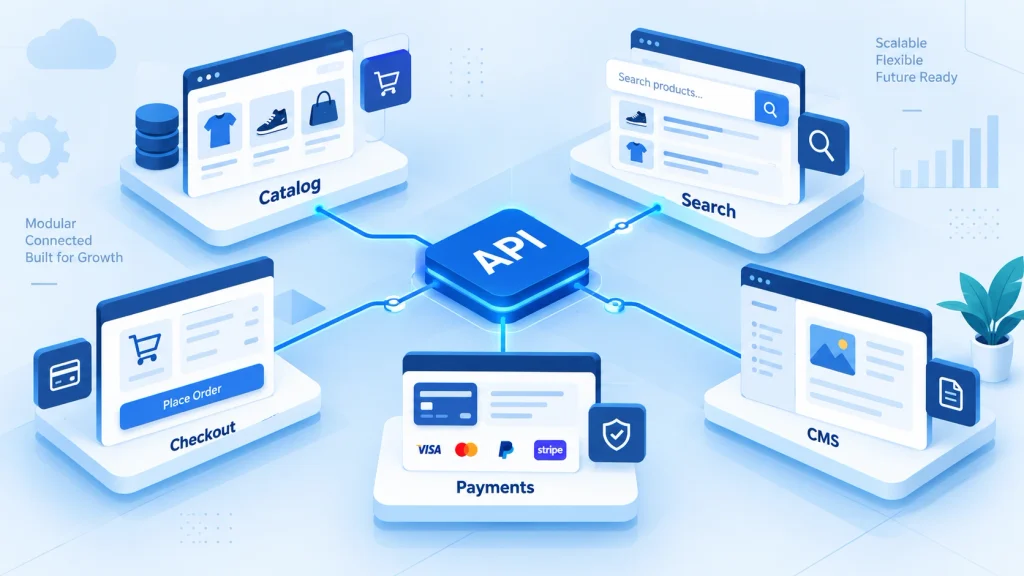
Composable commerce is an approach where individual capabilities work as separate, replaceable services. A complete storefront combines these independent services into one system. Rather than using one large platform for everything from inventory to marketing, businesses can choose a specific tool for each job. This may include a headless CMS for content, a dedicated search engine, a payment service, and a commerce engine for cart, catalog, and order functions.
The MACH framework stands for Microservices, API-first, Cloud-native, and Headless. It provides the technical foundation used by many composable commerce builds and is associated with the MACH Alliance.
The Four MACH Principles
- Microservices allow one component, such as promotions, to be updated without changing checkout code.
- API-first design allows services to share data through APIs instead of tightly connected templates.
- Cloud-native infrastructure can scale when demand increases.
- Headless separates the front end from the back end, allowing multiple storefronts to use the same commerce engine.
Flexibility: The Strongest Case for Composable Commerce
Freedom to Choose Best-of-Breed Tools
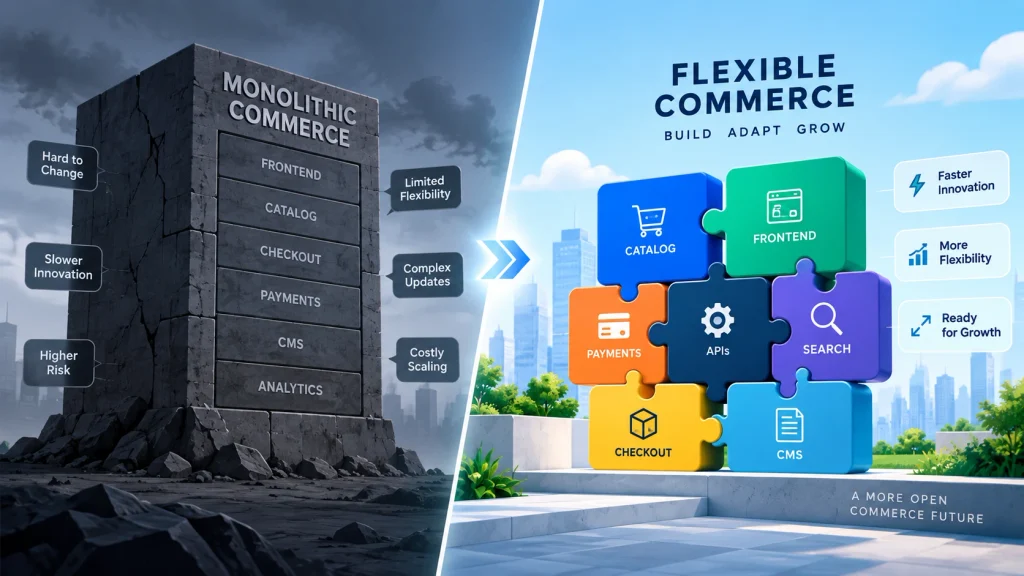
A monolithic platform ties every feature to one vendor’s release cycle. With composable commerce, a retailer can swap a search provider or payment processor without completing a full platform migration. For example, a retailer unhappy with native search performance can plug in Algolia or Elasticsearch while leaving the rest of the stack untouched.
Faster Adaptation to Market Change
Retail trends shift quickly, covering social commerce, live shopping, subscription models, and marketplace integrations. This architecture lets businesses add a new front-end experience or sales channel by connecting to existing APIs rather than rebuilding core logic. Brands launching a mobile app or voice-commerce channel can reuse the same catalog and checkout services already powering the website.
Headless Front-End Freedom
Decoupling presentation from backend logic gives design teams more freedom to build custom storefronts. Frameworks such as React, Vue, and Next.js support these experiences without relying entirely on traditional themes. This represents a significant shift from theme-restricted platforms where customization depends on templating limits.
Cost Considerations in a Composable Commerce Build
Upfront Investment
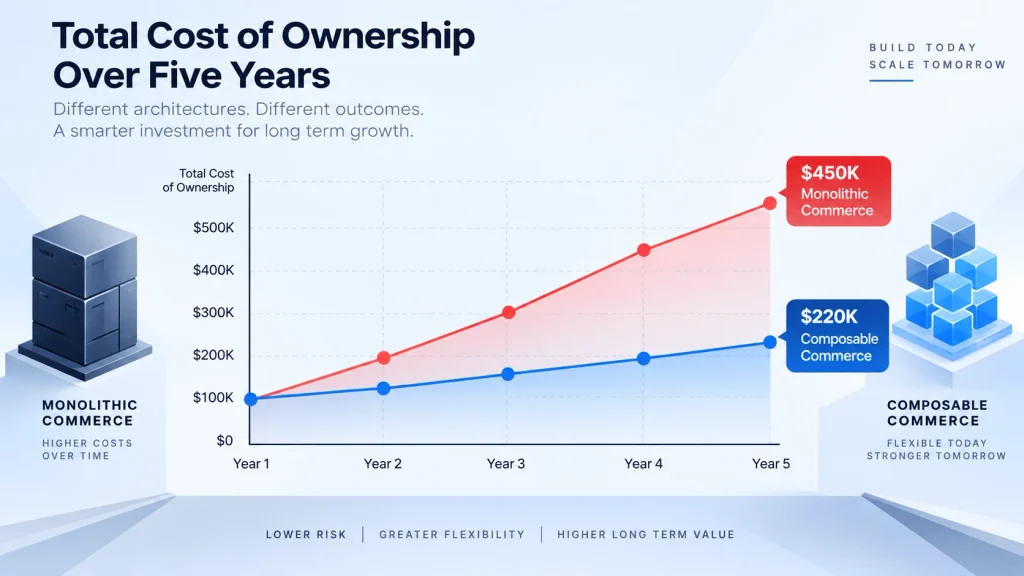
A composable approach generally requires a larger upfront investment than an out-of-the-box platform. Development teams must integrate multiple vendors, build custom front ends, and establish API orchestration layers. By comparison, traditional platforms like Shopify or WooCommerce offer templates and plugins that can significantly reduce initial build time.
Licensing and Vendor Costs
A modular stack typically involves separate subscription costs for each service CMS, search, personalization engine, commerce API. Platforms such as BigCommerce or Adobe Commerce bundle many capabilities, which can simplify budgeting even if it reduces flexibility. Independent research from Gartner on composable business models notes that phased adoption reduces initial financial risk.
Long-Term Total Cost of Ownership
Where composable commerce often wins is total cost of ownership over a multi-year horizon. Avoiding a full platform replatform every few years a common outcome with monolithic systems that outgrow their capabilities offsets higher initial spend. Modular upgrades cost less than wholesale migrations, since only the outdated component needs replacement.
Complexity: The Trade-Off Behind Composable Commerce
Integration Management
Connecting multiple best-of-breed services introduces coordination challenges. Each API integration is a potential point of failure, and testing becomes more involved since changes in one service can ripple into another. Governance around API versioning and authentication becomes a continuous operational concern in any modular stack.
Team and Skill Requirements
Composable implementations demand experienced development teams comfortable with API orchestration, cloud infrastructure, and modern front-end frameworks. Smaller businesses without dedicated engineering resources may find the learning curve steep compared to the drag-and-drop simplicity of Shopify or WooCommerce.
Vendor Coordination Challenges
Working with several vendors instead of one means several support relationships, several contracts, and several service-level agreements to track. Troubleshooting sometimes requires determining which vendor in the stack is responsible for a failure a diagnostic step that rarely exists on a single-vendor platform.
Security and Compliance in a Composable Commerce Stack
Distributing commerce functions across multiple vendors changes how security and compliance get managed. In a monolithic platform, one vendor typically handles PCI compliance, data encryption, and access control end to end. In a composable commerce environment, each service payments, customer data storage, search, CMS carries its own security posture, and responsibility for closing gaps between them shifts to the internal team or implementation partner. Adopting composable commerce without a security plan is one of the most common causes of project delays.
Practical Safeguards
- Confirm PCI DSS compliance separately for any payment or checkout service added to the stack
- Standardize authentication across services using a single identity provider rather than separate logins per vendor
- Audit API rate limits and access scopes regularly, since a compromised key in one microservice can expose data from connected services
- Maintain a data map showing where customer information lives across the stack, which simplifies compliance reporting under regulations such as GDPR or CCPA
Platform-by-Platform Comparison for Composable Commerce
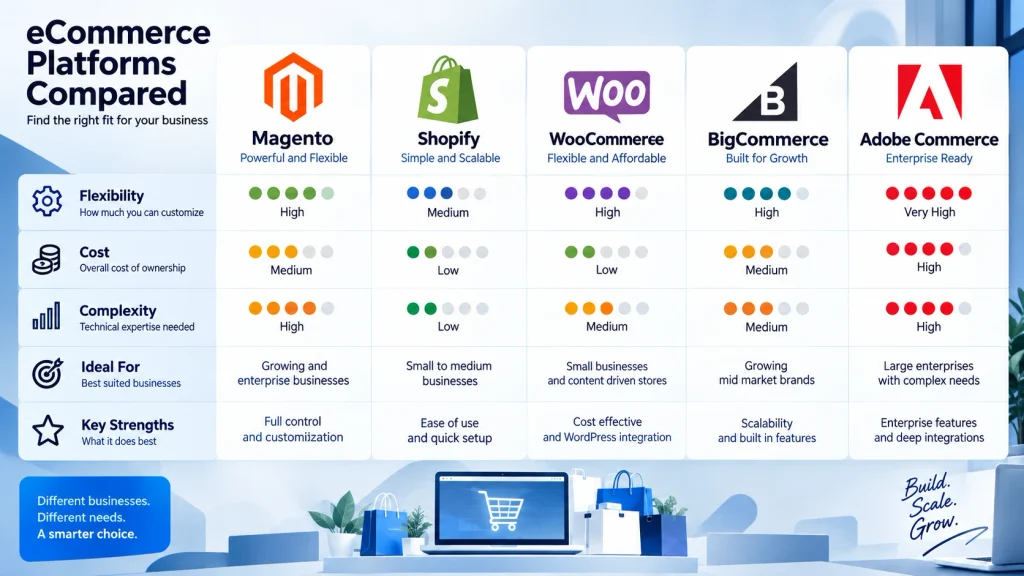
Magento (Adobe Commerce)
Adobe Commerce, built on the Magento open-source core, sits closer to a hybrid model. Enterprise merchants often extend it with composable elements a headless front-end or a dedicated PIM system while retaining the core commerce engine. Complexity runs moderate to high, and enterprise licensing costs are substantial, but the platform supports deep B2B functionality and large catalog management.
Shopify
Shopify remains the fastest route to launch for small and mid-sized retailers. Shopify Plus has introduced more composable-friendly options, including headless storefronts built with Hydrogen and Oxygen, letting merchants retain Shopify’s checkout while customizing the front-end independently.
WooCommerce
WooCommerce, built on WordPress, offers strong flexibility for content-driven commerce. Extending WooCommerce toward a modular model typically involves connecting external search, payment, or headless front-end tools via plugins and custom code, keeping cost lower than enterprise platforms.
BigCommerce
BigCommerce supports an “open SaaS” model, offering native APIs that make headless implementations more accessible than older monolithic systems. It bundles several commerce features while still allowing modular extensions for search, personalization, and content.
Headless Commerce Platforms
Purpose-built headless platforms such as commercetools, Elastic Path, and Fabric represent the fullest expression of composable commerce. These platforms provide only the commerce engine through APIs, leaving every other component, including the front-end, entirely open. Flexibility reaches its maximum here, alongside the highest implementation complexity.
Composable Commerce, AEO, and AI Search Visibility
Search behavior is shifting from keyword queries to conversational, answer-driven questions asked through AI assistants and generative engines. Answer Engine Optimization (AEO) and Generative Engine Optimization (GEO) focus on structuring content so AI systems can extract clear, quotable answers about this architecture rather than requiring a reader to click through multiple pages.
Content built for AI visibility benefits from:
- Direct, one-sentence answers placed immediately after each subheading
- Entity consistency platform names, frameworks, and terms like MACH, headless commerce, and this model are used consistently rather than swapped for synonyms, helping AI systems map content to a known topic
- Structured signals FAQ schema, table markup, and clear H2/H3 hierarchy give generative engines a ready-made structure to lift from
- Refreshed statistics and platform details, since generative engines favor recently updated sources when citing comparisons

Measuring Return on Investment for Composable Commerce
Justifying a migration to this architecture requires more than a flexibility argument it requires measurable outcomes tied to revenue and operational efficiency.
Metrics worth tracking before and after a rollout include:
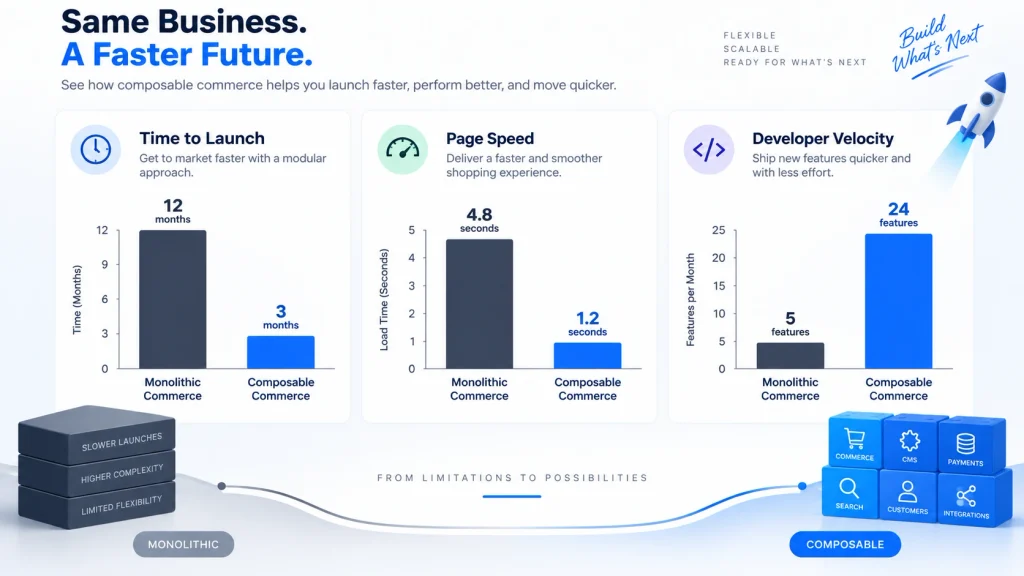
- Time to launch a new feature or channel: modular stacks typically cut this from months to weeks once the API layer is established
- Page load speed and conversion rate: headless front-ends often improve Core Web Vitals scores, which correlates with checkout completion, per web.dev guidance
- Cost per integration: tracking the cost of adding or replacing one component reveals whether the approach is actually reducing long-term spend
- Developer velocity: releases shipped per sprint tend to rise once teams stop waiting on a single platform’s release cycle
Setting a 12–18 month measurement window is realistic, since benefits from composable commerce compound gradually as more components go live.
Choosing Between Composable and Traditional Architecture
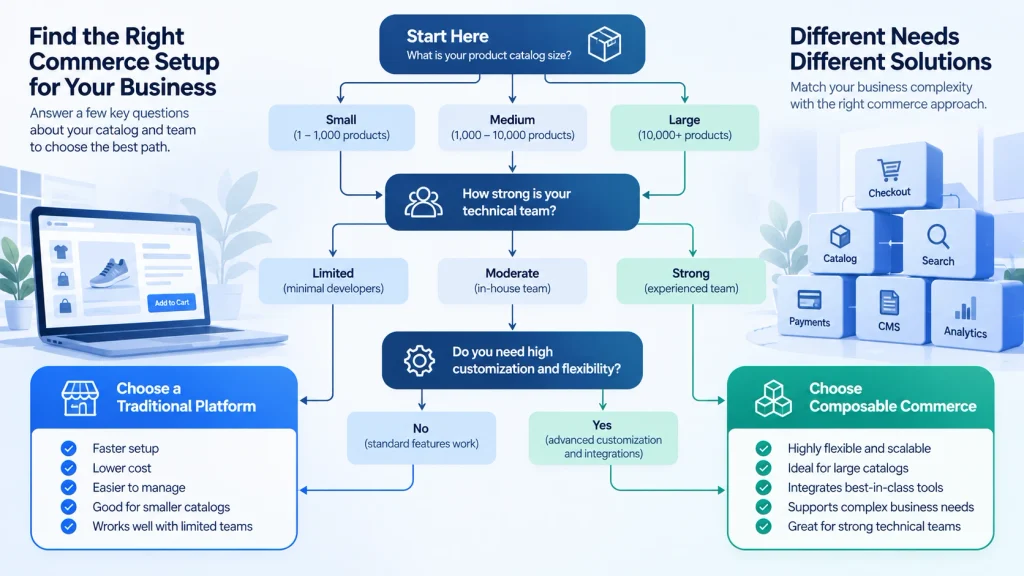
Selecting an approach depends on catalog size, growth ambitions, available technical talent, and budget horizon. A small business launching a first store benefits more from Shopify or WooCommerce‘s speed and simplicity. A large enterprise managing multiple brands, regions, or sales channels with dedicated engineering capacity stands to gain more from composable commerce’s long-term adaptability.
A useful evaluation checklist:
- Catalog complexity: number of SKUs, variants, and pricing rules
- Channel strategy: web, mobile app, marketplace, in-store, voice
- Internal technical capacity: developers familiar with APIs and cloud services
- Growth timeline: expected scaling needs over three to five years
- Budget structure: predictable bundled pricing versus variable multi-vendor spend
Building a Commerce Website with a Composable Mindset
Regardless of platform choice, a few practices support long-term success:
- Start with a clear API strategy before selecting vendors
- Prioritize a strong product information management (PIM) foundation, since inconsistent product data undermines every downstream channel
- Invest in monitoring tools that track performance across integrated services
- Plan for phased adoption adding one component at a time rather than a full rebuild to manage risk and cost simultaneously
For technical benchmarking, the W3C web performance standards offer reference points for evaluating headless front-end speed after a migration.
Frequently Asked Questions About Composable Commerce
What is composable commerce?
Composable commerce is an architecture where individual commerce capabilities catalog, checkout, search, payments, content are built as independent services connected through APIs, instead of running inside one bundled platform. This allows a business to select, replace, or scale a single component without rebuilding the entire storefront.
What is the main difference between composable commerce and headless commerce?
Headless commerce separates only the front-end presentation layer from backend commerce logic, while composable commerce applies that same separation principle across every function of the stack search, payments, content, and personalization not just the storefront. Headless commerce is one building block inside a fully composable architecture.
Is composable commerce suitable for small businesses?
Composable commerce is usually not the most practical starting point for small businesses with limited technical resources, since traditional platforms like Shopify or WooCommerce launch faster and cost less upfront. It becomes more suitable once catalog size, sales channels, or customization needs outgrow what a single bundled platform can support.
Does composable commerce cost more than a monolithic platform?
Composable commerce typically costs more to build initially because it requires custom integration work across multiple vendors. Over a multi-year period, the approach may reduce costs by avoiding a complete platform replatforming. The final comparison depends heavily on the number of integrated services and how long the business keeps the stack before upgrading.
Can Magento or Adobe Commerce be used in a composable setup?
Adobe Commerce can function as the commerce engine within a broader composable architecture, particularly when paired with a headless front-end or an external product information management (PIM) system. This makes Adobe Commerce a common hybrid choice between fully monolithic and fully composable models.
Conclusion
Composable commerce is not a universal upgrade. Instead, it represents a trade-off between flexibility, cost, and complexity. Greater adaptability and potential long-term cost efficiency come with higher upfront investment, integration overhead, and a greater need for skilled technical teams. Platforms like Shopify, WooCommerce, and BigCommerce continue to serve businesses that prioritize speed and simplicity. Meanwhile, Adobe Commerce and dedicated headless platforms such as commercetools can support enterprises prepared to manage a distributed, API-driven stack.
The right decision comes down to catalog complexity, channel strategy, internal engineering capacity, and how far out the growth plan extends. Businesses evaluating a rebuild get the clearest answer by mapping current pain points slow releases, rigid templates, scaling limits against what this architecture actually solves, rather than adopting it because it is trending.