
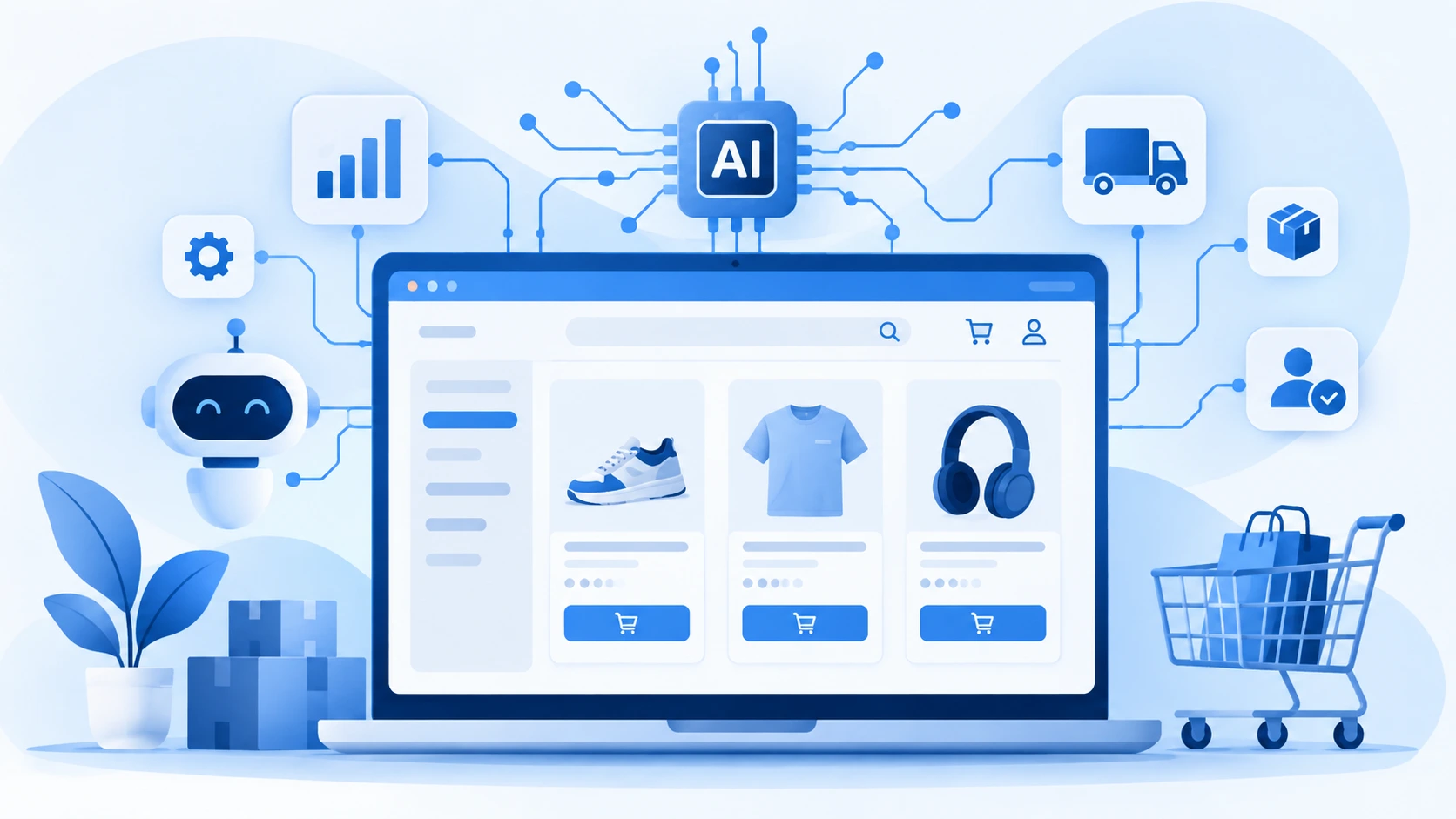
Online retail has entered a phase where using AI in eCommerce is no longer a futuristic add-on but a practical approach to running a store more efficiently. According to McKinsey’s research on generative AI, automation technologies could add trillions of dollars in value across global industries including retail, yet many businesses fall into a trap: piling on automation tools, chatbots, and predictive systems until the technology stack becomes harder to manage than the problems it was meant to solve.
The goal is not to adopt every available AI feature. The goal is to identify where automation genuinely improves the shopping experience and operational efficiency, then implement it in a way that stays maintainable.
Simplicity, not sophistication, tends to separate successful AI adoption from wasted investment.
Key takeaways covered in this guide:
- What problems AI in eCommerce actually solves
- Common mistakes that create unnecessary complexity
- A simplified implementation framework
- Platform-specific guidance (Shopify, WooCommerce, Magento, BigCommerce, headless)
- ROI measurement and compliance considerations
- Choosing vendors and planning for future scale
Understanding What AI Actually Solves in Online Retail
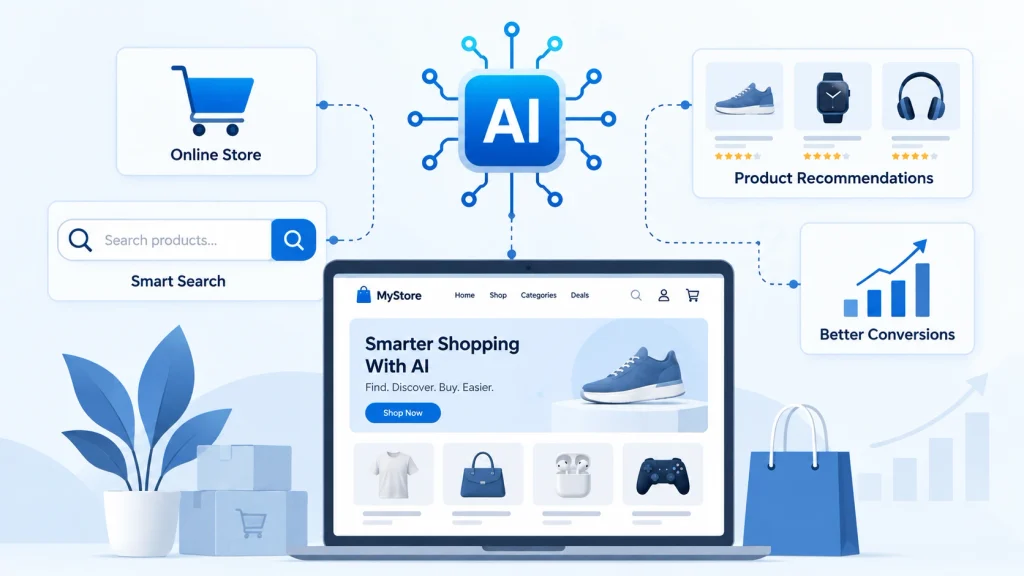
Before adding any automated system, defining the specific problem being addressed matters. AI in eCommerce typically supports four categories:
- Personalization: product recommendations, tailored search results, dynamic content
- Customer service: chatbots, automated ticket routing, order status queries
- Inventory forecasting: demand prediction, stock alerts, reorder automation
- Content generation: product descriptions, SEO copy, image tagging
According to Statista’s retail AI spending data, global retail AI investment continues to grow rapidly year over year, reflecting how central automation has become to competitive online selling.
Common Mistakes That Create Complexity
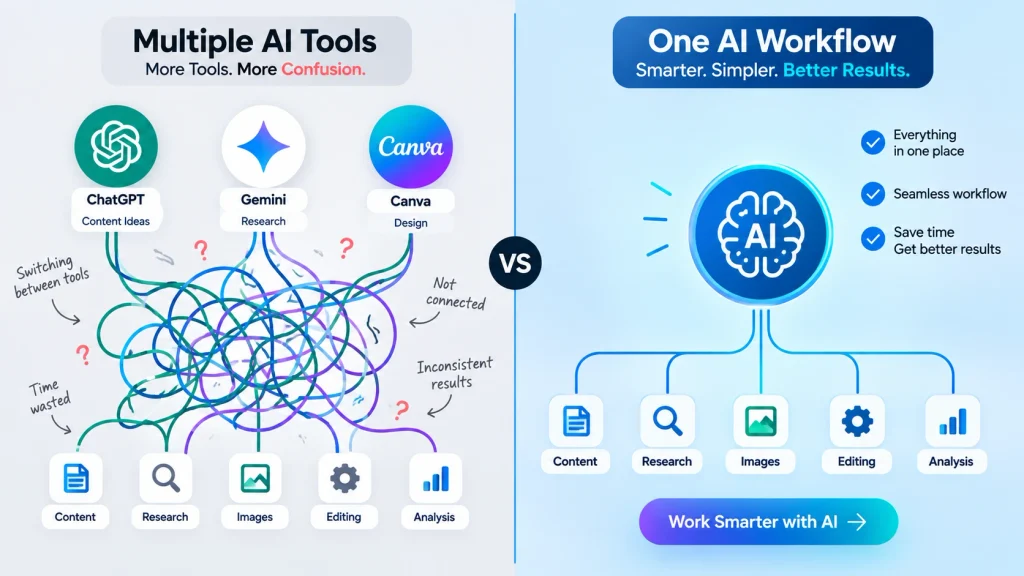
Complexity rarely appears all at once. It builds gradually, one tool at a time, until the system becomes difficult to manage. Recognizing the early warning signs helps prevent this pattern before it takes hold.
- Installing many AI plugins with overlapping features
- Enabling advanced personalization without enough traffic data to make it effective
- Choosing enterprise-grade AI suites for stores with a handful of SKUs
- Ignoring how new tools integrate with existing checkout, CRM, or ERP systems
- Adding tools independently instead of as part of a coordinated strategy
- Allowing dashboards to multiply until troubleshooting becomes a full-time task
A Simplified Framework for Implementing AI in eCommerce
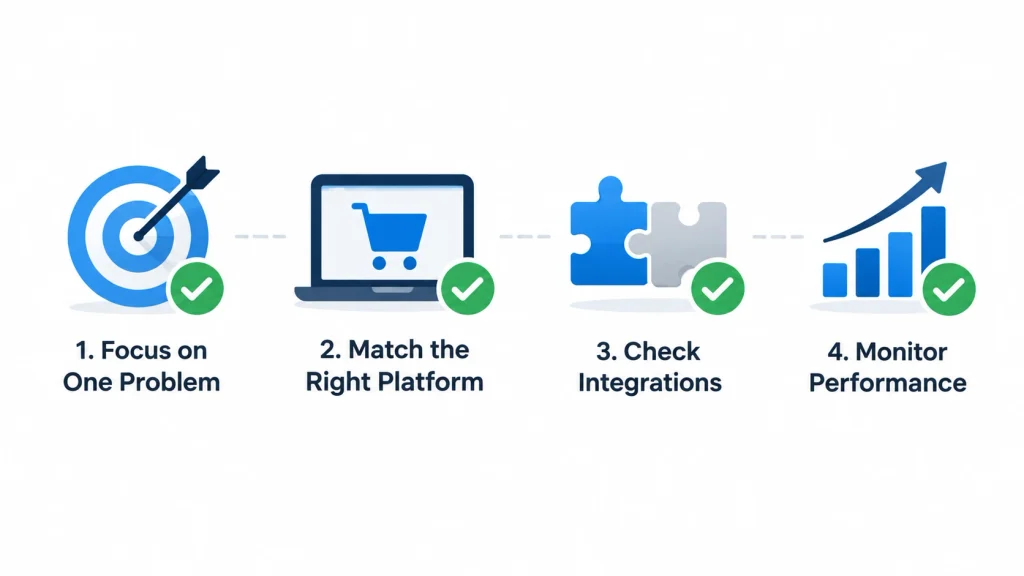
Start With One Measurable Problem
Focus produces better outcomes than volume. Choosing one clear issue to solve first keeps the project manageable and easier to evaluate. A few common starting points include:
- Reducing search abandonment
- Improving product recommendations
- Automating repetitive support tickets
- Shortening product description production time
Solving one problem well builds a foundation for expansion later.
Choose Tools That Match Platform Architecture
Every commerce platform has different strengths when it comes to AI integration:
- Shopify: Native AI support through Shopify Magic, plus a wide app ecosystem for personalization, product description generation, and support automation. Built-in tools often cover most needs for small to mid-sized catalogs.
- WooCommerce: Since WooCommerce runs on WordPress, AI functionality typically comes through official WooCommerce plugins. Plugin conflicts are common, so testing in a staging environment before deployment is advisable.
- Magento (Adobe Commerce): Built-in AI capabilities such as product recommendations and predictive search through Adobe Sensei. Suits larger catalogs and teams with dedicated technical resources.
- BigCommerce: Native AI-powered merchandising and search tools, along with API access for custom integrations. Works well for mid-sized to large stores.
- Headless Commerce: AI often lives in a separate layer a dedicated search service, recommendation API, or conversational commerce tool connected via API to the front end. Offers flexibility but requires careful planning around data flow.
Prioritize Integration Over Feature Count
More tools do not always mean better performance. In fact, poorly connected systems often create more work than they save. Before adding anything new, checking compatibility with existing platforms matters most:
- Fewer, well-integrated AI features generally outperform many disconnected tools
- Check whether a new system shares data with existing analytics, CRM, and inventory tools
- Avoid duplicate work and inconsistent customer profiles caused by siloed platforms
Monitor Performance Before Scaling Further with Using AI in eCommerce
Expansion should follow evidence, not assumption. Testing on a small scale first reveals whether a tool actually works before it gets rolled out further. Useful checkpoints include:
- Test on one product category, customer segment, or marketing channel first
- Track conversion rate, average order value, and support resolution time
- Expand only after a tool demonstrates measurable value
Practical Examples of Low-Complexity AI in eCommerce Adoption
- A small apparel store adding AI-generated product descriptions to reduce content production time
- A mid-sized electronics retailer using predictive search to lower bounce rates on category pages
- A subscription box business applying churn prediction models to trigger retention offers
- A B2B supplier using demand forecasting to reduce overstock without a full inventory management overhaul
This approach aligns with guidance from Google’s retail industry insights, which emphasizes targeted automation over blanket implementation.
Where Product Recommendation Engines Fit in with Using AI in eCommerce
Recommendation engines offer a low-risk way to begin using automation. Most platforms already include this feature, which makes setup straightforward. Getting started typically involves:
- Selecting rules such as “frequently bought together” or “recently viewed”
- Testing placement on product pages, cart pages, or checkout
- Monitoring how recommendations affect average order value over a testing period
Benchmarking research from Salesforce Commerce Cloud has consistently linked personalized recommendations to measurable increases in conversion rates across retail sectors.
Avoiding Over-Engineering on Headless Architectures
Flexibility can become a liability if left unmanaged. Headless systems allow for endless customization, but too many separate services quickly turn into a maintenance burden. A more sustainable structure involves:
- Grouping related AI functions search, recommendations, personalization under a single service layer
- Avoiding a dozen independent connections that each require separate maintenance
- Following integration guidance from platforms such as commercetools and Contentful, both commonly used in headless stacks
Measuring Return on Investment for AI Tools Using AI in eCommerce
Numbers tell the real story behind any AI investment. Without clear metrics, it becomes difficult to know whether a tool is helping or simply adding cost. The most useful indicators include:
- Conversion rate lift: comparing pages or segments with AI features against a control group
- Average order value change: tracking whether recommendation engines increase basket size
- Support cost reduction: measuring ticket volume before and after chatbot deployment
- Time saved on content production: comparing manual versus AI-assisted description writing
Benchmarking reports from Shopify’s commerce trends research and BigCommerce’s retail data studies provide comparison points for evaluating results. A/B testing frameworks, such as those documented by Optimizely, offer a structured method for isolating the impact of a newly added AI feature.
Security, Privacy, and Compliance in AI-Driven Stores
Automation introduces new responsibilities around customer data. As AI tools collect and process more information, staying compliant becomes a practical necessity rather than an afterthought. Key steps include:
- Review data retention settings on AI plugins before activation
- Confirm whether third-party AI vendors store data outside approved regions
- Document what customer data feeds into personalization or recommendation models
- Offer clear opt-out options for AI-driven personalization where required by law
Relevant regulatory guidance includes the Federal Trade Commission’s guidance on AI and data use and, for stores serving European customers, the GDPR framework published by the European Commission. Payment-related AI tools, such as fraud detection systems, should also align with PCI Security Standards Council requirements where transaction data is involved.
Training Teams to Manage AI Tools Effectively
Technology performs only as well as the people managing it. Even the most capable AI tool underdelivers without proper ownership and oversight. Building that internal structure typically involves:
- Assigning a clear owner for each AI tool rather than leaving oversight ambiguous
- Creating a simple internal document outlining what each tool does and how it integrates
- Scheduling quarterly reviews to check model accuracy and relevance as catalogs change
- Training customer service staff to recognize when a chatbot should hand off to a human agent
- Setting escalation paths for AI-related errors, such as incorrect recommendations or pricing glitches
- Avoiding tool sprawl by requiring a business case before adding any new AI system
Guidance from Gartner’s retail technology research notes that ongoing governance and team accountability are often the differentiating factors between AI projects that scale successfully and those that stall after launch. The Harvard Business Review’s coverage of AI adoption similarly points to organizational readiness as a stronger predictor of success than the sophistication of the tool itself.
Choosing the Right AI Vendor for an Online Store
Not every vendor claiming AI capability delivers the same quality or reliability. Selecting a partner carefully avoids wasted budget and prevents future migration headaches. A structured evaluation process typically covers:
- Data ownership terms: confirming who retains rights to customer and transaction data generated through the tool
- Integration depth: checking whether the vendor offers native plugins for the platform in use or requires custom API work
- Support and documentation quality: reviewing whether setup guides, troubleshooting resources, and support channels are actually maintained
- Pricing transparency: understanding whether costs scale with traffic, order volume, or feature tiers, since unexpected scaling costs are a common complaint
- Track record: looking at case studies or client references from similarly sized stores rather than relying on marketing claims alone
Comparative vendor research published by G2’s eCommerce AI category and Capterra’s retail software reviews offers independent user feedback that can validate or challenge a vendor’s own claims before a contract is signed.
Planning for Future Scale Without Overbuilding Today
Growth plans often tempt businesses into building for a scale they have not yet reached. Overbuilding early adds cost and maintenance burden without a corresponding return, while underbuilding risks a difficult migration later. Striking that balance involves a few practical habits:
- Choosing platforms and AI tools that support incremental upgrades rather than requiring a full replatform to add capacity
- Reviewing contract terms for flexibility, including the ability to scale usage up or down without penalty
- Documenting current AI architecture clearly enough that a future team member or vendor can understand it without lengthy onboarding
- Revisiting the original business case for each tool annually to confirm it still matches current order volume and customer behavior
- Avoiding speculative investment in advanced AI capabilities, such as predictive personalization at scale, before traffic and data volume justify the cost
Industry analysis from Forrester’s commerce technology research suggests that phased AI investment, aligned with actual growth milestones, consistently outperforms large upfront technology commitments made in anticipation of future demand that may not materialize as expected.
Frequently Asked Questions About Using AI in eCommerce
What is the simplest way to start using AI in eCommerce?
Begin with one targeted use case, such as automated product recommendations or AI-generated content, rather than a full suite of tools at once.
Does headless commerce make AI implementation more complicated?
Headless setups can add complexity if every AI function is built as a separate service. Grouping related functions under a shared layer keeps the architecture manageable.
Which platform offers the easiest built-in AI tools?
Shopify and BigCommerce both provide native AI features suited to smaller and mid-sized catalogs.
Is Adobe Commerce suitable for smaller stores wanting AI features?
Adobe Commerce is generally built for larger catalogs and enterprise-level operations. Smaller stores often find simpler platforms more cost-effective.
How is success measured after implementing an AI tool?
Tracking conversion rate, support resolution time, and average order value before and after implementation shows measurable value.
Are there compliance risks with AI in eCommerce?
Yes. AI tools that process customer data need to align with privacy regulations such as GDPR and relevant national data protection laws.
Who should manage AI tools internally?
A designated owner per tool, supported by periodic performance reviews, prevents tools from being abandoned or mismanaged after initial setup.
How should a store evaluate an AI vendor before signing a contract?
Reviewing data ownership terms, integration depth, pricing transparency, and independent user reviews helps validate vendor claims before committing budget.
Conclusion
Using AI in eCommerce delivers the most value when implementation stays deliberate rather than broad, with businesses starting small on a single measurable problem before layering on additional systems. Platform choice matters throughout this process Shopify and BigCommerce suit smaller catalogs, Adobe Commerce and Magento fit larger technical operations, WooCommerce offers flexibility through tested plugins, and headless setups require careful planning to avoid fragmentation. Tracking metrics such as conversion rate and average order value, alongside consistent attention to privacy compliance and careful vendor selection, keeps automation decisions grounded in data rather than assumptions. Ultimately, long-term success depends less on how many tools a store adopts and more on how thoughtfully those tools are selected, integrated, and maintained, since a simplified, well-governed approach consistently outperforms a crowded technology stack.