

AI in eCommerce has become a common topic in online retail. Yet many implementations fail to deliver measurable value. The problem is rarely the technology itself. Instead, businesses often skip a critical step: identifying the real problem before choosing a tool. Retailers may rush into automation, chatbots, or predictive tools without first identifying operational pain points. As a result, they can invest in expensive systems that solve the wrong problems. A problem-first approach changes that outcome entirely.
Why Technology-First Thinking Fails in Online Retail
A common pattern in digital commerce starts when leaders see a competitor succeed with automation. They then request a similar rollout. This reactive approach skips the discovery phase. Budgets are allocated, vendors are selected, and integrations begin before the business defines the problem it needs to solve. Without this groundwork, AI in eCommerce can produce systems that solve no clear business need. Teams may also struggle to measure their results.
Technology-first thinking creates several downstream issues:
- Tools get chosen based on marketing claims rather than operational fit
- Teams struggle to measure return on investment because no baseline problem was defined
- Customer experience sometimes worsens when automation replaces a process that did not need replacing
- Resources get diverted from genuine bottlenecks toward trendy but irrelevant features
Understanding the Real Problem Before Choosing AI in eCommerce Tools
Before any procurement conversation begins, a structured audit should identify where friction actually exists. This audit typically spans customer-facing touchpoints, backend operations, and marketing performance.
Common Pain Points Across Platforms
Several recurring issues surface across most online stores, regardless of platform:
- High cart abandonment linked to poor search or filtering
- Manual inventory reconciliation causing stockouts or overselling
- Generic product recommendations that ignore browsing behavior
- Customer support teams overwhelmed by repetitive queries
- Marketing spend disconnected from actual purchase intent data
Once a specific pain point is isolated, evaluating whether AI in eCommerce solutions genuinely address it becomes far more straightforward. A chatbot will not fix a checkout flow problem. A recommendation engine will not resolve a warehouse fulfillment delay. Matching the solution to the diagnosed problem is the entire point of this exercise.
How Different eCommerce Platforms Approach AI in eCommerce
Every major commerce platform has built or integrated automation capabilities differently, and understanding these differences matters when a business is choosing where to build or migrate a store.
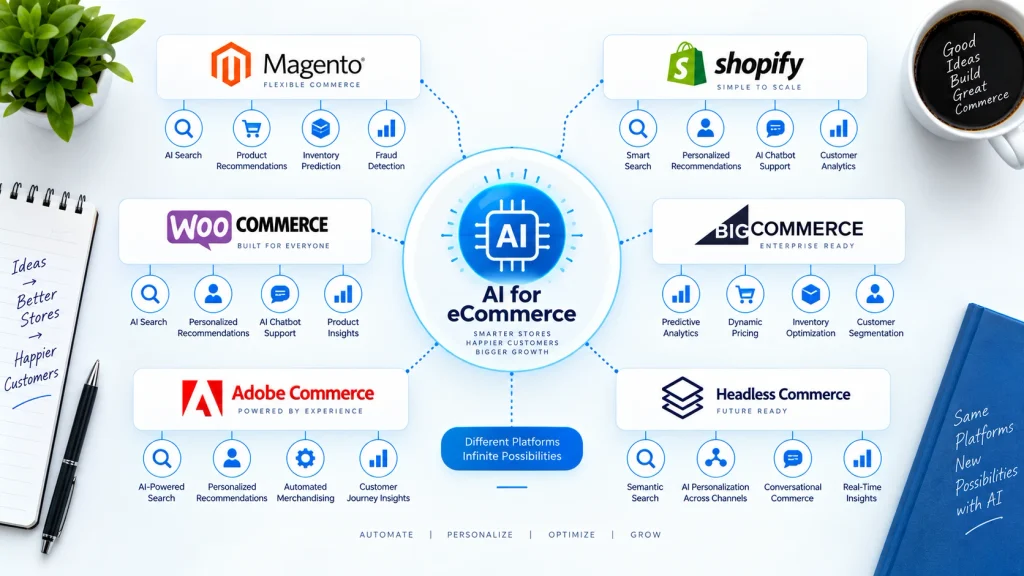
Magento and AI in eCommerce
Magento, now developed under the Adobe umbrella for its open-source and commerce editions, supports extensive customization through third-party modules. Predictive search, personalized merchandising rules, and behavioral segmentation can all be layered onto a Magento store, though implementation typically requires development resources due to the platform’s flexible but complex architecture.
Shopify and AI in eCommerce
Shopify has integrated automation directly into its core and app ecosystem, offering built-in product description generation, inventory forecasting, and customer segmentation tools. Smaller merchants often find Shopify’s approach more accessible since many features work with minimal technical setup. Shopify has also published guidance on choosing and configuring AI tools for a growing store, along with dedicated resources on using automation to strengthen customer support.
WooCommerce and AI in eCommerce
WooCommerce, built on WordPress, relies heavily on plugin ecosystems to introduce automation. Merchants can add a native AI assistant for store management, recommendation engines, and chat-based support, but performance and reliability depend on plugin quality and hosting infrastructure. WooCommerce has also outlined its roadmap for agentic commerce and AI-assisted store operations.
BigCommerce and AI in eCommerce
BigCommerce offers native AI tools for product recommendations, predictive analytics, and SEO-optimized copywriting, making it a reasonable middle ground between Shopify’s simplicity and Magento’s customization depth. BigCommerce has also documented the rise of AI shopping assistants as a merchandising trend worth monitoring.
Adobe Commerce and AI in eCommerce
Adobe Commerce, the enterprise tier built on Magento’s foundation, includes AI-driven commerce and product discovery capabilities alongside broader enterprise commerce functionality. Adobe has also detailed how its platform is adapting product data for discovery across AI-powered search surfaces. Larger enterprises with substantial catalogs tend to benefit most from these built-in capabilities.
Headless Commerce and AI in eCommerce
Headless commerce architecture separates the frontend presentation layer from backend commerce logic, allowing automation tools to be integrated through APIs without being constrained by a single platform’s native limitations. This approach suits organizations needing highly customized customer experiences across multiple channels, though it demands stronger engineering capacity.
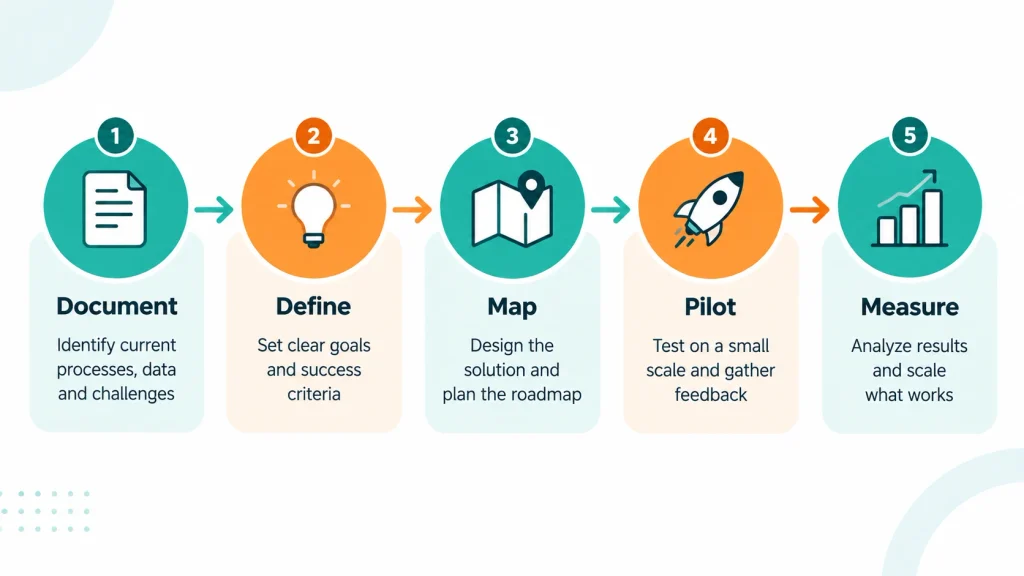
A Problem-First Framework for Adopting AI in eCommerce
A structured framework helps prevent the common trap of adopting automation for its own sake.
- Step one: Document the problem. Quantify the issue with data conversion rates, support ticket volume, forecast accuracy, or churn figures.
- Step two: Define success metrics. Establish what improvement would look like before evaluating any vendor or tool.
- Step three: Map potential solutions to the problem. Only after metrics are set should specific automation categories be considered.
- Step four: Pilot before full deployment. Testing on a limited segment of traffic or catalog reduces risk and validates assumptions.
- Step five: Measure against the original baseline. Comparing post-implementation data against the documented starting point confirms whether the investment delivered value. Research from McKinsey on scaling generative AI in retail points to the same conclusion: retailers that rewire processes around clear metrics scale automation more successfully than those chasing pilots without structure.
Common Mistakes When Adding AI in eCommerce
Several missteps repeat across industries and platform choices. Gartner’s analysis of generative AI project abandonment points to several of the same root causes seen across retail specifically:
- Selecting a tool because a competitor uses it, without validating relevance
- Skipping data quality checks automation trained on poor data produces poor results
- Ignoring the customer experience impact of automated interactions
- Underestimating the ongoing maintenance and monitoring automation requires
- Treating a pilot’s early success as guaranteed long-term performance without continued measurement
Avoiding these patterns requires discipline during the planning phase, long before any contract is signed.
Evaluating Vendors Before Signing a Contract
A structured evaluation process protects against the most expensive mistake in adopting AI in eCommerce: locking into a long-term contract with a tool that cannot actually solve the documented problem. A short scorecard applied consistently across every vendor under consideration keeps the decision grounded in facts rather than a polished sales demo.
Useful evaluation criteria include:
- Whether the vendor can point to a comparable use case with measurable, verifiable results
- How the tool handles data privacy, security certifications, and customer data ownership
- Integration effort required with the existing platform, catalog structure, and checkout flow
- Pricing structure flat fee, usage-based, or revenue share and how costs scale with traffic or order volume
- Availability of a contract exit clause or trial period that does not require a long-term commitment upfront
Requesting references from existing customers on the same commerce platform, rather than relying solely on case studies published by the vendor, tends to surface a more accurate picture of real-world performance. A published enterprise AI vendor evaluation checklist offers a useful starting template for scoring deployment flexibility, security architecture, and total cost of ownership side by side.
Building the Right Team Before Scaling Automation
Tooling decisions around AI in eCommerce rarely succeed in isolation from the people responsible for running them. A merchandising team needs to understand how a recommendation engine ranks products, a support team needs escalation paths for cases automation cannot resolve, and a data or engineering resource needs to monitor accuracy over time. Assigning clear ownership for monitoring, retraining, and adjusting automated systems prevents a common failure mode: a tool launches successfully, then drifts out of alignment with the catalog or customer base within a few months because nobody was tasked with maintaining it.
Cross-functional review sessions pulling in merchandising, customer service, and analytics help surface problems earlier than waiting for a quarterly report. Smaller teams without dedicated data specialists can still succeed by starting with a single, well-scoped use case rather than attempting a store-wide rollout. McKinsey’s research on rewiring organizations for AI similarly finds that cross-functional collaboration, not headcount alone, is what separates teams that scale automation successfully from those that stall.
What Comes Next After Initial Implementation
A successful pilot involving AI in eCommerce is a starting point, not a finish line. Consumer behavior shifts, catalogs expand, and seasonal demand patterns change, all of which affect how well an automated system performs over time. Retailers that treat implementation as a one-time project tend to see performance quietly decline months later. Retailers that build in a recurring review cycle tend to sustain and often improve the gains achieved during the initial rollout.
Expanding automation to a second or third use case should follow the same problem-first discipline as the first: a documented pain point, defined success metrics, a scoped pilot, and a measurement plan tied back to the original baseline.
Industry-Specific Considerations Across Retail Categories
The same automation category can perform very differently depending on the type of catalog and buying behavior involved. Fashion and apparel retailers often see the strongest gains from visual search and size-related recommendation tools, since browsing behavior in this category is heavily image-driven. Grocery and consumable goods retailers tend to benefit more from replenishment forecasting and subscription-timing predictions, where purchase cycles are more regular and easier to model.
B2B catalogs introduce a different set of priorities. Account-based pricing, bulk order patterns, and longer sales cycles mean that generic consumer-facing recommendation logic often needs significant customization before it produces useful results. Furniture, electronics, and other high-consideration categories usually see more value from support-related automation answering detailed product questions and reducing pre-purchase hesitation than from simple upsell widgets.
Matching the automation category to the buying behavior of a specific retail segment, rather than copying a generic implementation checklist, consistently produces better outcomes than a one-size-fits-all rollout. The National Retail Federation’s retail AI trends research reflects this same variation, with retailers reporting the strongest returns concentrated in a handful of category-specific use cases rather than uniform gains across the board.
Measuring Success
Post-implementation review should return to the original problem statement. If the goal was reducing cart abandonment, did the abandonment rate actually drop, and by how much relative to the investment made? If the goal was improving forecast accuracy, did stockouts and overstock incidents decline measurably?

Ongoing monitoring matters as much as initial results. Establishing a recurring review cadence, whether monthly or quarterly, keeps the system aligned with evolving business needs rather than becoming a static, aging investment. Shopify’s guide to calculating AI ROI recommends tracking both the direct cost savings and the avoided costs such as support tickets automation absorbed for a fuller picture of return.
Frequently Asked Questions (FAQ)
Is AI in eCommerce necessary for small online stores?
Not always. Smaller catalogs and lower traffic volumes may not generate enough data for automation to perform meaningfully better than manual processes. A documented problem should still justify any investment, regardless of store size.
Which platform makes AI in eCommerce easiest to implement?
Shopify and BigCommerce generally offer more accessible built-in automation for merchants without dedicated development teams, while Magento, Adobe Commerce, and headless setups suit organizations with stronger technical resources and more complex requirements.
How long does it take to see results from AI in eCommerce tools?
Timelines vary by use case. Search and recommendation improvements can show measurable shifts within weeks, while inventory forecasting or churn-reduction tools often need several sales cycles before patterns stabilize.
Can automation replace an entire customer support team?
Rarely a full replacement. Repetitive, high-volume queries are well suited to automation, while complex or emotionally sensitive issues typically still require human judgment.
What is the biggest risk of adopting automation too early?
Wasted budget and misdiagnosed problems. Without a documented baseline, it becomes nearly impossible to prove whether an automation tool actually improved performance or whether results were coincidental.
Conclusion
Automation is a tool, not a strategy. Retailers who treat AI in eCommerce as a means to solve a clearly defined problem rather than a checkbox to satisfy competitive pressure consistently see stronger, more sustainable outcomes across Magento, Shopify, WooCommerce, BigCommerce, Adobe Commerce, and headless commerce environments alike. Starting with the problem, documenting it clearly, and matching it to the right platform-specific capability remains the single most reliable predictor of whether an automation investment pays off.