
Every successful online store begins long before a single product is uploaded or a theme is installed. To scope a new ecommerce project properly, a structured process is required one that uncovers business goals, technical needs, budget realities, and timeline expectations before any development work starts. Skipping this stage is one of the most common reasons ecommerce builds run over budget, miss deadlines, or fail to meet business objectives.

This article walks through the exact stages a project team typically follows when scoping an online store build from initial discovery through platform selection across Magento, Shopify, WooCommerce, BigCommerce, Adobe Commerce, and headless commerce architectures.
Why It Matters to Scope a New Ecommerce Project Before Development Begins
A rushed start almost always leads to costly revisions later. Proper scoping identifies:
- Business goals and revenue targets
- Target audience and buyer journey
- Required integrations (ERP, CRM, payment gateways, shipping)
- Content and catalog complexity
- Platform fit based on scale and flexibility needs
- Realistic budget and timeline
Without this groundwork, a project can end up on the wrong platform entirely, forcing an expensive migration within a year of launch.
Stage 1: Discovery, the First Step in Establishing a New E-Commerce Project’s Scope
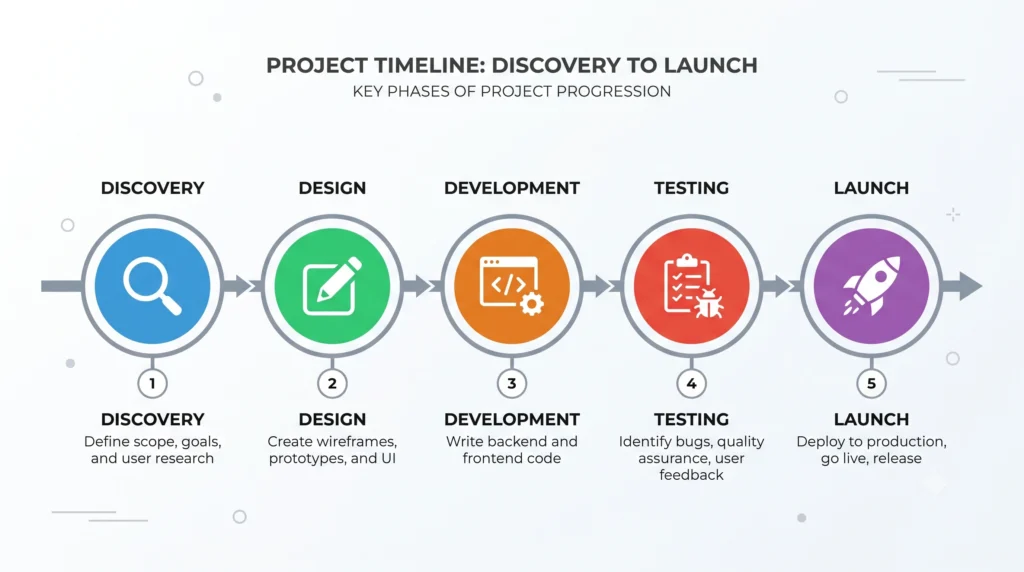
Discovery is the foundation of any ecommerce build. During this stage, stakeholders are interviewed, existing systems are audited, and pain points from any current store are documented. Key discovery activities include:
- Stakeholder interviews across marketing, operations, and IT
- Competitor and market analysis
- Technical audit of existing systems (inventory, fulfillment, tax, POS)
- Catalog complexity review SKU count, variants, bundles, subscriptions
- Compliance needs such as PCI DSS, GDPR, or accessibility standards

Documenting these details early prevents scope creep once development begins.
Step 2: Selecting the Appropriate E-Commerce Platform
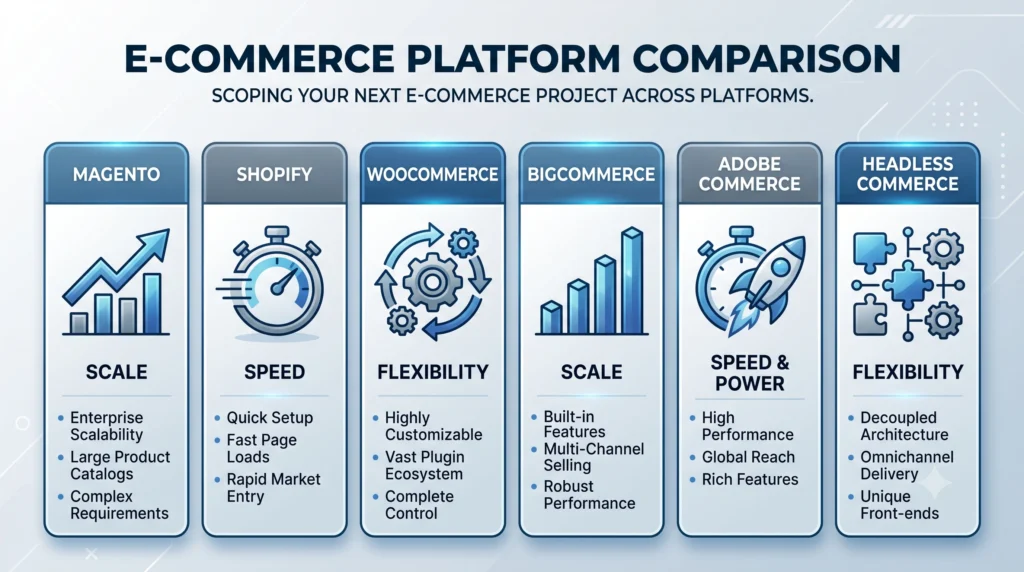
Platform selection is one of the most consequential decisions in the scoping process, since it shapes cost, scalability, and long-term flexibility.
Magento (Adobe Commerce)
Magento, now more broadly offered as Adobe Commerce, remains a strong choice for large catalogs, complex B2B pricing rules, and multi-store setups. It offers deep customization but typically requires a larger development budget and ongoing hosting and maintenance investment. Enterprises with global storefronts, multiple currencies, or intricate promotional rules often gravitate toward this platform.
Shopify
Shopify is frequently selected for its speed to launch, reliable uptime, and large app ecosystem. It suits growing brands that want to minimize infrastructure management. Shopify Plus extends this further for higher-volume merchants needing more customization and API access.
WooCommerce
WooCommerce, built on WordPress, appeals to businesses already using WordPress for content marketing. It offers flexibility through plugins and themes at a lower initial cost, though scaling a large catalog may require additional performance optimization such as caching and CDN configuration.
BigCommerce
BigCommerce provides a strong balance between built-in features and flexibility, with native multi-channel selling and less reliance on third-party apps for core functionality. It is often considered by mid-market brands seeking growth without heavy platform dependency.
Headless Commerce
Headless commerce separates the front-end presentation layer from the back-end commerce engine. This architecture allows content teams and developers to build custom storefronts using frameworks such as React or Next.js while relying on a commerce platform purely for catalog, cart, and checkout logic. Brands prioritizing unique user experiences, omnichannel delivery, or rapid front-end iteration often lean toward a headless approach.
Step 3: Specifying Technical Needs to Scope a New Ecommerce Project
Once a platform direction is chosen, technical requirements are documented in detail, including:
- Payment gateway integrations
- Shipping and tax calculation services
- ERP or inventory management connections
- Search and merchandising tools
- Localization and multi-currency needs
- Performance and hosting requirements
This stage often produces a technical specification document that development teams use as a reference throughout the build.
Stage 4: Budget and Timeline Planning to Scope a New Ecommerce Project
Budgeting for an ecommerce build typically breaks down into several categories:
- Platform licensing or subscription fees
- Design and user experience work
- Development and integration hours
- Quality assurance and testing
- Post-launch support and maintenance
Timelines vary significantly depending on complexity. A straightforward WooCommerce or Shopify storefront might launch within six to ten weeks, while an enterprise Adobe Commerce or headless commerce build with multiple integrations can extend to several months.
Stage 5: Roles and Duties of the Team to Scope a New Ecommerce Project
A well-scoped project assigns clear ownership across roles such as:
- Project manager overseeing timeline and budget
- UX/UI designer shaping the customer experience
- Backend developer handling platform configuration and integrations
- Frontend developer building the storefront interface
- QA specialist testing checkout flows, payment processing, and mobile responsiveness
- Content strategist preparing product copy and category structure
Clear role definition prevents duplicated effort and keeps communication efficient across the build.
Stage 6: Wireframes, Prototypes, and Sign-Off
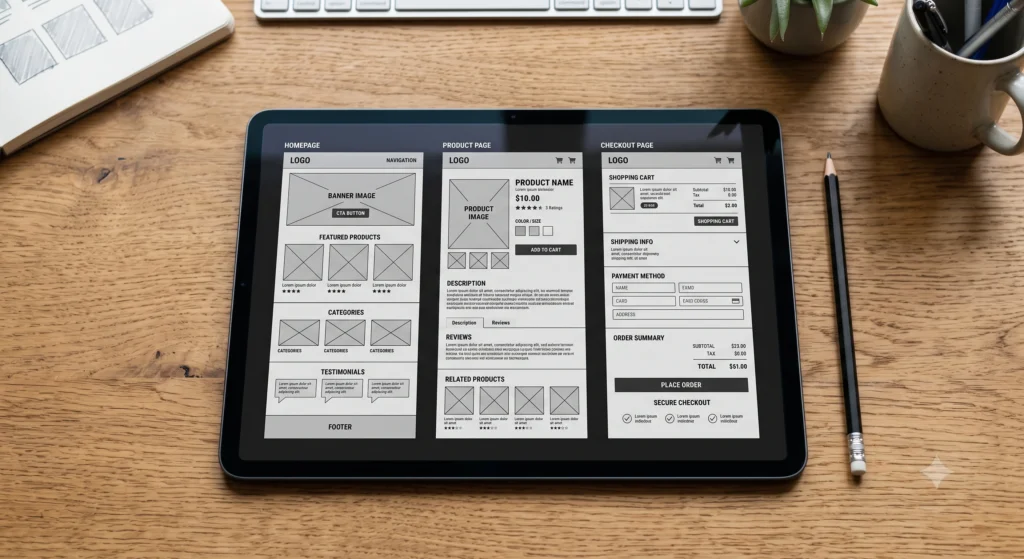
Before development starts, wireframes and clickable prototypes are typically reviewed and approved by stakeholders. This step confirms navigation structure, checkout flow, and key page layouts including home, category, product detail, cart, and checkout pages before any code is written.
Stage 7: Launch Readiness and Testing
Once development nears completion, a structured testing phase confirms that the store performs reliably under real conditions. Testing typically covers:
- Checkout and payment processing across devices
- Shipping calculation accuracy
- Load and performance testing under traffic spikes
- Cross-browser and mobile responsiveness
- Security and compliance checks
A pre-launch checklist ensures analytics tracking, tax settings, and backup systems are configured correctly before the store goes live.
Stage 8: Growth and Post-Launch Optimization
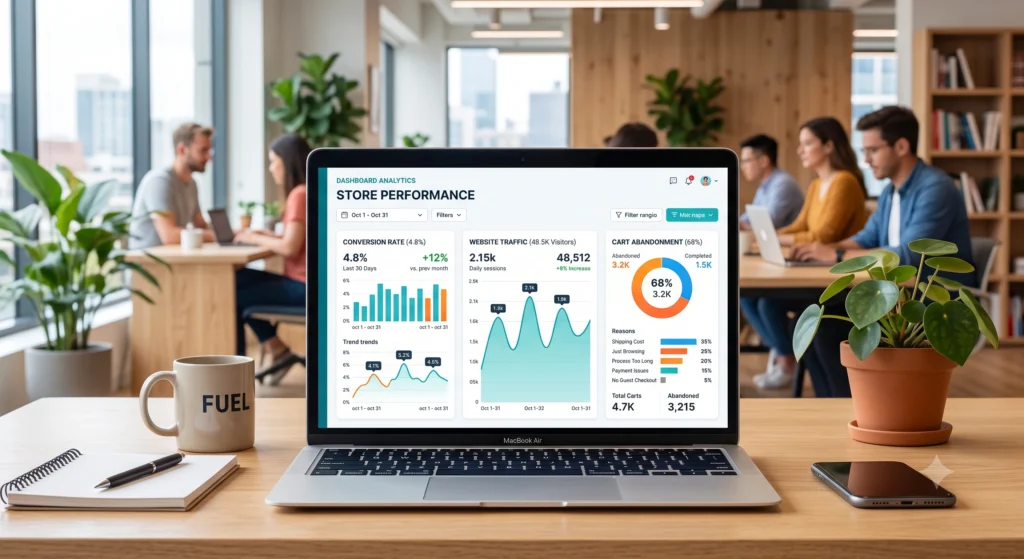
Launch marks the beginning of ongoing work rather than the end of the project. After going live, attention typically shifts toward:
- Monitoring conversion rate and cart abandonment metrics
- A/B testing product pages, pricing display, and checkout steps
- Refining site search and merchandising rules based on real customer behavior
- Expanding integrations such as loyalty programs, subscriptions, or marketplace channels
- Ongoing SEO refinement across category and product pages
Step 9: Choosing an Appropriate E-Commerce Development Partner
For businesses without an in-house technical team, choosing a development partner is part of the scoping process itself. Evaluation criteria commonly include:
- Verified experience with the chosen platform, whether Magento, Shopify, WooCommerce, BigCommerce, Adobe Commerce, or headless commerce stacks
- Portfolio examples in a similar industry or catalog size
- Transparent estimation and change-request processes
- Post-launch support availability and service-level agreements
- References from previous clients regarding communication and delivery timelines
A qualified partner will typically request the same discovery information outlined in Stage 1 before providing a formal estimate, which is a strong sign the scoping process is being taken seriously.
Common Mistakes That Derail Attempts to Scope a New Ecommerce Project
- Selecting a platform based on trend rather than business fit
- Underestimating integration complexity
- Skipping stakeholder interviews across departments
- Failing to plan for post-launch support and iteration
- Setting unrealistic timelines without buffer for testing
Avoiding these pitfalls early keeps a project on schedule and within budget.
scope a new ecommerce project: Frequently Asked Questions
What does it mean to scope a new ecommerce project?
Scoping refers to the process of defining business goals, technical requirements, budget, and timeline before development begins, ensuring the right platform and approach are selected from the start.
How long does it take to scope an ecommerce project?
Discovery and scoping typically take two to four weeks, depending on the complexity of the catalog, integrations, and number of stakeholders involved.
For a huge catalog, which e-commerce platform works best?
Platforms such as Magento (Adobe Commerce) and BigCommerce are commonly chosen for large or complex catalogs, while Shopify and WooCommerce suit smaller to mid-sized catalogs.
What distinguishes headless commerce from regular trade?
Traditional commerce platforms combine the front-end and back-end into a single system, while headless commerce separates the presentation layer from the commerce engine, allowing greater front-end flexibility.
Why does platform selection matter so much during scoping?
Platform choice affects long-term scalability, integration options, hosting costs, and the overall flexibility of the store, making it one of the most important decisions in the scoping phase.
Conclusion
A successful launch rarely happens by accident. Every stage described above discovery, platform selection, technical planning, budgeting, wireframing, testing, and post-launch optimization plays a role in how smoothly a build proceeds. Businesses that take time to properly scope a new ecommerce project before writing a single line of code consistently avoid the budget overruns, missed deadlines, and platform mismatches that derail rushed builds. Whether the final choice is Magento, Shopify, WooCommerce, BigCommerce, Adobe Commerce, or a headless commerce architecture, a disciplined scoping process remains the strongest predictor of long-term ecommerce success.