

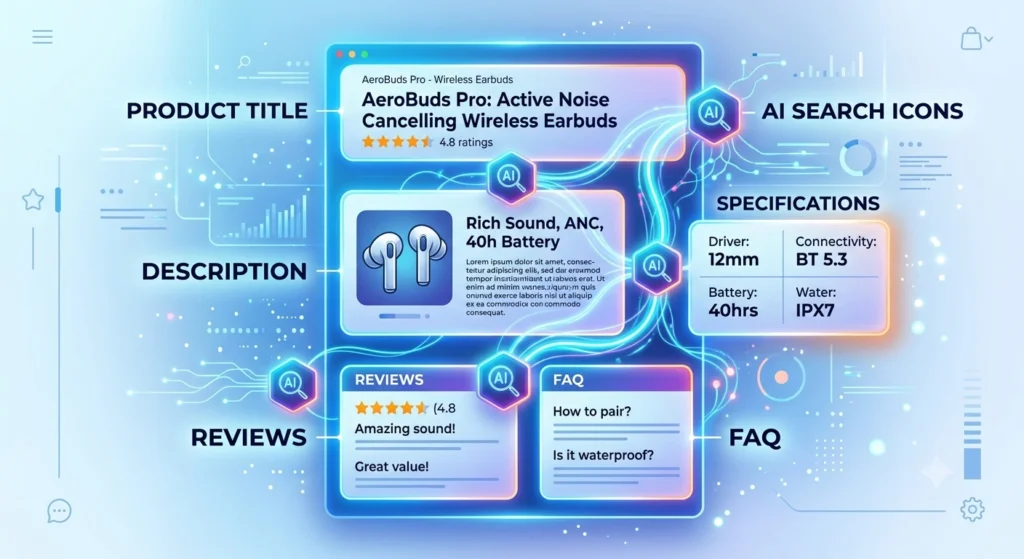
Improving AI search visibility product pages requires more than traditional keyword placement. Search engines powered by AI now evaluate structure, context, and intent, which means product pages must be built to answer questions clearly, present verified data, and support machine understanding alongside human readability. This guide outlines the exact elements that strengthen product page performance across AI-driven search results, along with platform-specific steps for Magento, Shopify, WooCommerce, BigCommerce, Adobe Commerce, and headless commerce setups.
What AI Search Visibility Means for Product Pages
AI search visibility refers to how easily an AI-driven search system can locate, interpret, and surface a product page in response to a query. Unlike traditional ranking systems that rely heavily on backlinks and keyword density, AI-based systems prioritize clarity, structured data, and content that directly answers a searcher’s question. A product page built for this environment functions less like a sales flyer and more like a well-organized reference document.
Why Product Pages Need Optimization for AI Search Engines
Search behavior has shifted toward conversational and question-based queries. Instead of typing short keyword phrases, shoppers now ask complete questions such as “which running shoes work best for flat feet” or “what is the return policy for this blender.” Product pages lacking clear answers to these questions are frequently skipped by AI search systems in favor of competitors with better-structured content.
How AI Search Engines Crawl and Interpret Product Pages
AI-driven crawlers process a page in layers. The first layer identifies raw text and structured data; the second layer maps relationships between entities such as product name, brand, category, and price; the third layer evaluates whether the content answers likely user questions. A page missing structured relationships between these entities is harder to interpret correctly, even if the raw content is accurate.
Entity Recognition on Product Pages
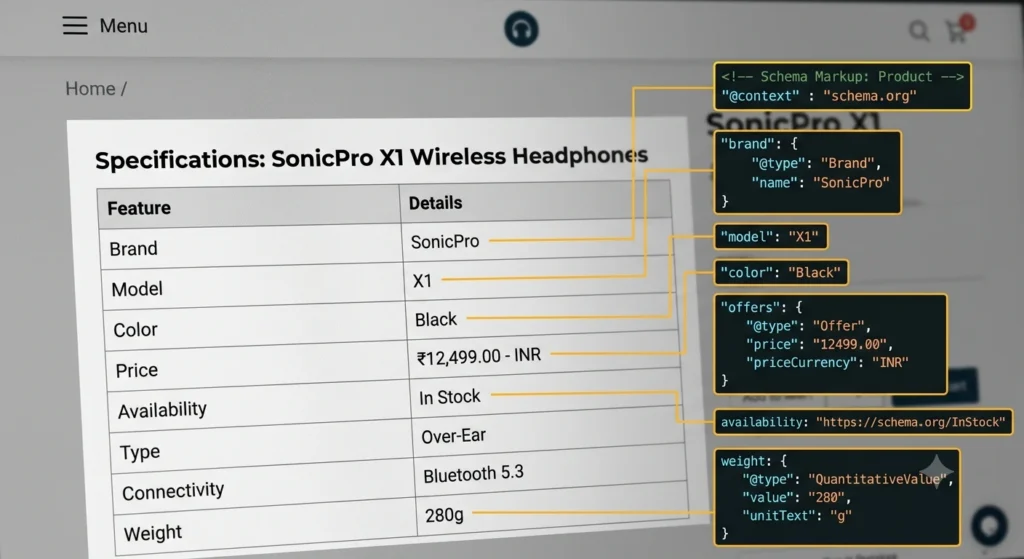
Product name, brand, model number, and category should appear consistently across the title, description, and structured data fields. Inconsistent naming between these areas creates confusion for entity-matching systems.
Content Freshness Signals
Regularly updated specifications, current pricing, and recent review dates signal that a page reflects accurate, current information, which AI search systems weigh when selecting sources to surface.
Core Elements of an AI-Search-Ready Product Page
Structured Data and Schema Markup
Product schema, review schema, and FAQ schema allow search systems to extract accurate details such as price, availability, and ratings without ambiguity. Reference: Schema.org Product markup guidelines.
Clear, Descriptive Product Content
Descriptions should explain materials, dimensions, use cases, and differentiators in plain language rather than promotional phrasing alone. Bullet-point specifications paired with a short narrative paragraph tend to perform well.
FAQ Sections Embedded Directly on the Page
A dedicated FAQ block addressing sizing, shipping, compatibility, and warranty questions gives AI systems ready-made question-answer pairs to reference.
Semantic Heading Structure
Subheadings should reflect actual subtopics, such as specifications, shipping details, compatibility, and care instructions, rather than vague labels like “More Info.”
Writing AI-Friendly Product Descriptions
Leading With Specifications
Placing key specifications, size, material, compatibility, near the top of the description helps both shoppers and AI systems locate essential facts quickly, rather than burying them under promotional copy.
Answering Implicit Questions
A well-written description anticipates unstated questions, such as durability under specific conditions or compatibility with related products and answers them directly within the first few sentences.
Avoiding Duplicate Manufacturer Copy
Descriptions copied directly from manufacturer feeds are common across competing listings, which reduces uniqueness signals. Rewriting descriptions with original phrasing and additional context improves distinctiveness.
Platform-Specific Strategies for AI Search Optimization
Magento
Magento supports advanced schema customization through layout XML and third-party extensions. Product attribute sets should be mapped directly to schema fields, and layered navigation pages should include canonical tags to avoid duplicate content signals. Related resource: Magento structured data documentation.
Shopify
Shopify themes generally include baseline product schema, but many require manual editing of theme. Liquid or app-based schema plugins to include review and FAQ schema. Meta fields can store additional structured attributes for richer product data.
WooCommerce
WooCommerce, built on WordPress, benefits from SEO plugins such as Yoast or Rank Math for automatic schema generation. Product short descriptions should be rewritten with specification-style clarity rather than left as default placeholder text.
BigCommerce
BigCommerce includes built-in schema support for most product types, though custom fields often need manual mapping to ensure specifications appear correctly in structured data output.
Adobe Commerce
Adobe Commerce (formerly Magento Commerce) allows enterprise-level catalog structuring, making it suitable for large inventories that require bulk schema application through PIM (Product Information Management) integrations.
Headless Commerce
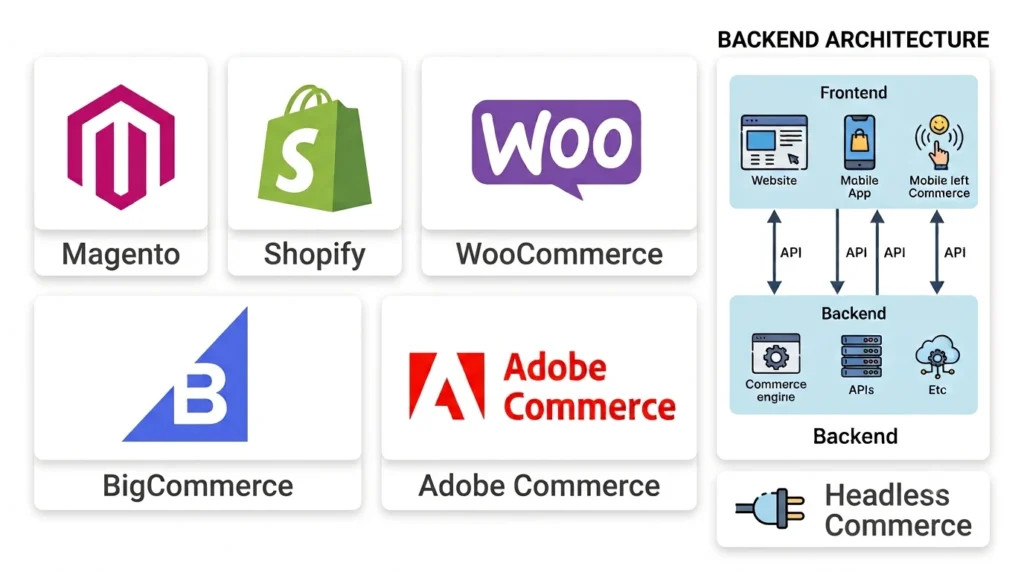
Because headless solutions isolate the front end from the commerce backend, default CMS-level SEO tools do not apply automatically, therefore schema markup, meta tags, and structured content must be explicitly injected through the front-end framework (such as Next.js or Vue Storefront).
Measuring AI Search Visibility Performance
Tracking impressions and click-through data from search console tools, combined with monitoring which product pages appear in AI-generated answer summaries, provides a baseline for measuring progress. A recommended internal resource for ongoing tracking: structured data checklist for ecommerce pages.
Comparing performance across similar product categories helps isolate whether schema updates, description rewrites, or FAQ additions are driving visibility improvements.
Technical Checklist for AI Search Visibility
- Focus keyword placed in the URL, SEO title, meta description, and first paragraph
- Focus keyword density maintained between 0.5% and 1.5% of total content
- Meta description kept between 150–160 characters
- SEO title kept between 50–60 characters
- The real page subjects are reflected in the H2 and H3 subheadings.
- Product schema, FAQ schema, and review schema implemented
- Internal links added to related category or guide pages
- External links added to authoritative sources
- Image alt attributes include the focus keyword naturally
- Content length exceeds 2,000 words for comprehensive topic coverage
Related internal resource: ecommerce platform comparison guide.
Common Mistakes That Reduce AI Search Visibility
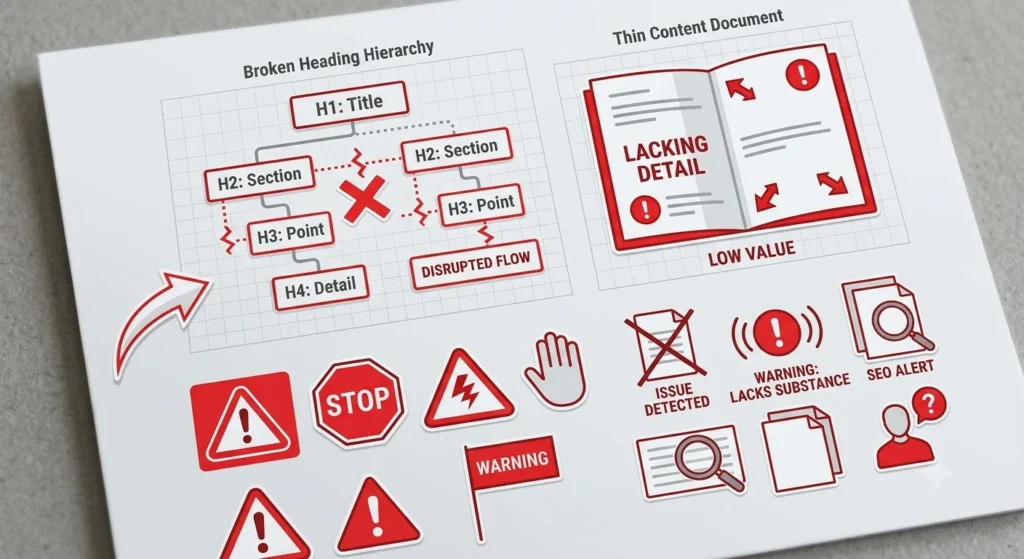
- Thin product descriptions copied directly from manufacturer listings
- Missing or incomplete schema markup
- Overuse of promotional language without factual specifications
- Absence of an FAQ section addressing common pre-purchase questions
- Broken heading hierarchy, such as skipping from H1 directly to H3
Further reading: Google Search Central documentation on structured data.
Frequently Asked Questions About AI Search Visibility Product Pages
What is AI search visibility for product pages?
It refers to how effectively an AI-driven search system can locate, interpret, and present a product page in response to a relevant query, based on structured data and clear content.
Does schema markup improve AI search visibility?
Yes. Schema markup provides explicit, machine-readable details about price, availability, and reviews, reducing ambiguity for AI search systems.
Which ecommerce platform is best for AI search optimization?
Each platform, Magento, Shopify, WooCommerce, BigCommerce, Adobe Commerce, and headless commerce setups, can achieve strong AI search visibility when schema markup, structured content, and FAQ sections are properly implemented.
How long should a product page be for good AI search visibility?
Comprehensive product pages exceeding 300–500 words of unique descriptive content, paired with structured specifications and an FAQ section, tend to perform better than thin, template-only pages.
Is it required for each product page to provide FAQ content?
FAQ content is not mandatory but significantly improves AI search visibility by directly answering common pre-purchase questions in a format AI system can easily extract.
Conclusion
Strong AI search visibility for product pages depends on structured data, clear and original descriptions, logical heading hierarchy, and embedded FAQ content that mirrors real shopper questions. Across Magento, Shopify, WooCommerce, BigCommerce, Adobe Commerce, and headless commerce environments, the underlying principle remains consistent: pages built for clarity and machine interpretability tend to outperform thin, templated listings. Applying the checklist, correcting common mistakes, and monitoring performance over time supports steady improvement in how product pages are surfaced by AI-driven search systems.