

Pharmacy retail has moved far beyond the neighborhood counter. Patients now expect prescription refills, over-the-counter purchases, and consultation bookings through a single digital storefront. Adobe Commerce for Pharmacy eCommerce has emerged as a leading answer to that demand, combining regulatory-grade compliance controls, enterprise-level performance, and real-time inventory synchronization inside one platform. Pharmacy brands operating across multiple states or countries face a narrow margin for error: a delayed page load can cost a sale, an out-of-sync inventory feed can lead to a stockout on a life-sustaining medication, and a compliance gap can trigger regulatory penalties. A platform built to handle healthcare-grade demands separates thriving pharmacy brands from those struggling with legacy systems.
The sections below outline how Adobe Commerce addresses the three pillars that matter most for pharmacy retail, compliance, speed, and inventory synchronization, along with a comparison against other major platforms and a practical roadmap for adoption.
Why Pharmacy eCommerce Demands a Specialized Platform
There are significant legal distinctions between general merchandise trade and pharmacy retail. Prescription verification, controlled substance tracking, insurance billing integration, and patient data protection are not optional add-ons. Every transaction involving medication must be handled strictly by regulatory organizations like the National Association of Boards of Pharmacy (NABP) and health data legislation.
Generic commerce platforms often bolt on compliance features after launch, creating fragile workarounds. Adobe Commerce for Pharmacy eCommerce takes a different approach, treating compliance, security, and scalability as core architecture decisions rather than afterthoughts.
Key Regulatory Pressures Facing Online Pharmacies
Protected health information (PHI) handling under HIPAA-aligned frameworks stands as a primary concern, alongside state-by-state licensing and shipping restriction rules for controlled substances. PCI DSS compliance for payment and insurance card data adds another layer of obligation, and audit trails for every prescription-related transaction round out the core regulatory pressures facing online pharmacy operations.

Compliance: Building Trust Into Every Transaction
Adobe Commerce for Pharmacy eCommerce: HIPAA-Ready Data Architecture
Patient records, prescription histories, and payment details require encryption at rest and in transit. Adobe Commerce supports role-based access control, granular admin permissions, and encrypted data storage, foundations that align with guidance published by the U.S. Department of Health and Human Services on safeguarding protected health information.
Controlled Substance and Age Verification Workflows
Custom modules can enforce age verification, prescription upload requirements, and license validation before checkout completes. Automated flags route restricted orders to pharmacist review queues rather than allowing an unsupervised transaction to proceed.
PCI DSS and Secure Payment Processing Adobe Commerce for Pharmacy eCommerce
Payment data for pharmacy transactions, including insurance co-pay processing, must meet standards set by the PCI Security Standards Council. Adobe Commerce integrates with tokenized payment gateways so sensitive card data never touches unprotected servers.
Compliance is not a checkbox exercise for pharmacy retail. It stands as the foundation that determines whether a storefront can legally operate across multiple jurisdictions.
Speed: Performance That Matches Patient Urgency
Why Page Speed Is a Clinical Concern, Not Just a Marketing Metric
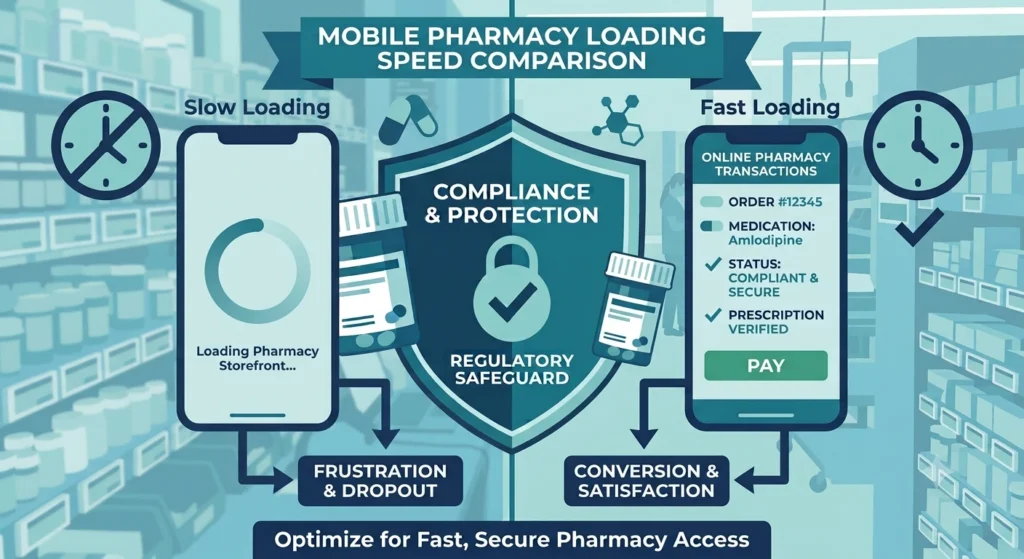
A patient searching for an urgent medication refill will abandon a slow-loading site within seconds. Site speed directly affects conversion rates, and for pharmacy brands, a lost conversion can mean a patient going without a needed refill on schedule.
Adobe Commerce for Pharmacy eCommerce Performance Advantages
Varnish caching and full-page cache reduce server load and accelerate repeat visits. Elasticsearch-powered catalog search returns accurate medication results instantly, even across large SKU catalogs. Cloud infrastructure options through Adobe Commerce Cloud provide auto-scaling during seasonal demand spikes such as flu season or public health events, while Progressive Web App (PWA) storefronts deliver app-like speed on mobile devices, where a growing share of prescription refill traffic originates.
Headless Commerce for Maximum Speed
Pharmacy brands seeking the fastest possible front-end experience often pair Adobe Commerce’s backend with a decoupled, headless commerce front end. Separating the presentation layer from the commerce engine allows front-end teams to optimize rendering speed independently, delivering sub-second load times even during high-traffic periods such as open enrollment season.
Inventory Sync: Never Sell What Is Not on the Shelf
The Cost of Inventory Mismatch in Pharmacy Retail
Unlike apparel or electronics, pharmacy inventory errors carry health consequences. A customer ordering a medication marked “in stock” that has actually expired or been recalled creates both a compliance issue and a patient safety concern.
Real-Time Synchronization Capabilities Adobe Commerce for Pharmacy eCommerce
Adobe Commerce connects with Enterprise Resource Planning (ERP) and pharmacy management systems to synchronize stock levels, lot numbers, and expiration dates in real time. Multi-location pharmacy chains benefit from centralized inventory visibility across physical stores, fulfillment centers, and third-party pharmacy networks.
Automated Reordering and Recall Management
Low-stock thresholds trigger automated purchase orders, while recall alerts can be pushed instantly across the catalog to prevent a recalled batch from appearing as purchasable. This level of automation reduces manual reconciliation work and lowers the risk of dispensing errors.

Platform Comparison: Adobe Commerce vs. Alternatives for Pharmacy Retail
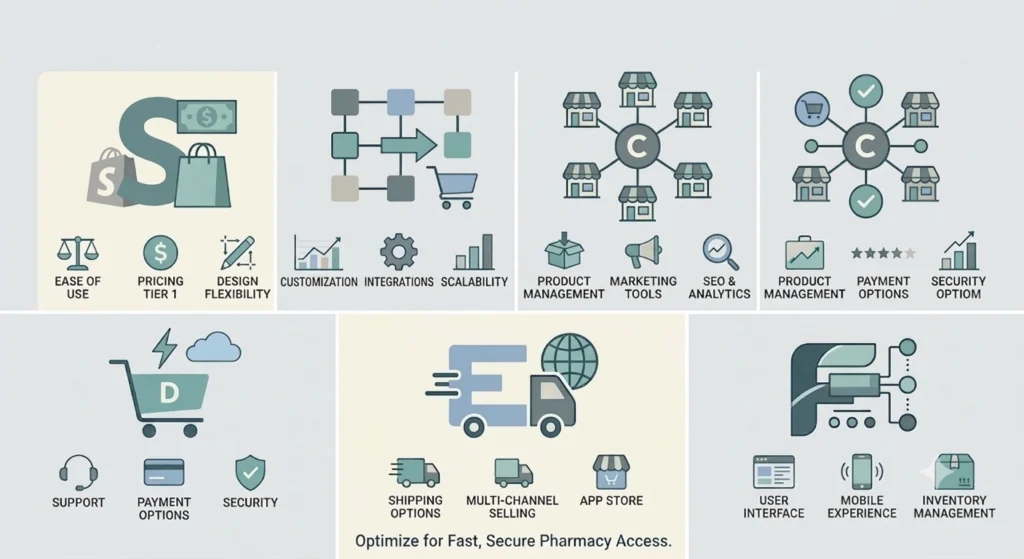
Adobe Commerce offers strong native support for HIPAA-aligned architecture, PCI DSS, and custom compliance modules, paired with high performance through cloud auto-scaling and PWA support, along with deep ERP integration and real-time multi-location inventory sync. The platform fits mid-to-enterprise pharmacy brands facing regulatory complexity.
Magento, the open-source core underlying Adobe Commerce, requires custom development for compliance features and delivers good performance depending on hosting and optimization choices. Inventory sync is achievable through extensions, making Magento a fit for smaller pharmacy retailers with development resources on hand.
Shopify provides limited native healthcare compliance tooling and relies heavily on third-party apps to fill regulatory gaps, though performance for standard catalogs runs very fast. Inventory sync remains basic, with multi-location sync often needing add-ons, a reasonable fit for small pharmacy or wellness brands running simple catalogs.
BigCommerce carries moderate compliance capability through an API-first design that allows compliance layering, alongside strong out-of-the-box performance and solid API-based inventory management. Mid-market pharmacy brands prioritizing quick deployment tend to gravitate toward this option.
WooCommerce offers minimal native compliance, remaining fully dependent on plugins, with variable performance tied to WordPress hosting quality and plugin-dependent inventory management that grows less reliable at scale. Small independent pharmacies with limited budgets represent the primary fit.
Headless commerce, as a platform-agnostic approach, inherits its compliance depth entirely from whichever backend commerce engine gets selected, while delivering exceptional front-end speed. Inventory sync quality depends on backend integration strength, a strong option for brands prioritizing custom user experience and omnichannel delivery.
Among these options, Adobe Commerce for Pharmacy eCommerce stands out for organizations that cannot compromise on regulatory depth while still requiring enterprise-grade speed and inventory precision.
Implementation Roadmap for Pharmacy Brands
A compliance audit comes first, mapping existing prescription, payment, and data-handling workflows against regulatory requirements before development begins. Architecture planning follows, deciding between traditional Adobe Commerce, Adobe Commerce Cloud, or a headless configuration based on traffic patterns and team resources. ERP and pharmacy management integration connects inventory, prescription, and fulfillment systems for real-time data flow, while performance testing load-tests the storefront under peak conditions such as seasonal illness surges or public health emergencies. Launch and monitoring closes the roadmap, establishing ongoing checks for compliance drift, page speed degradation, and inventory discrepancies.
In order to match technological architecture with pharmacy-specific regulatory requirements, organizations assessing a build frequently gain from collaborating with a seasoned Adobe Commerce development partner like Create and Commerce.
Adobe Commerce for Pharmacy eCommerce: Frequently Asked Questions
Is Adobe Commerce suitable for small independent pharmacies?
Smaller pharmacy operations can adopt Adobe Commerce, though the platform delivers the strongest return for multi-location chains or brands managing complex compliance and inventory requirements. Smaller independent pharmacies with simpler catalogs sometimes start with lighter platforms before migrating as volume grows.
Does Adobe Commerce handle prescription verification automatically?
Native prescription verification is not built in by default; however, custom modules and third-party integrations can be layered onto Adobe Commerce to automate license checks, age verification, and prescription upload requirements.
How does headless commerce affect pharmacy compliance?
Headless architecture separates the front end from the commerce engine, meaning compliance controls remain governed by the backend platform. A headless setup built on Adobe Commerce retains the same compliance depth while gaining front-end flexibility.
What is the typical timeline for a pharmacy eCommerce build on Adobe Commerce?
Timelines vary based on integration complexity, but a mid-market pharmacy build with ERP integration, compliance modules, and PWA storefront typically spans several months from discovery through launch.
Can Adobe Commerce integrate with insurance billing systems?
Patients can complete transactions that take insurance coverage into account by integrating with insurer billing and co-pay processing systems through API connections and payment gateway agreements.
Conclusion
Pharmacy retail sits at the intersection of healthcare regulation and digital commerce expectation. Adobe Commerce for Pharmacy eCommerce provides the compliance architecture, performance infrastructure, and inventory precision required to meet both demands simultaneously. Brands weighing a platform decision for pharmacy retail gain the most value by evaluating compliance depth first, performance capability second, and inventory synchronization third, three pillars that together determine long-term operational reliability.
For organizations planning an Adobe Commerce build tailored to pharmacy or healthcare retail, Create and Commerce offers development and consulting support across compliance-driven commerce projects.