
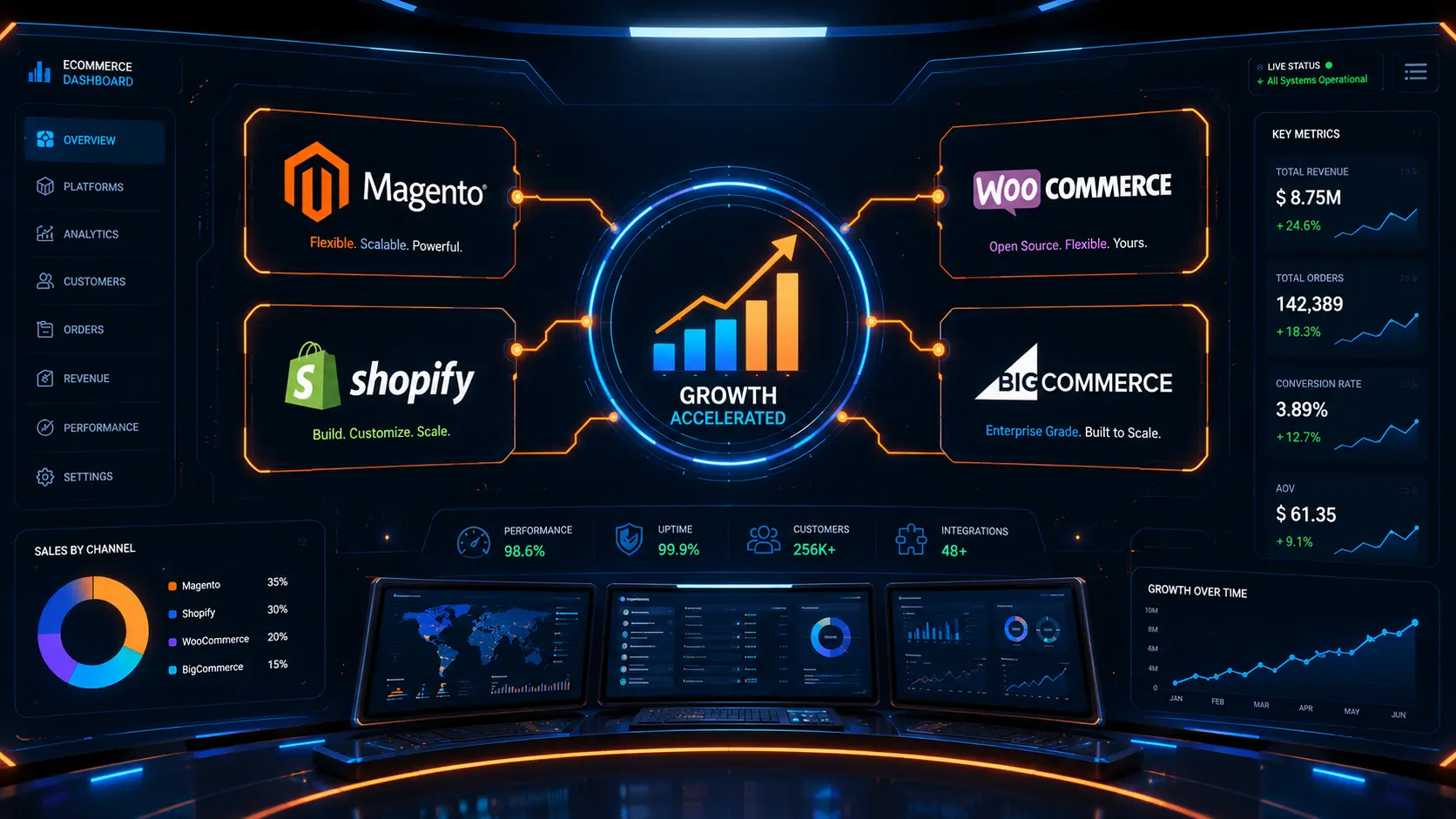
Businesses who approach online selling as a system rather than a single storefront will be rewarded by the retail landscape in 2026. The Enterprise eCommerce Growth Blueprint for 2026 brings together platform strategy, personalization, omnichannel execution, and technical scalability into a single roadmap that large-scale brands can apply immediately. Enterprises operating on Magento, Shopify, WooCommerce, BigCommerce, or headless commerce architecture all face the same core challenge: turning traffic into predictable, compounding revenue without sacrificing speed, security, or customer experience.
A structured blueprint removes guesswork from enterprise growth planning. Instead of chasing isolated tactics, organizations following the plan below align platform selection, content strategy, and technology stack decisions toward one measurable outcome, sustainable revenue growth throughout 2026 and beyond. A closer look at platform-specific execution is available through Create and Commerce’s enterprise eCommerce services.
What Defines the Enterprise eCommerce Growth Blueprint for 2026
An enterprise-grade growth plan differs from a small-business marketing checklist. Scale introduces complexity across multiple storefronts, currencies, warehouses, and customer segments. Four elements support the Enterprise eCommerce Growth Blueprint for 2026:
- Platform Architecture, selecting infrastructure capable of handling enterprise-level catalog size and traffic volume.
- Customer Experience Personalization, delivering tailored product discovery at scale using data and automation.
- Omnichannel Consistency, unifying inventory, pricing, and messaging across every touchpoint.
- Performance and Security Engineering, protecting uptime, page speed, and transaction integrity under heavy load.
Each pillar connects directly to revenue outcomes, and each depends on the underlying commerce platform chosen for the build.
Why Every Growth Decision Is Shaped by Platform Choice
Marketing budgets, personalization tools, and integration timelines all depend on the flexibility of the underlying commerce engine. Companies that choose a platform that isn’t appropriate for the complexity of their catalog or the volume of traffic usually have to pay for expensive re-platforming projects within 18 months. Evaluating Magento, Shopify, WooCommerce, BigCommerce, and headless commerce architecture early prevents that outcome, a comparison further detailed in the platform selection guide from Create and Commerce.
Choosing the Right Platform, Magento, Shopify, WooCommerce, BigCommerce, and Headless Commerce
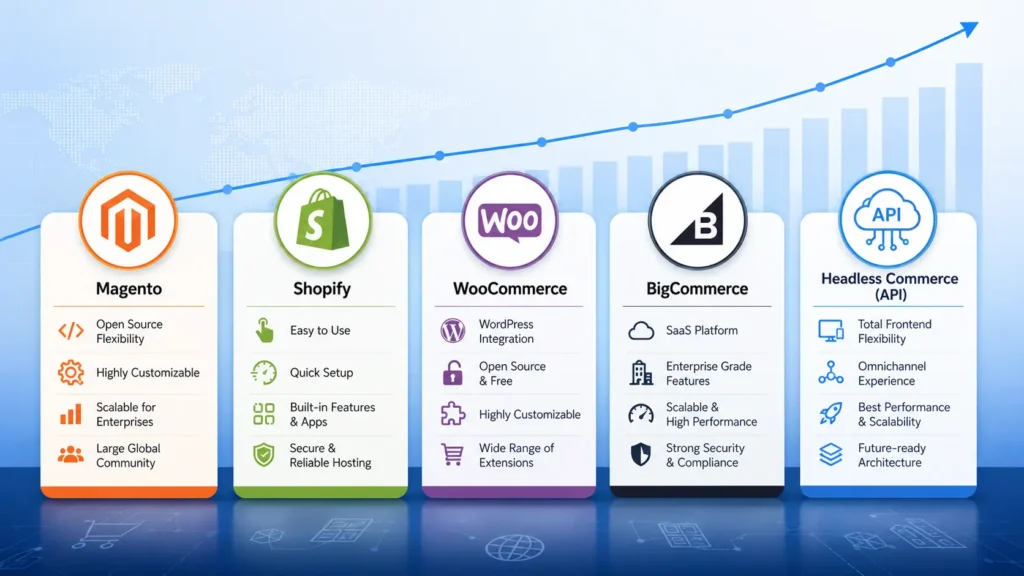
Platform selection remains the single biggest structural decision inside any enterprise eCommerce growth plan. A short breakdown of each option follows.
Magento for Enterprise-Scale Catalogs
Adobe Commerce (Magento) continues to serve large catalogs, B2B storefronts, and complex product configurations well. Magento’s open architecture and extensive customization capabilities make it a popular choice for businesses with tens of thousands of SKUs, multi-warehouse logistics, or region-specific pricing. Development and hosting costs run higher than SaaS alternatives, making Magento best suited for organizations with dedicated development resources. Businesses assessing a Magento development can use Create and Commerce’s Magento strategy resources to examine platform-fit factors.
Shopify Plus for Rapid Enterprise Growth
Shopify Plus offers a managed SaaS environment built for fast-scaling enterprise brands. Marketing and operations teams may easily develop campaigns without heavily relying on engineering because to checkout extensibility, native automation capabilities, and an established app ecosystem. Brands prioritizing speed-to-market over deep backend customization often favor Shopify Plus.
WooCommerce for Flexible, Content Driven Enterprise Sites
WooCommerce works well with WordPress-based content initiatives, providing a flexible foundation for businesses with high editorial or blog traffic. Although growing to enterprise transaction volume usually involves managed hosting and performance tuning, plugin-based extensibility lowers initial expenses.
BigCommerce for Multi-Channel Enterprise Selling in the Enterprise eCommerce Growth Blueprint 2026
BigCommerce offers a scalable SaaS foundation in addition to native multi-channel selling via social media and marketplaces. Enterprises selling across Amazon, eBay, and social commerce channels alongside a primary storefront frequently choose BigCommerce for its built-in channel management tools and API depth.
Headless Commerce for Future-Ready Enterprise Architecture
Headless commerce decouples the frontend presentation layer from backend commerce logic, allowing enterprises to build custom storefronts, mobile apps, and IoT experiences on top of a single commerce engine. Organizations pursuing omnichannel expansion, rapid frontend iteration, or unique brand experiences increasingly adopt headless architecture as part of long-term platform strategy, a direction outlined further in Create and Commerce’s headless commerce insights.
Key Strategies for Growth in the Enterprise Blueprint
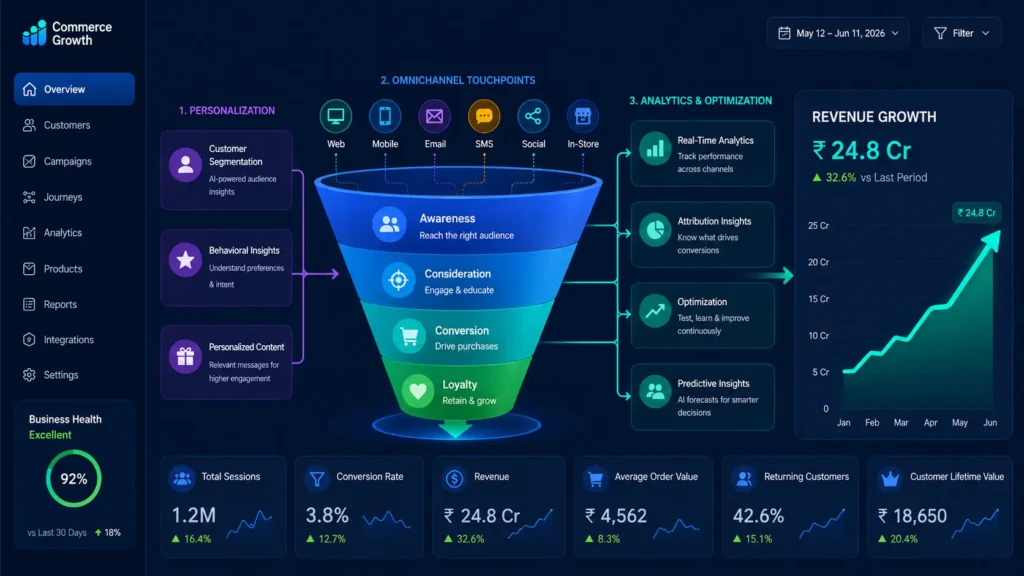
Personalization and AI-Driven Product Discovery
Enterprise storefronts generate enormous behavioral datasets, and applying machine-learning-driven personalization to that data measurably lifts conversion rates. Product recommendation engines, dynamic search ranking, and personalized email flows all draw from unified customer profiles rather than isolated campaign data. Platforms such as Shopify Plus, Magento, and BigCommerce each offer native or third-party AI personalization tooling suited to enterprise catalog sizes, a topic covered in more depth through Create and Commerce’s personalization strategy guide.
Omnichannel and Multi-Storefront Consistency
Enterprise buyers move between mobile apps, marketplaces, physical retail, and desktop browsing before completing a purchase. Inventory, pricing, and promotional messaging must all remain in sync across all platforms. Headless commerce architecture particularly supports this pillar, since a single backend can feed multiple frontend experiences without duplicated data entry.
Performance, Security, and Scalability Engineering for Enterprise eCommerce Growth
Page load speed and checkout reliability directly influence enterprise conversion rates, especially during high-traffic sales events. Content delivery networks, server-side caching, and PCI-compliant payment infrastructure form the technical backbone supporting growth at scale. Performance benchmarks such as Google’s Core Web Vitals provide a measurable standard for enterprise page-speed targets. Security audits and load-testing schedules belong inside every enterprise implementation calendar, not treated as one-time launch tasks.
SEO and Content Strategy for Enterprise Storefronts
Enterprise SEO differs from small-business SEO primarily in scale, thousands of category and product pages require templated, structured metadata rather than manual optimization. Structured data markup, canonical tag management, and internal linking between category pages and supporting content all influence organic visibility. Agencies such as Create and Commerce specialize in aligning enterprise SEO architecture with platform-specific technical requirements across Magento, Shopify, WooCommerce, and BigCommerce builds.
Data, Analytics, and Conversion Rate Optimization
Enterprise growth planning depends on clean, unified analytics across every storefront and channel. Accurate event monitoring is essential for client lifetime value modeling, A/B testing frameworks, and cart-abandonment recovery routines. Global online shopping is growing yearly, according to Statista’s eCommerce research, which strengthens the argument for investing in enterprise-grade analytics rather than superficial reporting dashboards.
Building the 2026 Implementation Roadmap
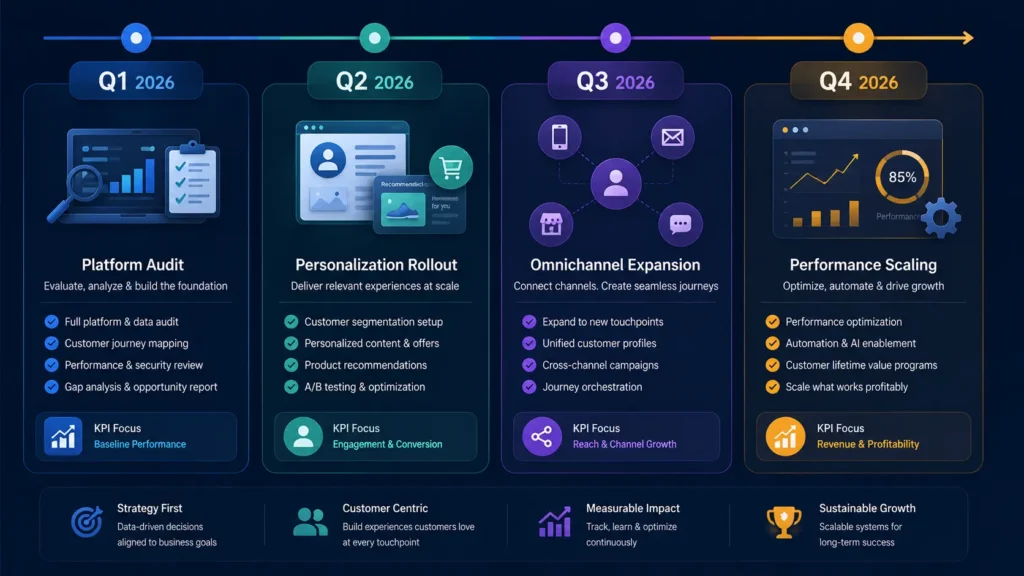
A practical rollout sequence keeps enterprise teams from attempting every initiative simultaneously.
- Quarter One : Platform audit and gap analysis across Magento, Shopify, WooCommerce, BigCommerce, or existing headless commerce infrastructure.
- Quarter Two : Personalization and search optimization rollout using unified customer data.
- Quarter Three : Omnichannel expansion, including marketplace integration and mobile experience refinement.
- Quarter Four : Performance load-testing, security auditing, and holiday-traffic scalability preparation.
Enterprises pairing the phased roadmap with internal resources such as the platform comparison guide above and dedicated enterprise SEO services typically shorten implementation timelines while reducing costly rework.
Common Enterprise eCommerce Challenges and Solutions
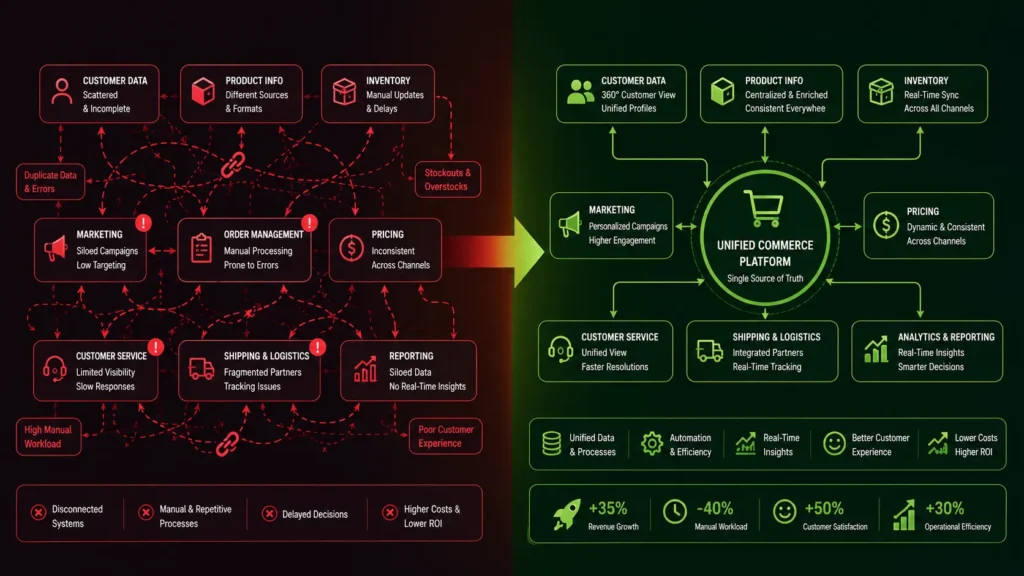
Enterprise teams tend to encounter the same recurring obstacles regardless of platform choice. Recognizing the pattern early shortens resolution time.
Fragmented Customer Data Across Systems
Legacy CRM tools, marketing platforms, and storefront databases frequently operate in isolation, preventing a unified customer view. Consolidating data through a customer data platform (CDP) connected to Magento, Shopify, WooCommerce, or BigCommerce resolves fragmentation and enables accurate personalization, an approach detailed further in Create and Commerce’s data strategy resources.
Slow Page Speed During Peak Traffic in Enterprise eCommerce Growth
Flash sales, holiday campaigns, and viral product moments generate sudden traffic spikes that overwhelm under-provisioned infrastructure. Auto-scaling cloud hosting, image compression, and CDN caching prevent slowdowns that directly reduce conversion rates during the highest-revenue periods of the year.
Inconsistent Pricing and Inventory Across Channels
Overselling, refunds, and a decline in customer confidence result from selling across a central storefront, marketplaces, and physical retail locations without coordinated inventory management. Centralized inventory management tools connected through API integrations keep stock levels and pricing aligned across every channel in real time.
Slow Adoption of New Technology
Large organizations often move cautiously when adopting headless commerce, AI personalization, or new payment technology due to internal approval cycles. Building a phased pilot program, testing new technology on a single product category or region before full rollout, reduces organizational risk while still capturing early performance gains.
Measuring Success, KPIs for Enterprise eCommerce Growth
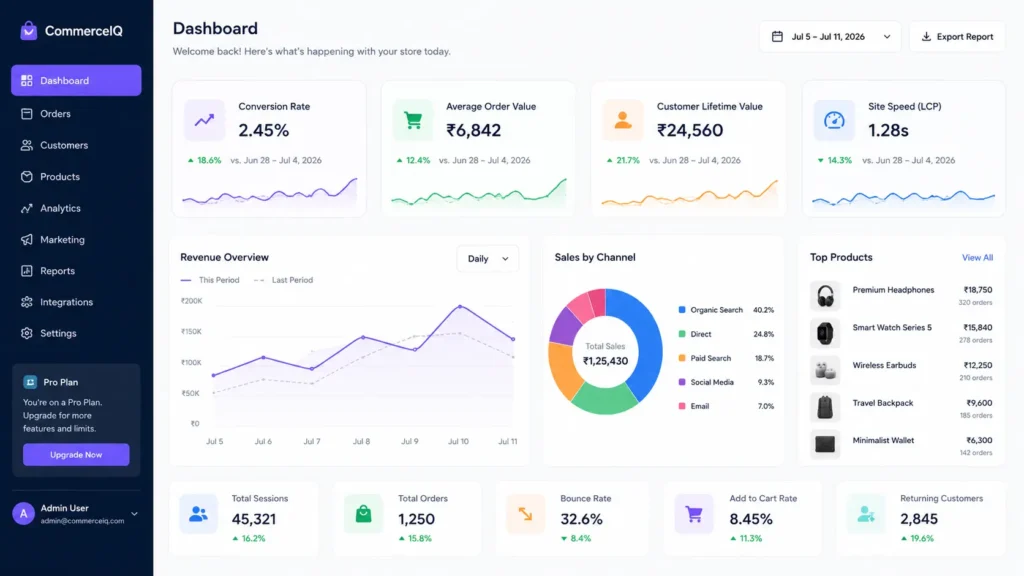
Tracking the right metrics keeps enterprise growth initiatives accountable to revenue outcomes rather than vanity statistics. Benchmark data from Statista’s eCommerce reports offers useful external context when setting realistic KPI targets.
- Conversion Rate by Channel, measures how effectively each storefront or marketplace turns visits into orders.
- Average Order Value (AOV), reflects the impact of bundling, upsell, and personalization efforts.
- Customer Lifetime Value (CLV) tracks long-term profitability beyond a single transaction.
- Site Speed and Core Web Vitals, directly correlates with both SEO rankings and checkout completion rates.
- Cart Abandonment Rate, highlights friction points inside the checkout flow that require optimization.
- Organic Traffic Growth indicates the long-term compounding value of enterprise SEO investment across category and content pages.
Reviewing the metrics quarterly alongside the implementation roadmap keeps the Enterprise eCommerce Growth Blueprint for 2026 grounded in measurable progress rather than assumption.
Frequently Asked Questions About Enterprise eCommerce Growth
Which platform works best for large enterprise catalogs?
Magento (Adobe Commerce) generally suits enterprises with tens of thousands of SKUs and complex B2B pricing rules, while Shopify Plus and BigCommerce serve fast-scaling brands prioritizing managed infrastructure over deep customization.
Is headless commerce worth the investment for a mid-size enterprise?
For businesses planning several frontend experiences, such mobile applications, kiosks, or region-specific stores, built on a single backend, headless commerce offers the highest return. Enterprises with a single storefront and limited frontend expansion plans may find traditional platforms more cost-effective in the short term.
What is the average duration of an enterprise eCommerce replat forming project?
Enterprise replat forming projects generally span six to twelve months depending on catalog size, integration complexity, and the extent of custom feature development required during migration.
What is the ideal focus keyword density for enterprise SEO content?
A focus keyword density between 0.5% and 1% keeps content natural and readable while satisfying most on-page SEO tools without triggering keyword-stuffing penalties.
How often should an enterprise eCommerce growth strategy be reviewed?
Quarterly reviews align well with the four-phase implementation roadmap, allowing KPI tracking, platform audits, and personalization performance to be reassessed before the next phase begins.
Does WooCommerce scale for enterprise-level traffic?
WooCommerce can scale to enterprise traffic levels when paired with managed WordPress hosting, server-side caching, and a properly optimized database, though very large catalogs may require additional performance engineering compared to SaaS-native platforms.
Conclusion
Sustainable enterprise growth in 2026 depends less on any single tactic and more on architectural alignment between platform, personalization, omnichannel execution, and technical performance. Whether the foundation runs on Magento, Shopify, WooCommerce, BigCommerce, or a fully headless commerce stack, the Enterprise eCommerce Growth Blueprint for 2026 provides a repeatable framework for scaling revenue without sacrificing site reliability or customer experience. Enterprises that pair the roadmap with consistent KPI tracking and proactive challenge management position their storefronts for compounding growth throughout the year and into future planning cycles. Additional platform-specific implementation support is available through Create and Commerce.